About This Tool
How this meta tag generator builds a full head block and grades it as you type
This tool runs entirely in your browser. There is no fetch call, no proxy, no server round trip anywhere in the source. Every field you type updates a live output on the input and change events, and the output is three separate blocks of markup: the primary tags every page needs, an Open Graph block for Facebook and LinkedIn, and a Twitter Card block, each buildable and copyable on its own tab.
The length rules baked into the counters
The title and description fields are not just text boxes, they carry live character counters tied directly to Google’s search snippet behavior. These are the exact thresholds the tool checks on every keystroke.
Title, under 20 characters
Flagged as too short. The hint tells you to aim for 40 to 60 characters, the range that fills a search result line without inviting truncation.
Title, over 60 characters
Flagged as too long, since Google may truncate the visible title around that point and append an ellipsis.
Description, under 70 characters
Flagged as too short, with guidance to aim for 120 to 160 characters.
Description, over 160 characters
Flagged as too long, since Google generally truncates snippets around 155 to 160 characters depending on pixel width, not a strict character count.
// the counter logic, adapted from source
tc.textContent = title.length + ‘ / 60’;
tc.className = ‘mt-counter’ + (title.length > 60 ? ‘ warn’ : (title.length >= 40 ? ‘ ok’ : ”));
if (!title) tHint = ‘Title is required’;
else if (title.length < 20) tHint = ‘Too short. Aim for 40 to 60 characters.’;
else if (title.length > 60) tHint = ‘Too long. Google may truncate at 60 chars.’;
What gets generated in each block
| Block | Tags included |
|---|
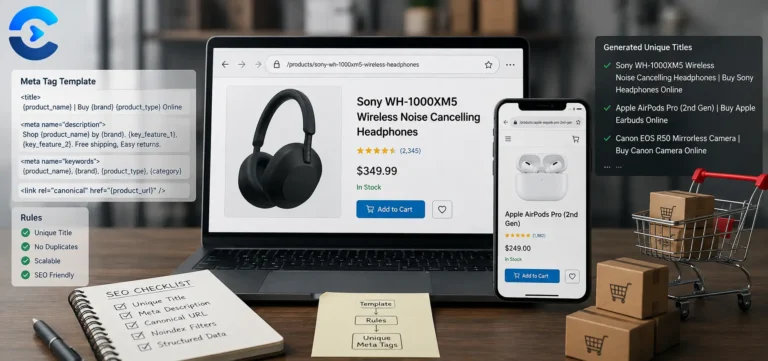
| Primary | title, meta name title, meta description, optional keywords and author, meta robots, meta googlebot, optional viewport, optional canonical link |
| Open Graph | og:type, og:url, og:title, og:description, og:image plus fixed og:image:width 1200 and og:image:height 630 when an image URL is set, og:site_name pulled from the hostname of your URL field |
| Twitter Card | twitter:card, twitter:url, twitter:title, twitter:description, twitter:image, twitter:site |
Open Graph and Twitter title and description fall back to the primary title and description if you leave the social specific fields blank, so you never end up with an empty social tag as long as the primary fields are filled in.
The robots string is assembled, not typed. Clicking the index, follow, noarchive, nosnippet and noimageindex toggles does not just add a word, turning index or follow off swaps in noindex or nofollow instead, since those are the actual valid directive tokens. The other three only ever appear when switched on, they have no negated form in the robots meta spec.
The seven point checklist
Below the generated code sits a running checklist, evaluated fresh on every update: title length between 20 and 60, description length between 70 and 160, a canonical URL present, an OG image present, the page set to index, links set to follow, and a viewport tag present. Each renders as a pass or a warning icon so you can see at a glance what is missing before you copy the code out.
og:image dimensions
The 1200 by 630 pair is the widely recommended aspect ratio for link previews across Facebook, LinkedIn and Slack, roughly 1.91 to 1. The tool always emits this pair once an image URL exists, so if your actual image uses a different ratio you should adjust these two values by hand before publishing.
og:site_name derivation
Pulled by splitting your URL field on the slash character and taking the third segment, which is the hostname portion of a standard https://host/path string. No separate site name field exists.
Pure client-side, no network calls
Live SERP preview
Copy button with execCommand fallback
Meta tag documentation
Tags worth getting right
Drafting a new landing page’s head block before a CMS template exists, quickly checking whether an existing title or description falls outside Google’s comfortable length range, generating a consistent social preview across a batch of blog posts, and handing a developer a copy and paste ready snippet instead of a checklist of instructions.