Free Health Calculator Online

Home / Tools / Health & Fitness

Health and fitness calculators that show their working

BMI, BMR, TDEE, body fat, macros, hydration and cycle tracking. Every one names the published equation it uses, because the equation you pick changes the answer more than most people realise.

10 tools here, 150+ across the site
BMI = kg / m² BMR = Mifflin St Jeor TDEE = BMR × activity
Reference

The published equations these tools run

Naming the source matters here. Two calorie calculators can differ by 200 kcal a day purely because they picked different formulas, and neither is wrong.

Body Mass Index Quetelet, 1832
BMI = weight(kg) / height(m)²

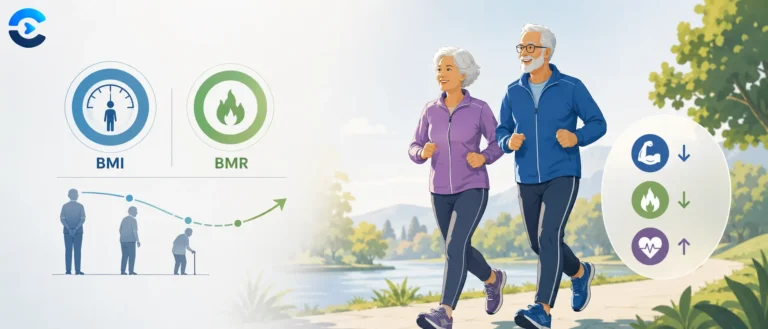
Devised by a Belgian statistician to describe populations, not to assess individuals. It cannot distinguish muscle from fat, which is why athletes routinely register as overweight and why it underestimates risk in older adults who have lost muscle.

Basal Metabolic Rate Mifflin St Jeor, 1990
men: (10 × kg) + (6.25 × cm) − (5 × age) + 5 women: (10 × kg) + (6.25 × cm) − (5 × age) − 161

Now the preferred equation in clinical practice, having been shown more accurate than the older Harris Benedict formula for modern populations. Still carries roughly a 10 percent error band for any given person.

Total Daily Energy Expenditure BMR multiplied by an activity factor
sedentary BMR × 1.2 light BMR × 1.375 moderate BMR × 1.55 very active BMR × 1.725 athlete BMR × 1.9

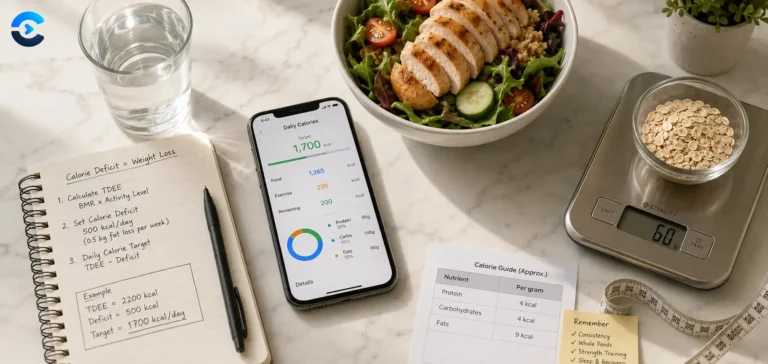
The multiplier is the weakest link in the chain. Most people overestimate their activity level by a full band, which is the single most common reason a calorie target does not produce the expected result.

Body fat, US Navy method Hodgdon and Beckett, 1984
men: 86.010 × log10(waist − neck) − 70.041 × log10(height) + 36.76 women: 163.205 × log10(waist + hip − neck) − 97.684 × log10(height) − 78.387

Circumference based, so it needs only a tape measure. Accurate to roughly 3 or 4 percentage points against a DEXA scan, and highly sensitive to where exactly you place the tape.

Reality check

How much to trust each number

Not all estimates are equally shaky. Roughly, from most to least reliable.

BMI is arithmetic on two measurements, so the number itself is exact. What is uncertain is what it implies about your health, not the calculation.
BMR lands within about 10 percent for most people. Outliers are those with unusual muscle mass or thyroid conditions.
Body fat by tape is within 3 to 4 points of a lab scan when measured carefully, and much worse when measured casually.
TDEE inherits the BMR error and adds activity guesswork on top. Treat it as a starting point, then adjust based on what actually happens over three weeks.
Ovulation timing assumes a textbook cycle. Real ovulation varies by several days between cycles in the same person.
Due dates are famously imprecise. Fewer than 5 percent of babies arrive on the estimated date, and the useful output is a two week window.
Boundaries

Who these formulas were never fitted to

Every equation above came from a study of a particular population. Outside it, the estimate degrades.

GroupWhat shifts
Athletes and heavily trainedBMI overstates body fat badly, since muscle is denser than fat. A lean rugby player can register as obese.
Older adultsMuscle loss means BMI can look healthy while body composition is not. Waist measurement is more informative.
South Asian populationsCardiometabolic risk rises at lower BMI, which is why several health bodies apply a lower overweight threshold rather than the standard 25.
Children and teenagersAdult BMI categories do not apply at all. Paediatric growth centiles are the correct tool.
PregnancyBMI, body fat and calorie formulas are all invalid. Follow clinical guidance instead.
Very tall or very shortBMI squares height, which systematically flatters tall people and penalises short ones.

If you want the underlying material, the World Health Organization publishes the BMI classification and its caveats, and the NHS healthy weight guidance is a readable summary of what to do with the number rather than just how to get it.

Browse more

Browse other tools

Every category on ConvertNow, free and growing.

FAQ

Questions about these health and fitness calculators

What the numbers mean, how accurate they are, and when to ignore them.

Is any of this medical advice?
No. These calculators apply published formulas to the numbers you enter. They cannot diagnose anything, rule anything out, or account for your medical history. If a result here worries you, that is a reason to speak to a doctor rather than a substitute for doing so.
Which BMR formula do you use?
Mifflin St Jeor, published in 1990, which is now preferred in clinical practice over the older Harris Benedict equation because it proved more accurate for modern populations. It still carries roughly a 10 percent error band for any individual.
Why is my BMI high when I am clearly fit?
Because BMI cannot tell muscle from fat. It was devised in the 1830s to describe populations, not to assess individuals, and muscle is considerably denser than fat. A lean, heavily trained athlete routinely registers as overweight or obese on it.
How accurate is the body fat estimate?
Within roughly 3 to 4 percentage points of a DEXA scan when the measurements are taken carefully, and considerably worse when they are not. The US Navy method is circumference based, so exactly where you place the tape changes the answer.
Can I use the ovulation calculator for contraception?
No, absolutely not. It assumes a textbook 28 day cycle with ovulation on day 14, and real ovulation varies by several days between cycles in the same person. It is a planning aid for conception, never a basis for avoiding it.
How accurate are due dates?
Not very, and that is normal. Fewer than 5 percent of babies arrive on the estimated date. The useful output is a two week window rather than a day. Dating scans in the first trimester are more accurate than any calculation from a last period date.
Why does my calorie target not produce the expected result?
Most often because the activity multiplier was set too high. Most people overestimate their activity by a full band. The other common reason is that the formula gives a starting estimate carrying about 10 percent uncertainty, so adjust based on what actually happens over three or four weeks.
Is my weight, height or cycle data stored?
No. All of it stays in your browser and is discarded when you close the tab. There is no account, no submission and no record kept. This category handles genuinely sensitive information and it is treated that way.
Please read

Estimates, not diagnoses

This is the category where the disclaimer is not boilerplate. These tools model populations, and you are an individual.

Not medical adviceNothing here can diagnose, treat or rule out a condition. If a number here concerns you, that is a reason to speak to a doctor, not a substitute for doing so.
Population formulas, individual bodiesEvery equation was fitted to a study group. If your age, ethnicity, muscle mass or medical history sits outside that group, the estimate drifts, sometimes considerably.
Pregnancy and cycle tools are estimatesDue dates assume a 28 day cycle and ovulation on day 14. Real cycles vary widely. These are planning aids, never a basis for contraception decisions.
Nothing you enter is storedWeight, height, cycle dates and body measurements are sensitive. All of it stays in your browser and is gone when you close the tab.
Explore all tools
Privacy Overview

Cookies let this site remember your preferences and show us which tools people actually use. Full detail sits in our Privacy Policy.