
Math Calculators Online that show the working
Base conversion, prime factors, percentages, fractions, statistics, probability and sample sizes. Each one displays the intermediate steps, because the steps are usually the point.
Maths and number tools
Calculators and converters, all with visible working.
Every base works the same way once you see the columns
Decimal 2026 is 2 thousands, 0 hundreds, 2 tens and 6 units. Binary does the same with powers of two rather than ten. Here is 2026 in binary, column by column.
Add the columns marked on: 1024 plus 512 plus 256 plus 128 plus 64 plus 32 plus 8 plus 2 gives 2026. That is the entire method, and it works identically for any base.
| Base | Digits | Where you meet it |
|---|---|---|
| Binary, 2 | 0 to 1 | Every digital circuit. Two states are easy to distinguish reliably at speed. |
| Octal, 8 | 0 to 7 | Unix file permissions. Three bits per digit maps exactly onto read, write and execute. |
| Decimal, 10 | 0 to 9 | Human counting, almost certainly because of fingers. |
| Hex, 16 | 0 to 9, A to F | Colours, memory addresses, hashes. One hex digit is exactly four bits, so a byte is always two digits. |
| Base64 | A to Z, a to z, 0 to 9, + / | Not really a number base. An encoding for moving binary through text channels. |
Three different questions, all called percentage
Most percentage confusion comes from not noticing which of these is being asked.
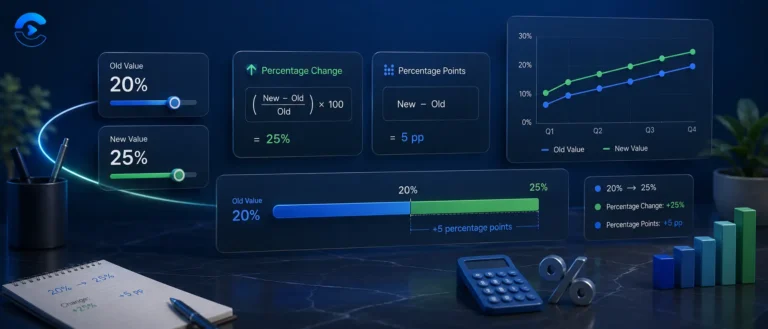
The trap worth internalising: a 50 percent fall followed by a 50 percent rise does not return you to where you started. Drop 100 to 50, then add 50 percent of 50, and you land at 75. Percentage changes do not add, they multiply, which is why a stock down 50 percent needs to double to recover.
The other one is percentage points. Moving from 10 percent to 12 percent is a rise of 2 percentage points and a rise of 20 percent. Both are correct, they mean different things, and headlines routinely pick whichever sounds more dramatic.
Mean, median and the gap between them
The statistics calculator reports both, and the difference between them tells you something the numbers alone do not.
| Measure | What it does | When it misleads |
|---|---|---|
| Mean | Sum divided by count | Dragged hard by outliers. One billionaire in a room changes average wealth and tells you nothing about anyone in it. |
| Median | Middle value when sorted | Ignores the shape of the tails entirely. Two very different distributions can share a median. |
| Mode | Most frequent value | Can be absent, or there can be several. Rarely useful on continuous data. |
| Standard deviation | Typical distance from the mean | Assumes a roughly symmetric spread. On skewed data it implies a symmetry that is not there. |
| Range | Max minus min | Determined entirely by the two most extreme points, so a single error destroys it. |
When the mean sits well above the median, the data is skewed right, which is the usual shape for income, house prices and response times. In those cases the median is the honest headline number. Sample size matters too. The sample size calculator uses the standard formula for a proportion at a given confidence level and margin of error, and the thing that surprises people is that the required size barely changes with population once the population is large. Polling 1,000 people gives roughly the same margin of error whether the country has five million residents or three hundred million.
Other tool sets
Every category on ConvertNow, free and growing.
Number theory, lightly
Base systems, primes and the statistics people get wrong.
Questions About the Math Calculators Online
On precision, statistics and the questions that sound simpler than they are.
Why does 0.1 plus 0.2 not equal 0.3?
What is the difference between percent and percentage points?
How large can numbers get before things break?
Should I report the mean or the median?
What sample size do I need for a survey?
Why does hexadecimal use letters?
Is 1 a prime number?
Do the tools show their working?
Arithmetic you can check
A calculator that only gives an answer is hard to trust. These show enough that you can verify by hand.