Free Text Tools Online

Home / Tools / Text & Content

Text tools online for the tidying nobody enjoys

Count words, strip duplicates, sort lines, compare two versions, convert case and score readability. Small jobs that are tedious by hand and instant here.

9 tools here, 150+ across the site
1,284words
7,932characters
61sentences
5.2 minreading time
Naming

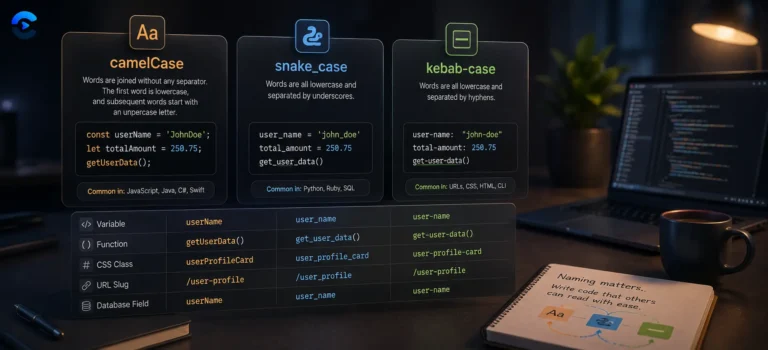
Every case style, and where each one belongs

The case converter offers all of these. Which one is correct depends entirely on where the string is going.

camelCaseuserAccountBalanceJavaScript and Java variables, JSON keys in most APIs
PascalCaseUserAccountBalanceClass and component names, C# methods, React components
snake_caseuser_account_balancePython, Ruby, SQL column names, most database schemas
SCREAMING_SNAKEUSER_ACCOUNT_BALANCEConstants and environment variables across nearly every language
kebab-caseuser-account-balanceURLs, CSS classes, HTML attributes, npm package names
Title CaseUser Account BalanceHeadlines and page titles. Note that which small words stay lowercase varies by style guide.
Sentence caseUser account balanceInterface labels and buttons. Easier to read and the modern default in most design systems.

The one that trips people up is Title Case, because there is no single rule. AP style capitalises words of four letters or more, Chicago uses a part of speech rule, and neither agrees on prepositions. If consistency matters, pick a guide and stick to it.

The hidden stuff

Characters you cannot see but your code definitely can

When a comparison says two identical looking strings differ, it is almost always one of these. The diff tool surfaces them rather than rendering them invisibly.

U+00A0Non breaking space. Looks exactly like a normal space, does not match one. Word processors and rich text editors insert them constantly.
U+200BZero width space. Occupies no visual room at all. Often arrives via copy and paste from a web page.
U+FEFFByte order mark. Sits at the start of a file and breaks JSON parsers, CSV headers and shell scripts in confusing ways.
CR LF vs LFWindows ends lines with two characters, Unix with one. Every line differs in a diff even when the text is identical.
U+2019Curly apostrophe. Autocorrect swaps the straight one for it, which then fails an exact match against your source.
Trailing whitespaceInvisible on screen, visible to a comparison. The duplicate line remover normalises it before matching.

There is a security angle too. Unicode has characters from different scripts that render almost identically, so a domain or username can be spoofed with a Cyrillic letter that looks Latin. This is called a homograph attack, and it is why browsers now display suspicious domains in punycode.

Scoring

What a readability score is measuring, and what it is not

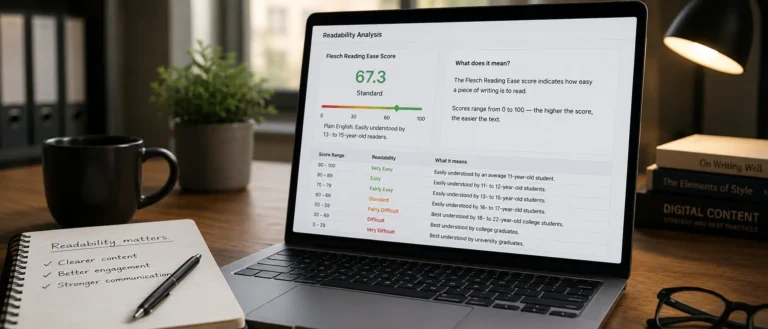
Flesch Reading Ease runs 0 to 100, higher being easier. It counts syllables per word and words per sentence, and nothing else.

0 to 30 30 to 50 50 to 60 60 to 70 70 to 100

Below 30 reads like an academic paper. 60 to 70 is standard for general readership, roughly a UK Year 9 level, and is what most newspapers target. Above 70 is comfortably plain English.

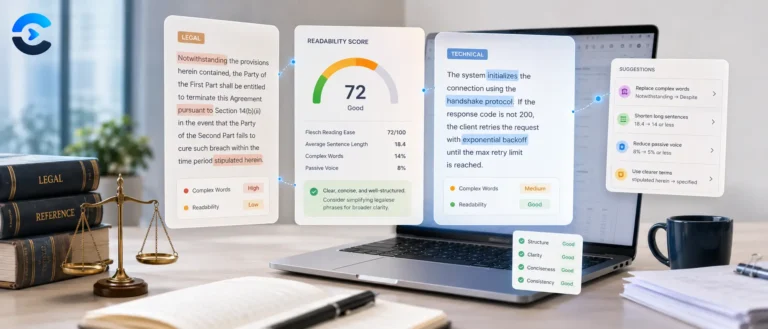
Here is the limitation worth understanding. The formula has no idea what your words mean. Shorten every sentence and swap long words for short ones and the score improves even if the result is nonsense. It also penalises correct technical terms, so a genuinely clear piece about photosynthesis will score badly for containing the word photosynthesis. Treat it as a signal that something might be dense, not as a grade.

The tool also reports Flesch Kincaid grade level, Gunning Fog and Coleman Liau. They disagree with each other by a year or two routinely, because each weights sentence length and word complexity differently. If three formulas all say your text is hard, it probably is.

Browse more

Elsewhere on the site

Every category on ConvertNow, free and growing.

FAQ

Questions about the text tools online

Counting rules, encoding oddities and what happens to what you paste.

Is there a limit on how much text I can paste?
No fixed limit. Processing happens on your device, so the practical ceiling is your available memory rather than a rule. A full manuscript is fine, though very large documents may take a moment to render.
How exactly do you count a word?
By splitting on whitespace after collapsing runs of spaces, tabs and line breaks. Hyphenated compounds count as one word, and numbers count as words. Different tools make different choices here, which is why counts vary slightly between a word processor and a web tool.
Why do two strings that look identical show as different?
Almost always an invisible character. A non breaking space, a zero width space, a byte order mark, a curly apostrophe substituted by autocorrect, or Windows line endings against Unix ones. The diff tool surfaces these rather than rendering them invisibly.
Which readability formula do you use?
Flesch Reading Ease as the headline, plus Flesch Kincaid grade level, Gunning Fog and Coleman Liau. They disagree by a year or two routinely because each weights sentence length and word complexity differently. If all of them say your text is hard, it probably is.
Does any of this work with non English text?
Counting, sorting, deduplication and case conversion all handle Unicode correctly, including accented characters and non Latin scripts. Readability scoring does not, because those formulas count English syllable patterns and were fitted to English text.
Is my text sent anywhere?
No. Every count, sort, comparison and conversion runs in JavaScript in your browser. People paste drafts, contracts and private notes into text tools, so none of it moves.
What keyword density should I aim for?
There is no target, and chasing one is counterproductive. Density was a ranking signal two decades ago and has not been a meaningful one for years. Use the checker to spot accidental repetition or a term you have forgotten to mention, not to hit a percentage.
Which case style should I use for a URL?
Lowercase kebab case, meaning words separated by hyphens. URLs are case sensitive after the domain, so mixed case creates duplicate URL risk, and hyphens are treated as word separators by search engines while underscores historically were not.
Privacy

Your text stays in the tab

People paste drafts, contracts, transcripts and private notes into text tools. None of it moves.

No upload stepEvery count, sort, diff and conversion runs in JavaScript on your device. There is no request to inspect and no server log to worry about.
Works offlineOnce the page loads these keep working with no connection, because the logic is already in the page.
No length capPaste a whole manuscript if you want. The only limit is your device memory, not a paid tier.
Explore all tools
Privacy Overview

Cookies let this site remember your preferences and show us which tools people actually use. Full detail sits in our Privacy Policy.