






Guides on Analytics, Development and Everyday Tools

KM/H to MPH Explained: A Simple Guide With 12 Examples

Learn km/h to mph from scratch: what speed units mean, the exact factor 0.621371, easy mental shortcuts, knots, Mach and 12 clear worked examples.
GCD and LCM: A Simple 7 Step Playbook That Works

GCD and LCM made simple: a 7 step playbook with checklists, the Euclidean method, worked problems on tiles, schedules and fractions.
PSI to Bar: 8 Step Playbook for Safe, Exact Readings

PSI to bar in one step: multiply by 0.0689476. This playbook adds 8 checks, two interactive checklists and worked tyre, scuba and washer examples.

Loan EMI Calculator Myths: 7 Facts That Save Real Money

A loan EMI calculator shows more than a monthly payment. See 7 myths about EMI, interest and tenure corrected with exact numbers you can verify.
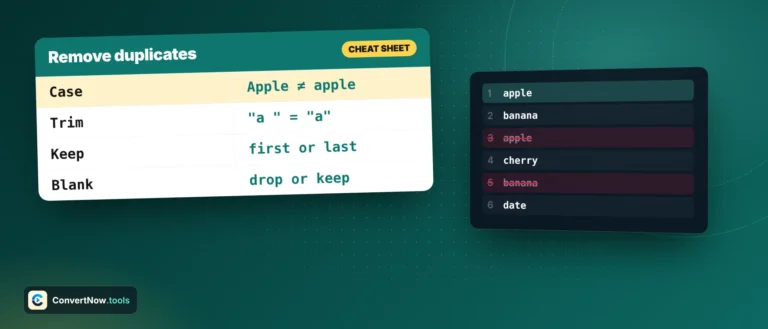
Remove Duplicate Lines: Quick Cheat Sheet With 13 Fixes

Need to remove duplicate lines fast? This cheat sheet covers the options that matter, one line commands, spreadsheet formulas and common traps.
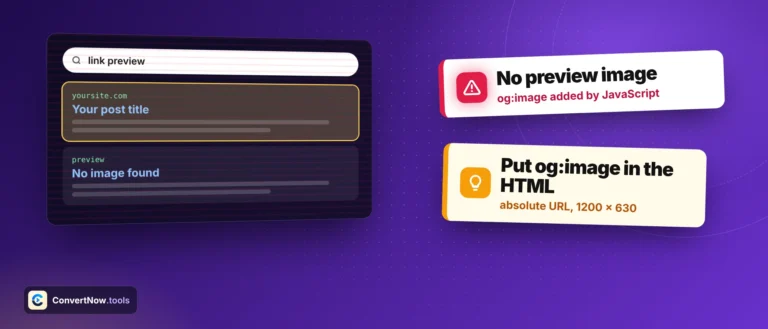
Open Graph Image Not Showing? 7 Easy Fixes That Work

Open graph image not showing in link previews? Match your symptom to its cause, then apply the exact fix, from image size to cached scrapes.
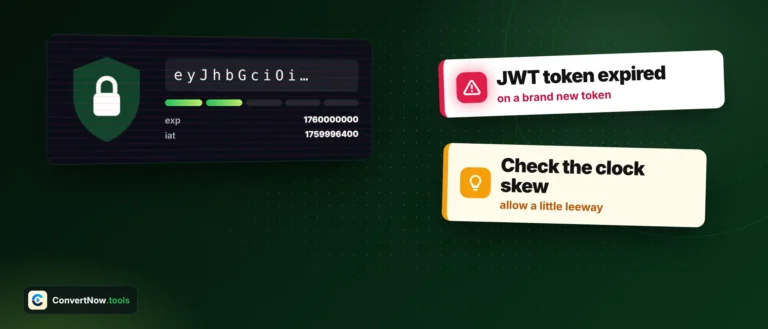
JWT Token Expired: 9 Quick Fixes for Real 401 Errors

JWT token expired but the exp claim looks fine? Read the claims, check clock skew, units and audience, and fix the cause with a nine row troubleshooting table.

Salary to Hourly: 8 Easy Steps, Exact Rate, No Guesswork

Salary to hourly done right: an 8 step playbook with two checklists, real schedules and the exact formula, so your hourly rate reflects the hours you work.

HP to kW Wrong? 7 Easy Fixes for Real Power Errors

If your hp to kw result looks off, one of seven causes is to blame. Match the symptom to the fix, with exact factors for three horsepower types and BTU/hr.
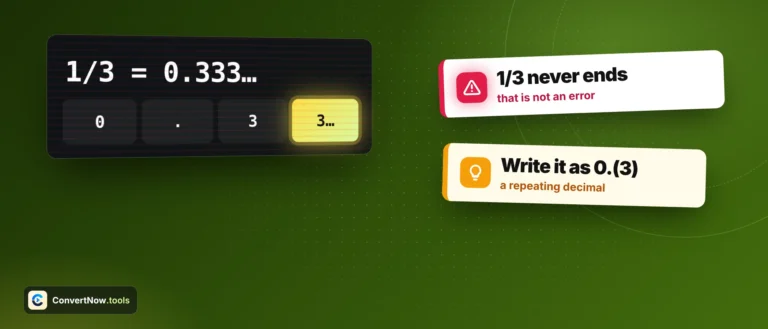
Fraction to Decimal Not Working? 7 Easy Fixes, Explained

Fraction to decimal gone wrong? Find the symptom, the cause and the exact fix for endless digits, rounding clashes, mixed numbers and more.

📚 About this blog

The reasoning that does not fit on a tool page

Every tool on ConvertNow answers one question in a second. This is where the longer answers live: why the number came out that way, what the format was designed for, and when the tool is the wrong thing to reach for.

A tool page has a job and that job is to get out of your way. It should load, take your input and give you an answer before you have finished reading the heading. What it cannot do is explain why a 20 percent discount followed by a 20 percent rise leaves you short, or why your hard drive shows 931 gigabytes when the box promised a terabyte, or why the same JSON file parses in one language and fails in another. Those answers need paragraphs.

So the writing here sits deliberately behind the tools rather than in front of them. Each post is anchored to a real task, usually one that somebody emailed about after losing an evening to it, and it links to the tool that does the job so you can test the idea on your own data while you read.

Twelve categories run in parallel with the tool library: developer topics, unit conversion, finance, text and content, image and design, dates and time, security, health and fitness, SEO and marketing, maths and numbers, files and documents, and networking. A handful of posts sit across several at once, which is usually a sign the topic is more interesting than its category.

There is no publishing schedule and no filler. Posts appear when there is something worth explaining, which in practice means most weeks.

What you will find here

  • Explainers that go past the definition into why it works that way
  • How to guides tied to a specific tool you can open alongside
  • Comparisons run on one identical scenario, so the difference is visible
  • Myth busters, for the advice that gets repeated and was never true
FAQ

Questions about this blog

Who writes it, how topics are chosen and how the posts connect to the tools.

One person. Prateek Zare, an independent software developer based in Berlin, who also builds and maintains every tool on the site. There is no content team and nothing is outsourced, which is the main reason the posts stay tied to problems that actually came up rather than to a keyword list. More on the about page.

Mostly from email. Somebody describes an evening they lost to a problem, and if the explanation they needed does not exist anywhere decent, it becomes a post. The rest comes from questions that keep arriving about a specific tool, which usually means the tool page is not explaining itself well enough.

Not for most of them. Categories such as finance, health, dates and maths are written for anyone. Developer, security and network posts assume more, but each one states its assumptions at the top rather than letting you discover them halfway through.

They are drafted and edited by a human who has done the thing being described. Where a tool result or a code sample appears, it has been run rather than imagined, and where a standard is cited it has been read. That is the bar, and if a post ever falls short of it, tell us and it gets fixed.

Directly. Almost every post is anchored to one or more of the free tools, and links to them at the point where you would want to try the idea yourself. The tool gives you the answer, the post tells you whether the answer means what you think it means.

Short quotes with a link back are welcome and no permission is needed. For anything longer, or for translation or syndication, email [email protected] first. The tool output itself is a different matter and is entirely yours, with no attribution required.

Most weeks, without a fixed schedule. Existing posts also get corrected and updated when something changes, and a post that is materially out of date is either fixed or removed rather than left to quietly mislead people.