












Free Online Tools Blog: Increase Your Productivity
Why SIP Returns Differ From App Projections
Why SIP Returns Differ From App Projections Why SIP returns differ from what your mutual fund app shows comes down to one core fact: a SIP calculator assumes a flat

What Is Domain Age, and Why Check Domain Age Before Buying
What Is Domain Age, and Why Check Domain Age Before Buying Domain age is simply how long a domain name has existed since it was first registered, not how long

UUID Collisions: UUID v4 Collision Probability Math
UUID Collisions: UUID v4 Collision Probability Math The uuid v4 collision probability is not zero, but it is close enough to zero for any real system to treat it that

How to Compare Two API Responses Before Prod Breaks
How to Compare Two API Responses Before Prod Breaks The fastest way to answer how to compare two API responses is to paste both JSON payloads into a diff tool

Traveler’s Guide to Quick Unit Conversion Tricks for Travel
Traveler’s Guide to Quick Unit Conversion Tricks for Travel The quick unit conversion tricks for travel that actually stick: double the Celsius reading and add 30 for a rough Fahrenheit
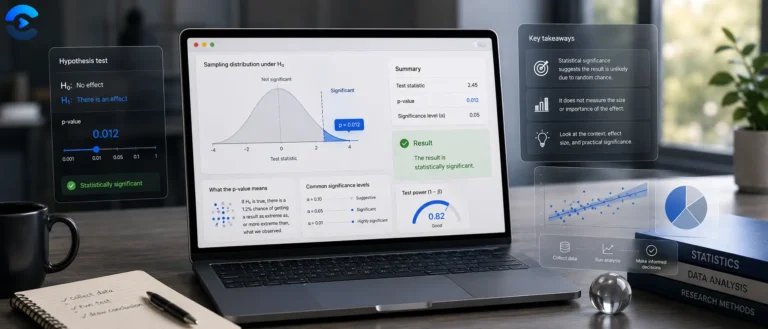
What Does Statistically Significant Mean? In Plain English
What Does Statistically Significant Mean? Plain English So what does statistically significant mean in plain terms. It means a result is unlikely to have happened by random chance alone, based

Loan Overpayment Savings Calculator: Extra $100 a Month
Loan Overpayment Savings Calculator: Extra $100 a Month Take a $300,000 loan at 6.5 percent over 30 years. The standard payment runs about $1,896 a month, and paid on schedule

Readability Score for Technical Writing: When Low Is Fine
Readability Score for Technical Writing: When Low Is Fine A readability score for technical writing will usually land lower than the scores you see praised in general blogging advice, and

How to Calculate Calories for Cutting, the Lifter’s Way
How to Calculate Calories for Cutting, the Lifter’s Way To calculate calories for cutting or bulking, start with your TDEE (total daily energy expenditure), then adjust it by a fixed

Historical Dates: Unix Timestamp Before 1970 Explained
Historical Dates: Unix Timestamp Before 1970 Explained Standard Unix time counts seconds since January 1, 1970, so representing a unix timestamp before 1970 requires a negative number instead of the
The reasoning that does not fit on a tool page
Every tool on ConvertNow answers one question in a second. This is where the longer answers live: why the number came out that way, what the format was designed for, and when the tool is the wrong thing to reach for.
A tool page has a job and that job is to get out of your way. It should load, take your input and give you an answer before you have finished reading the heading. What it cannot do is explain why a 20 percent discount followed by a 20 percent rise leaves you short, or why your hard drive shows 931 gigabytes when the box promised a terabyte, or why the same JSON file parses in one language and fails in another. Those answers need paragraphs.
So the writing here sits deliberately behind the tools rather than in front of them. Each post is anchored to a real task, usually one that somebody emailed about after losing an evening to it, and it links to the tool that does the job so you can test the idea on your own data while you read.
Twelve categories run in parallel with the tool library: developer topics, unit conversion, finance, text and content, image and design, dates and time, security, health and fitness, SEO and marketing, maths and numbers, files and documents, and networking. A handful of posts sit across several at once, which is usually a sign the topic is more interesting than its category.
There is no publishing schedule and no filler. Posts appear when there is something worth explaining, which in practice means most weeks.
What you will find here
- Explainers that go past the definition into why it works that way
- How to guides tied to a specific tool you can open alongside
- Comparisons run on one identical scenario, so the difference is visible
- Myth busters, for the advice that gets repeated and was never true
Questions about this blog
Who writes it, how topics are chosen and how the posts connect to the tools.
One person. Prateek Zare, an independent software developer based in Berlin, who also builds and maintains every tool on the site. There is no content team and nothing is outsourced, which is the main reason the posts stay tied to problems that actually came up rather than to a keyword list. More on the about page.
Mostly from email. Somebody describes an evening they lost to a problem, and if the explanation they needed does not exist anywhere decent, it becomes a post. The rest comes from questions that keep arriving about a specific tool, which usually means the tool page is not explaining itself well enough.
Not for most of them. Categories such as finance, health, dates and maths are written for anyone. Developer, security and network posts assume more, but each one states its assumptions at the top rather than letting you discover them halfway through.
They are drafted and edited by a human who has done the thing being described. Where a tool result or a code sample appears, it has been run rather than imagined, and where a standard is cited it has been read. That is the bar, and if a post ever falls short of it, tell us and it gets fixed.
Directly. Almost every post is anchored to one or more of the free tools, and links to them at the point where you would want to try the idea yourself. The tool gives you the answer, the post tells you whether the answer means what you think it means.
Short quotes with a link back are welcome and no permission is needed. For anything longer, or for translation or syndication, email [email protected] first. The tool output itself is a different matter and is entirely yours, with no attribution required.
Most weeks, without a fixed schedule. Existing posts also get corrected and updated when something changes, and a post that is materially out of date is either fixed or removed rather than left to quietly mislead people.