
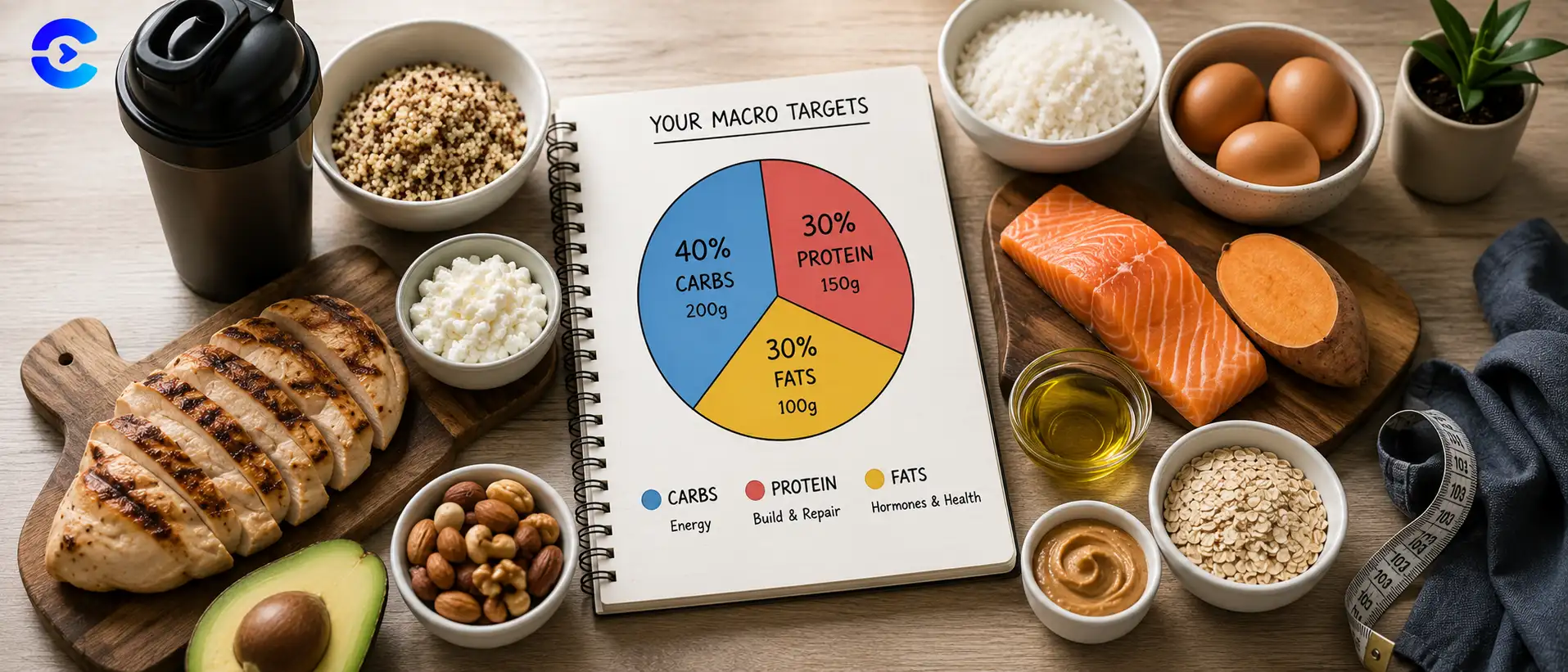

How to Calculate Macros for Cutting, Bulking, or Maintaining
To calculate macros, first find your daily calorie target, then split that number into protein, carbohydrate, and fat grams based on your goal. Protein is usually set first, around 0.7 to 1 gram per pound of bodyweight, fat is set next at roughly 20 to 30 percent of total calories, and carbohydrates fill whatever calories remain. The exact split shifts slightly depending on whether you are cutting, maintaining, or bulking.
To calculate macros, first find your daily calorie target, then split that number into protein, carbohydrate, and fat grams based on your goal.
FAQ: How to Calculate Macros
How to calculate macros if I already know my calorie target?
Set protein first based on bodyweight, set fat as a percentage of total calories, then let carbohydrate fill whatever calories remain after protein and fat are subtracted from the total.
How much protein do I need per day?
Most people aiming to build or preserve muscle should target roughly 0.7 to 1 gram of protein per pound of bodyweight per day.
Should protein change between cutting and bulking?
Protein often increases slightly as a percentage during a cut to help preserve muscle in a calorie deficit, while it can be slightly lower during a bulk since extra calories support muscle growth on their own.
What is the minimum amount of fat I should eat?
Most guidance suggests keeping fat above roughly 15 to 20 percent of total daily calories to support hormone production and overall health.
Why does carbohydrate change more than protein or fat?
Carbohydrate is typically treated as the flexible macro that absorbs whatever calories remain after protein and fat are set, so it naturally shifts the most as total calories rise or fall.
Do I need to track macros exactly every day?
Exact daily precision is not required for most people; staying within a reasonable range of your targets most days will still produce results over time.
How many calories are in a gram of protein, carbohydrate, and fat?
Protein and carbohydrate each provide four calories per gram, while fat provides nine calories per gram.
Can I use a general macro ratio instead of doing the math myself?
General ratios can work as a starting point, but calculating macros from your own bodyweight and calorie target gives a more accurate and personalized result than a generic percentage split.
Starting from your total calorie number
Macro math only works once you already know your daily calorie target, since protein, carbohydrate, and fat grams are simply pieces of that total. Each gram of protein and carbohydrate provides four calories, while each gram of fat provides nine calories. Once you know your total and your goal, the split becomes a straightforward calculation rather than a guess.
How to calculate macros step by step
Take a person with a maintenance calorie target of 2200 calories per day and a bodyweight of 170 pounds. Start with protein at 0.9 grams per pound, which gives 153 grams of protein, worth 612 calories. Next set fat at 25 percent of total calories, which is 550 calories, or about 61 grams of fat. Subtract both from the total: 2200 minus 612 minus 550 leaves 1038 calories for carbohydrates, which works out to about 260 grams of carbohydrate. That full split, roughly 153 grams protein, 61 grams fat, and 260 grams carbohydrate, is the maintenance target for this person.
Adjusting the same numbers for cutting and bulking
For a cut, the same person might drop total calories to 1800 while keeping protein high to protect muscle, since protein needs actually increase slightly as a percentage during a deficit. At 1 gram per pound, protein becomes 170 grams, worth 680 calories. Fat drops to about 20 percent of total, which is 360 calories or 40 grams. That leaves 760 calories for carbohydrate, roughly 190 grams.
For a bulk, calories might rise to 2700, protein stays around 0.8 grams per pound at 136 grams, fat holds near 25 percent at 675 calories or 75 grams, leaving 1350 calories for carbohydrate, about 337 grams. Notice how protein stays relatively stable across all three goals while carbohydrate is the number that moves the most.
Macro splits at a glance
| Goal | Calories | Protein | Fat | Carbohydrate |
|---|---|---|---|---|
| Cutting | 1800 | 170g | 40g | 190g |
| Maintenance | 2200 | 153g | 61g | 260g |
| Bulking | 2700 | 136g | 75g | 337g |
A short checklist before you start tracking
- Confirm your total daily calorie target first, since every macro depends on it.
- Set protein based on bodyweight rather than a fixed percentage, so it stays consistent as calories change.
- Do not drop fat below roughly 15 percent of total calories, since hormone production needs a baseline amount.
- Let carbohydrate be the flexible number that absorbs whatever calories remain.
- Recheck your macros every few weeks as bodyweight or activity level shifts.
Calculators to pair with your macros
Macros are one piece of a broader nutrition picture. Checking your BMI alongside your macro targets can give useful context, though body composition matters more than BMI alone. Hydration also plays a role in performance and recovery, so the Water Intake Calculator is worth pairing with your macro plan. For the complete set of nutrition and fitness tools, visit the health and fitness tools page, and read more nutrition breakdowns on the ConvertNow blog.
Your macro plan in three steps
Macros are just your calorie target divided into protein, fat, and carbohydrate grams based on your goal, and the split shifts more in carbohydrate than in protein as you move between cutting and bulking. Skip the manual math with the Macro Calculator once you know your daily calories.
How to Calculate Macros for Different Bodies: More Examples and Fixes
The main post walks one person through the sums. Real people vary, so here are three more cases for how to calculate macros, the percentage method, and the mistakes that quietly wreck a plan. This guide on how to calculate macros fills the gaps.
How to calculate macros for three different people
Each row uses the same order: protein first, fat second, carbohydrate last. The method never changes. Only the inputs do.
| Person | Calories | Protein | Fat | Carbohydrate |
|---|---|---|---|---|
| 140 lb woman, how to calculate macros at maintenance | 1800 | 112g at 0.8 per lb | 56g at 28 percent | 212g |
| 200 lb man, how to calculate macros for a lean bulk | 2600 | 180g at 0.9 per lb | 72g at 25 percent | 308g |
| Percentage method, 40 / 30 / 30 split | 2000 | 150g | 67g | 200g |
Check the first row of the how to calculate macros table. 112 grams of protein is 448 calories. 56 grams of fat is 504 calories. Carbohydrate gets the remaining 848 calories, which is 212 grams. Add them and you land back on 1800.
Should you learn how to calculate macros by grams or by percent?
Both ways of how to calculate macros work, but they behave differently when calories change. A fixed percentage split scales protein down when you cut. A gram based setup keeps protein steady. For most people who ask how to calculate macros, grams per pound for protein is the safer base, then percent for fat. The percentage method of how to calculate macros is fine for a quick start and for people who eat the same calories every day.
- Weigh food raw or cooked, but pick one and stay with it, whatever your approach to how to calculate macros.
- When you practise how to calculate macros, round protein and fat to the nearest 5 grams. Chasing exact numbers is wasted effort.
- Count fibre inside carbohydrate unless your tracker lists net carbs separately.
- Log oils and sauces. They are the biggest gap between a plan and real intake.
- Reread how to calculate macros whenever your calories change by more than 10 percent.
What do you do about alcohol when you calculate macros?
Alcohol gives 7 calories per gram, and it is not protein, fat or carbohydrate. A standard US drink holds 14 grams of alcohol, which is 98 calories. So when you calculate macros and then have two drinks, about 196 calories sit outside your targets. Subtract them from carbohydrate first, since that is the flexible number. Anyone studying how to calculate macros properly should treat those calories as a separate line.
Sanity check
Multiply protein by 4, carbohydrate by 4 and fat by 9, then add. If the total is more than 50 calories away from your target, the sums are wrong. In row three above, 150 x 4 plus 67 x 9 plus 200 x 4 gives 2003.
How to calculate macros when your week is uneven
Weekends often run 300 calories higher than weekdays. You can handle this in two ways. Either set one daily target and accept the swings, or work out a weekly total. For a 2000 calorie plan the weekly total is 14000, so if Saturday hits 2400 you pull 400 back across the other days. Treat protein as the fixed piece in this version of how to calculate macros, and let carbohydrate flex.
Questions people ask about how to calculate macros
How close do I need to be when I learn how to calculate macros? Within 5 to 10 percent on each macro is fine. Averages over a week matter more than any single day when you work out how to calculate macros for fat loss.
Do I redo how to calculate macros after losing weight? Yes. Protein is tied to bodyweight, so it drops a little as you lean out. Use the macro calculator to rerun the numbers in seconds.
Does how to calculate macros change for older adults or athletes? The steps stay the same. Protein targets tend to sit at the higher end for both groups, but get personal advice if you have a medical condition.
| # | Key takeaway |
|---|---|
| 1 | Confirm your total daily calorie target first, since every macro depends on it. |
| 2 | Set protein based on bodyweight rather than a fixed percentage, so it stays consistent as calories change. |
| 3 | Do not drop fat below roughly 15 percent of total calories, since hormone production needs a baseline amount. |
| 4 | Let carbohydrate be the flexible number that absorbs whatever calories remain. |
Get your calorie target first
Before you can split any macros, you need an accurate calorie number. Use the TDEE and Calorie Calculator to find your daily energy needs based on your age, weight, activity level, and goal.
Open the TDEE CalculatorThen let the math run itself
Once you have a calorie target, the Macro Calculator converts it into exact protein, fat, and carbohydrate grams for cutting, maintenance, or bulking, so you skip the manual arithmetic entirely.
Open the Macro CalculatorSources and further reading
- Macronutrient on Wikipedia: calories per gram of protein, carbs and fat.
- Basal metabolic rate on Wikipedia: the starting point for any calorie target.