

Prime Factorization Mistakes: 9 Easy Fixes That Work
Your prime factorization of 84 came out as 4 × 21, the answer key says 2² × 3 × 7, and you cannot see why both look right. Most prime factorization errors come from nine habits, and each one has a quick fix you can apply in under a minute.
Here is the thing. Prime factorization is not hard, but it is unforgiving. One missed factor of 2 changes the whole answer, and it ruins every step that builds on it, such as simplifying fractions or finding a GCD. Let us break down where it goes wrong.
What a correct prime factorization looks like
A prime is a whole number greater than 1 whose only divisors are 1 and itself. A prime factorization writes a number as a product of primes only, with repeats shown as exponents. For 360 it is 2³ × 3² × 5, which is 8 × 9 × 5.
The reason a single right answer exists is the Fundamental Theorem of Arithmetic. Every whole number above 1 is either prime or a product of primes in exactly one way, ignoring the order of the factors. That uniqueness is also why you can check your work so reliably: any correct route lands on the same result.
Mistake 1: treating 1 as a prime
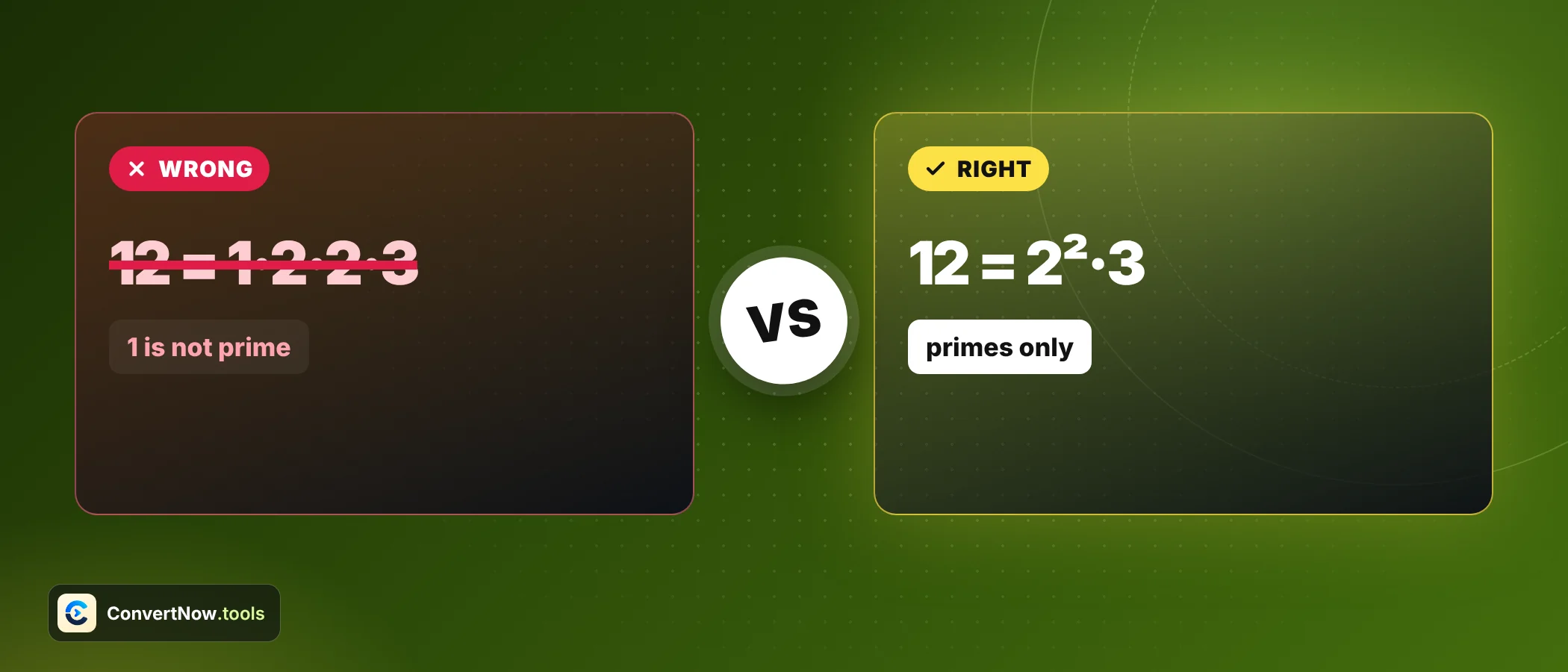
Before (wrong)
- 12 = 1 × 2 × 2 × 3
- Lists 1 as a prime factor
- Factor count comes out as 4
After (correct)
- 12 = 2² × 3
- 1 is left out completely
- Factor count is 3 with repeats, 2 distinct
Why it happens: 1 divides everything, so it feels like a building block. Why it is wrong: a prime needs exactly two divisors, and 1 has only one. There is a deeper reason too. If 1 counted as prime, 12 could be written as 2² × 3, or 1 × 2² × 3, or 1 × 1 × 2² × 3, and the factorization would no longer be unique.
The fix: never write 1 as a factor. The number 1 itself is the empty product, a product with no primes at all, so it has nothing to list.
Divide 150 by 2 to get 75, then by 3 to get 25, then by 5 twice. That gives 2 × 3 × 5². The options 2 × 75 and 5 × 30 stop on composite numbers, and 25 in 2 × 3 × 25 is not prime.
Mistake 2: stopping at a composite factor
Before (wrong)
- 84 = 4 × 21
- Both numbers look like final answers
- Neither 4 nor 21 is prime
After (correct)
- 4 = 2 × 2 and 21 = 3 × 7
- 84 = 2 × 2 × 3 × 7
- Written compactly: 2² × 3 × 7
A factor tree invites this error. You split once, see two smaller numbers, and call it done. The rule is simple: every leaf must be prime. If a leaf is even, divisible by 3, or ends in 0 or 5, split it again.
Mistake 3: dropping a repeated factor
Take 72. A common wrong answer is 2 × 2 × 3 × 3, which feels complete. Multiply it out and you get 36, not 72. One factor of 2 went missing.
| Step | Divide by | Result | Factors so far |
|---|---|---|---|
| 1 | 2 | 36 | 2 |
| 2 | 2 | 18 | 2, 2 |
| 3 | 2 | 9 | 2, 2, 2 |
| 4 | 3 | 3 | 2, 2, 2, 3 |
| 5 | 3 | 1 | 2, 2, 2, 3, 3 |
The fix: keep dividing by the same prime until it no longer goes in evenly, and only then move to the next prime. The correct answer is 2³ × 3². Multiply back: 8 × 9 = 72.
Mistake 4: reading exponents as multiplication
The expression 2³ means 2 × 2 × 2, which is 8. It does not mean 2 × 3, which is 6. This slip shows up when students expand an answer to check it, and it quietly produces a wrong total.
Expanding 360 = 2³ × 3² × 5 the right way
2^3 = 2 * 2 * 2 = 8
3^2 = 3 * 3 = 9
5^1 = 5
8 * 9 * 5 = 360Add the exponents to count factors with repeats. For 360 that is 3 + 2 + 1 = 6 prime factors in total, and 3 distinct primes. If your expanded list does not have 6 entries, an exponent is off.
Mistake 5: trusting odd numbers that look prime
Primes feel like numbers that are awkward and odd. Plenty of awkward odd numbers are not prime. The classics are the ones just outside the times tables most people memorise.
| Number | Looks prime because | Actual prime factorization | Smallest divisor to test |
|---|---|---|---|
| 51 | Not in the 3 times table you recall | 3 × 17 | 3 (digits add to 6) |
| 87 | Ends in 7 | 3 × 29 | 3 (digits add to 15) |
| 91 | No small pattern | 7 × 13 | 7 |
| 119 | Close to 120, an even number | 7 × 17 | 7 |
| 143 | Looks like 144 minus 1 | 11 × 13 | 11 |
| 187 | Ends in 7 | 11 × 17 | 11 |
The fix is a fixed order of tests: 2, 3, 5, 7, 11, 13. For 3, add the digits and check whether the sum divides by 3. For 7, 11 and 13 there is no cheap trick, so divide. A number only earns the label prime after the tests run out.
Mistake 6: stopping the search too early or too late
How far must you test? Up to the square root of the number, and no further. If n had a factor above its square root, the matching partner factor would sit below it and you would have found it already.
Stopping too early is the real danger. Take 221. Its square root is about 14.9, so you must test up to 14. Primes up to 14 are 2, 3, 5, 7, 11 and 13. Quit after 11 and you will call 221 prime. It is not: 221 = 13 × 17.
| Number | Square root (rounded down) | Primes to test | Result |
|---|---|---|---|
| 97 | 9 | 2, 3, 5, 7 | Prime |
| 221 | 14 | 2, 3, 5, 7, 11, 13 | 13 × 17 |
| 997 | 31 | 2, 3, 5, 7, 11, 13, 17, 19, 23, 29, 31 | Prime |
| 10403 | 101 | Up to 101 | 101 × 103 |
Stopping too late is harmless but wasteful. To prove 997 is prime you test 11 primes, not 168 primes below 997.
Finished a factorization by hand? Paste the number into the tool, compare the result with yours, and see the exponent form and factor counts instantly.
Open the Prime Factorization ToolMistake 7: forgetting to shrink the limit
Once you divide out a factor, the remaining number is smaller, and so is its square root. Many people keep testing against the old limit. That wastes effort and, worse, hides the finish line.
| Step | Remaining | Square root limit | Action |
|---|---|---|---|
| Start | 7429 | 86 | Test 2, 3, 5, 7, 11, 13 |
| 17 divides | 437 | 20 | Remaining is 7429 ÷ 17 |
| 19 divides | 23 | 4 | Now 4 is below the next candidate |
| Stop | 23 | 4 | 23 is prime, add it |
Result: 7429 = 17 × 19 × 23. Notice that after dividing by 19 the limit fell to 4, so no more testing was needed. The leftover 23 goes straight into the answer. The Prime Factorization Tool recomputes its limit after each division in exactly this way.
Mistake 8: mishandling 0, 1 and negative numbers
Zero has no prime factorization because every number divides it. The number 1 is neither prime nor composite, and its factorization is empty. For negative numbers, factor the positive value and keep the sign apart. For example, minus 60 is minus 1 times 2² × 3 × 5.
| Input | Prime factorization | Why |
|---|---|---|
| 0 | None | Every number divides 0, so there is no unique answer |
| 1 | Empty product | No primes are needed to build 1 |
| 2 | 2 | The smallest prime, and the only even one |
| 97 | 97 | Prime, so the number is its own factorization |
| 1024 | 2¹⁰ | A power of two has only one distinct prime |
Mistake 9: misusing it for GCD and LCM
Prime factorization is the cleanest way to find a greatest common divisor and a least common multiple. The slip is mixing up which exponent to keep. Take 84 = 2² × 3 × 7 and 90 = 2 × 3² × 5.
| Prime | In 84 | In 90 | GCD uses | LCM uses |
|---|---|---|---|---|
| 2 | 2 | 1 | 1 | 2 |
| 3 | 1 | 2 | 1 | 2 |
| 5 | 0 | 1 | 0 | 1 |
| 7 | 1 | 0 | 0 | 1 |
The GCD takes the smaller exponent of each prime: 2 × 3 = 6. The LCM takes the larger: 2² × 3² × 5 × 7 = 1260. A neat check is that GCD × LCM equals the product of the two numbers: 6 × 1260 = 7560, and 84 × 90 = 7560. If you only need the answer, the GCD and LCM calculator does it directly.
Fractions use the same idea. To simplify 84/90, cancel the shared primes: 2 × 3 is 6 on top and bottom, which leaves 14/15. If a fraction comes out as a decimal and you want to check it, the fraction to decimal converter shows that 14/15 is 0.9333 repeating. Miss one shared prime and the fraction stays unsimplified, which is a quiet way to lose marks.
A repeatable routine that avoids all nine mistakes
- Divide by 2 until the number is oddCount how many times it divided. That count is your exponent for 2.
- Try 3, 5, 7, 11 in orderRepeat each prime until it stops dividing. Never skip a prime, and never move on while it still goes in.
- Recompute the limitAfter each division, take the square root of what is left. If the next prime is larger than that, the leftover number is prime.
- Write the answer with exponentsGroup repeats, for example 2³ × 3² × 5. Leave out 1.
- Multiply backThe product must equal the starting number. If not, find the missing or extra factor.
Factoring by code, and where it runs out
The same logic fits in a few lines. This version strips 2s, tries odd candidates and shrinks the limit as it goes.
Trial division in Python
def factorize(n):
out = {}
while n % 2 == 0:
out[2] = out.get(2, 0) + 1
n //= 2
p = 3
while p * p <= n:
while n % p == 0:
out[p] = out.get(p, 0) + 1
n //= p
p += 2
if n > 1:
out[n] = out.get(n, 0) + 1
return out
print(factorize(7429)) # {17: 1, 19: 1, 23: 1}Trial division is fast for everyday numbers. Its worst case is a large prime. For a prime near one trillion, such as 999999999989, the loop must try about 500,000 odd candidates before it can stop. That is quick on a modern computer, which is why the tool accepts numbers up to 10¹². Beyond that, other methods are used, and factoring very large numbers is the problem that modern encryption relies on being hard.
Questions people ask about prime factorization
Why is 1 not a prime number?
A prime must have exactly two divisors, and 1 has only one. Allowing 1 as a prime would also break the rule that every number has a single prime factorization.
How do I check that a prime factorization is correct?
Multiply all the factors together and compare the product with the original number. Then confirm each factor is prime by testing divisors up to its square root.
Can a number have more than one prime factorization?
No. The Fundamental Theorem of Arithmetic says the factorization is unique apart from the order of the factors. Different methods, such as a factor tree or repeated division, always agree.
What is the prime factorization of 360?
It is 2³ × 3² × 5, because 8 × 9 × 5 = 360. That gives 3 distinct primes and 6 prime factors when repeats are counted.
Do I need to test every number up to n?
No. Testing primes up to the square root of n is enough, since any larger factor has a partner below the square root. This cuts a huge amount of work.
Is 0 or 1 a prime or composite number?
Neither. Zero has no factorization, and 1 is the empty product, so both are handled as special cases.
Sources: Fundamental theorem of arithmetic, Wikipedia · Trial division, Wikipedia