

Percentage Change vs Percentage Points: Why It Matters
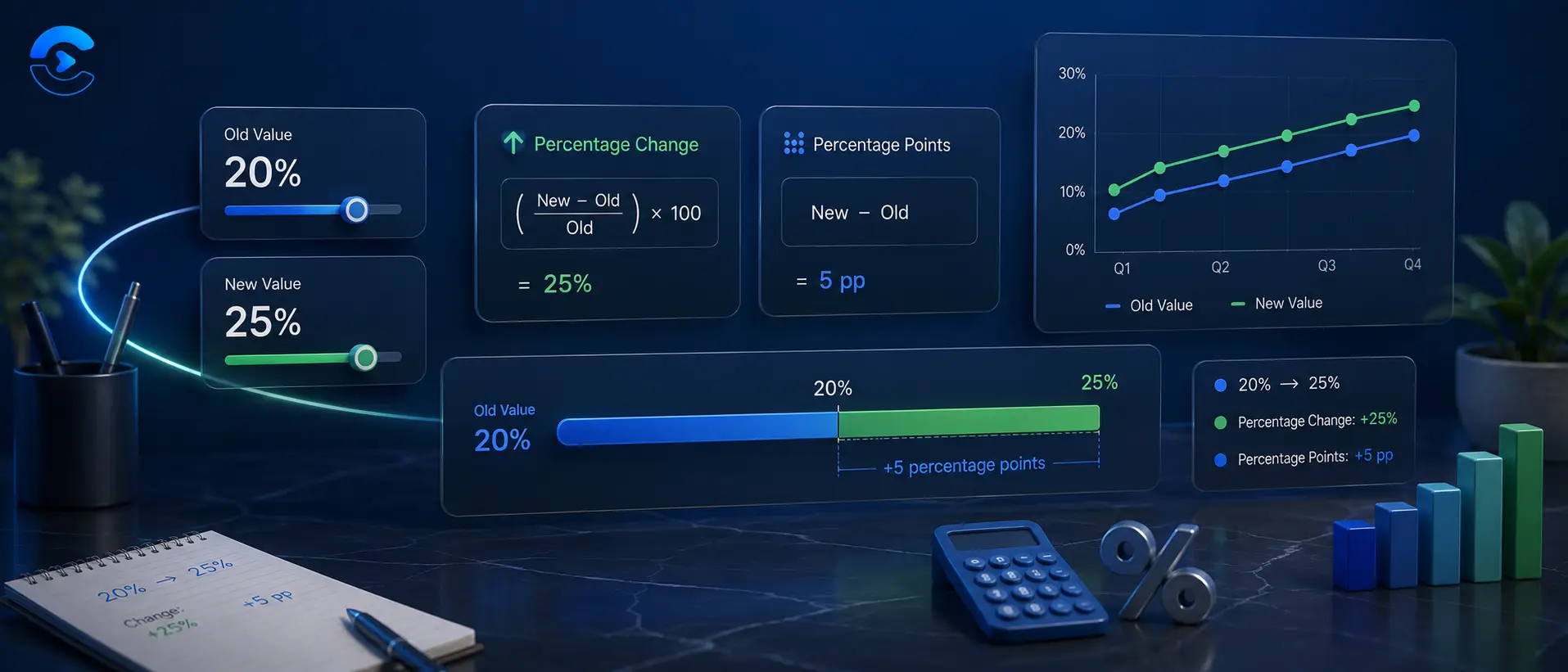
When interest rates rise from 4 percent to 5 percent, headlines often call that a 1 percent increase, but the honest number is a 1 percentage point increase, which is actually a 25 percent relative jump. Percentage points measure the raw difference between two percentages, while percentage change measures how large that difference is relative to the starting value. Mixing the two up can make a modest shift sound tiny or a huge shift sound modest, depending on which framing someone chooses.
Why interest rate headlines get this wrong
Financial news is full of numbers that move between percentages, so the two terms get blurred constantly. A rate moving from 4 percent to 5 percent has changed by one percentage point, a simple subtraction of the two figures. But relative to where it started, that same move represents a 25 percent increase, because 1 divided by 4 equals 0.25. Both numbers are true at once, they just answer different questions, and a headline writer who picks the smaller sounding one is not necessarily lying, just using percentage change vs percentage points loosely, sometimes without realizing readers will interpret the smaller figure as the full story.
What a percentage point actually measures
A percentage point is a direct subtraction. If unemployment moves from 6 percent to 8 percent, that is a rise of 2 percentage points, full stop, no reference to the starting value required. This makes percentage points useful for comparing two rates cleanly without implying anything about how big that shift felt relative to where things began.
What percentage change actually measures
Percentage change instead asks how much something grew or shrank compared to its own starting point. The formula is the difference divided by the original value, then multiplied by 100. Using the same unemployment example, going from 6 percent to 8 percent is a 2 percentage point rise, but it is also a relative increase of about 33 percent, since 2 divided by 6 rounds up to that figure. Neither number is wrong, they simply serve different purposes.
Why this mistake matters beyond interest rates
The confusion spreads well past central banks. A tax rate moving from 10 percent to 12 percent is 2 percentage points but a 20 percent relative increase. A conversion rate improving from 2 percent to 3 percent looks tiny in points but is actually a 50 percent relative gain, which matters enormously to a marketing team reporting results. Choosing the wrong framing, intentionally or by accident, can make a strong result look weak or a small change look dramatic.
How to keep the two straight
A simple habit helps: whenever you see a number described only as a percent change between two percentages, ask whether the writer means the raw point difference or the relative change from the starting value. If the source does not specify, do the math yourself using both formulas and compare. Over time this becomes second nature, and you will start noticing how often financial and political reporting leans on whichever framing supports the story being told, sometimes without any intent to mislead, simply because the shorter phrase reads more smoothly in a headline.
Why relative framing feels bigger
A relative percentage change often sounds more dramatic because it compares the shift to a smaller base. Small starting values inflate the relative number even when the raw point difference is tiny, which is exactly why a conversion rate moving by one point can be described as fifty percent higher. Recognizing this pattern helps you judge whether a bold sounding claim reflects a genuinely large shift or just a small base doing the heavy lifting.
Worked reference table
| Example | Percentage point change | Relative percentage change |
|---|---|---|
| Interest rate: 4 percent to 5 percent | 1 point | 25 percent |
| Unemployment: 6 percent to 8 percent | 2 points | about 33 percent |
| Tax rate: 10 percent to 12 percent | 2 points | 20 percent |
| Conversion rate: 2 percent to 3 percent | 1 point | 50 percent |
Quick checklist for reading percentage claims
- Identify the two raw percentages being compared before trusting any summary.
- Subtract them for the percentage point difference.
- Divide that difference by the starting value for the relative percentage change.
- Check which version a headline is actually using before repeating the claim yourself.
Quick recap: Percentage change vs percentage points
To sum up percentage change vs percentage points in one place, remember the core distinction and apply it consistently any time you read or write about a rate that moved from one level to another.
Calculate both figures instantly
Working these out by hand is easy to get wrong under time pressure, especially when a report is full of shifting figures. The Percentage Calculator lets you plug in any two values and get both the point difference and the relative percentage change side by side, so you never have to guess which framing a source intended. It is a fast way to double check a headline before repeating its claim in your own writing or analysis.
Open the Percentage CalculatorRelated tools for finishing the job
Percentage math rarely lives in isolation, and once you have the point difference and relative change sorted out, you may still need broader statistical context to interpret a result properly. The Statistics Calculator can help with averages, standard deviation, and other figures that often accompany percentage claims in reports. Browse the full Math and Numbers collection for more calculators, or check the ConvertNow blog for further explainers on reading numbers correctly.
Key takeaway
A percentage point is a plain subtraction between two percentages, while percentage change measures that same gap relative to the starting value, and the two can tell very different stories from the same data. Run your own numbers through the Percentage Calculator before trusting a headline that only gives you one side of the picture.
FAQ: Percentage Change vs Percentage Points: Why It Matters
What is the difference between percentage change and percentage points?
Percentage points are the raw subtraction between two percentages, while percentage change measures that same gap relative to the starting value, expressed as a relative percent.
Is a 1 percentage point rise the same as a 1 percent rise?
No, a 1 percentage point rise from 4 percent to 5 percent is actually a 25 percent relative rise, since the relative change depends on the starting value.
How do I calculate percentage change between two values?
Subtract the original value from the new value, divide that result by the original value, then multiply by 100 to get the relative percentage change.
Why do news headlines confuse percentage points and percentage change?
Both numbers are technically accurate but tell different stories, and writers sometimes pick whichever framing sounds more dramatic or fits the headline better, whether or not that is intentional.
Does a small percentage point change always mean a small relative change?
No, a small point change on a small starting value can represent a large relative change, such as a conversion rate moving from 2 percent to 3 percent being a 50 percent relative gain.
Which figure should I use when reporting results?
Report both numbers when possible, since the percentage point difference and the relative percentage change each answer a different question and together give a complete picture.
Can I use a calculator to check percentage point and percentage change at once?
Yes, the Percentage Calculator lets you enter two values and instantly see both the point difference and the relative percentage change side by side.