BMI Calculator Online Free
Enter your height and weight in metric or imperial units and see your BMI score and category instantly.
BMI is a screening tool, not a medical diagnosis. It does not account for muscle mass, bone density, or fat distribution. Consult a healthcare professional for personal health advice.
How this BMI calculator works, and where the number stops being useful
Body Mass Index is one division and one multiplication. Weight in kilograms divided by height in metres, squared. That’s the entire formula, unchanged since a Belgian statistician named Adolphe Quetelet worked it out in the 1830s while trying to describe the average man for a population study, not to size up any one person’s health. The tool below runs that same equation the moment you type a number, no server round trip involved, and maps the result against the World Health Organization’s classification bands.
Everything happens in your browser. Height and weight never leave the page, there’s no upload, no account, and closing the tab clears the calculation completely.
Unit conversion, then one equation
Most of the code in this tool isn’t the BMI formula itself, it’s getting your numbers into metric first. You can enter height in centimetres, metres, or feet and inches, and weight in kilograms, pounds, or stone. Whichever you pick gets converted to kilograms and metres behind the scenes before the division happens.
That last pair of lines runs the formula backward. Instead of solving for BMI given weight, it solves for weight given a target BMI of 18.5 and 24.9, the lower and upper bounds of the normal band. That’s how the tool tells you not just your score but how many kilograms or pounds separate you from the healthy range.
The WHO classification table
The eight bands below come from the World Health Organization’s adult BMI classification, which is itself the most widely cited version of a scheme with roots going back to work by Ancel Keys in 1972, the paper that first proposed weight-over-height-squared as a practical population screening index and gave it the name Body Mass Index.
| BMI Range | Category | Note |
|---|---|---|
| Below 16 | Severely Underweight | Associated with elevated health risk |
| 16 to 17 | Moderately Underweight | |
| 17 to 18.5 | Mildly Underweight | |
| 18.5 to 24.9 | Normal Weight | Lowest average population risk band |
| 25 to 29.9 | Overweight | |
| 30 to 34.9 | Obese Class I | |
| 35 to 39.9 | Obese Class II | |
| 40 and above | Obese Class III |
The extra numbers next to your score
Two supporting figures sit beside the main result, and both are derived directly from your inputs rather than looked up from a table.
BMI Prime
Your BMI divided by 25, the upper edge of the normal range. A value of exactly 1.0 sits precisely on that boundary, so BMI Prime gives you a ratio-to-threshold reading rather than an absolute score, useful for tracking how far above or below the line you sit.
Ponderal Index
Weight divided by height cubed rather than squared. Because it scales with volume instead of area, it holds up better than BMI at unusual heights, which is why paediatricians and some obstetric charts prefer it over BMI for newborns and very tall or short adults.
Age adjustment notes
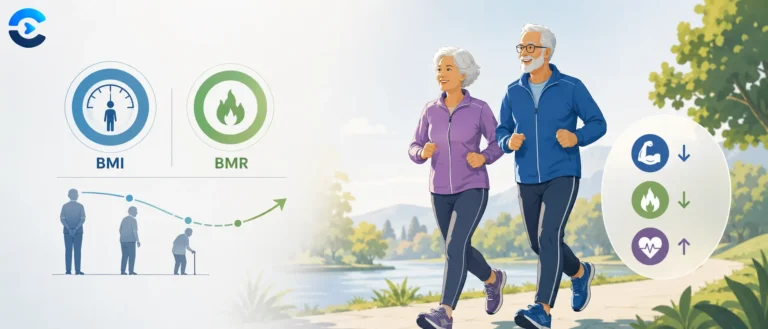
Under 18, the standard adult bands do not apply, growth charts based on age and sex-specific percentiles are the correct reference. At 65 and older, a number of geriatric guidelines suggest 22 to 27 may be a more appropriate target range than the standard 18.5 to 24.9 band.
Where BMI holds up and where it breaks
The formula was built for population averages, and it stays reasonably reliable at that level. Applied to an individual, several known blind spots show up consistently.
On that ethnicity point specifically, several Asian population studies have found elevated cardiometabolic risk at BMI levels below the standard 25 cutoff, which is why the WHO also publishes an alternate set of action points for Asian populations starting overweight risk closer to 23. This calculator uses the standard global bands, so treat the result as a general reference rather than a population matched one if that applies to you.
Doing this yourself, or going further
If you want a body composition number that accounts for what BMI misses, muscle mass and fat distribution, a circumference based or skinfold method is the next step up in accuracy without needing lab equipment.
- World Health Organization, Obesity and Overweight is the source of the classification bands used above.
- CDC Adult BMI Categories mirrors the same thresholds with US-specific guidance.
- Keys et al., 1972, Journal of Chronic Diseases is the paper that formalized weight-over-height-squared as the Body Mass Index for population studies.
- NHLBI BMI Calculator from the National Institutes of Health offers a second independent reference point.
- WHO expert consultation, Lancet 2004 on appropriate BMI cutoffs for Asian populations.
This tool is an educational estimate, not a medical diagnosis. It cannot account for muscle mass, bone density, pregnancy, or ethnicity specific risk thresholds, and it is not a substitute for a clinical assessment. Talk to a doctor or registered dietitian before making health decisions based on a BMI score.
Where BMI is used, and where it fails
Quick self tracking between annual physicals, a starting reference point before a first conversation with a doctor or dietitian, life insurance premium estimation where BMI bands are a standard underwriting input, sports team weight class screening, and population health research where BMI remains the standard, low cost proxy despite its individual level limitations. In every one of those cases, treat the number as a screening signal to investigate further, not a verdict.
Questions About Bmi Calculator Online Free
It uses the standard WHO BMI formula: weight (kg) divided by height (m) squared. Results are accurate based on the inputs provided.
The WHO defines Normal weight as a BMI between 18.5 and 24.9. Below 18.5 is Underweight. 25 to 29.9 is Overweight. 30 or above is Obese.
BMI is less accurate for athletes with high muscle mass. A muscular person may have a high BMI without excess body fat. Body fat percentage is a better measure for athletes.
The calculation is the same but the interpretation can differ. Some health guidelines use slightly different ranges for men and women.
This calculator uses adult BMI thresholds. For children and teenagers, age-specific growth charts are more appropriate.
From the blog
The research behind the numbers
Where these formulas came from and what the studies actually showed.