Word Counter Online Free
Paste any text and instantly see word count, character count, sentence count, paragraph count and estimated reading time.
How this word counter measures ten metrics from the same block of text
A word counter looks like a single number, but this tool is running roughly ten independent measurements on every keystroke: words, characters with and without spaces, sentences, paragraphs, lines, syllables, unique words, reading time, speaking time, and a Flesch reading ease score. Each one uses a slightly different regex or counting rule, and knowing those rules explains why Mr. Smith arrived. can confuse a naive sentence counter.
All counting happens locally in your browser on every input event. Nothing about your draft is ever transmitted.
The counting rules, one by one
/\s+/, any run of whitespace, then filtered for empty strings. This means a word is defined purely by whitespace separation, so a hyphenated term like well-known counts as one word while an em dash separated phrase without spaces would not split at all.
text.length. A second count strips all whitespace with text.replace(/\s/g, '') to give characters excluding spaces, which is the number most character limit fields actually enforce.
/[.!?]+/ and filter out empty results, so consecutive punctuation like ... or ?! collapses into a single boundary rather than counting multiple sentences. Paragraphs split on /\n\s*\n/, a blank line, and default to one paragraph if the text is non-empty but contains no blank line separator.
replace(/[^a-zA-Z0-9]/g, '').toLowerCase() before being checked against a seen object, so Word, and word are treated as the same unique word.
The reading speed defaults to 200 words per minute but is a configurable field, since reading speed varies by content type and audience. Speaking time is fixed at 130 words per minute, a figure that lines up with typical conversational and presentation speaking pace, useful for estimating how long a script will take to read aloud.
Syllables and the Flesch score, shared logic with the readability scorer
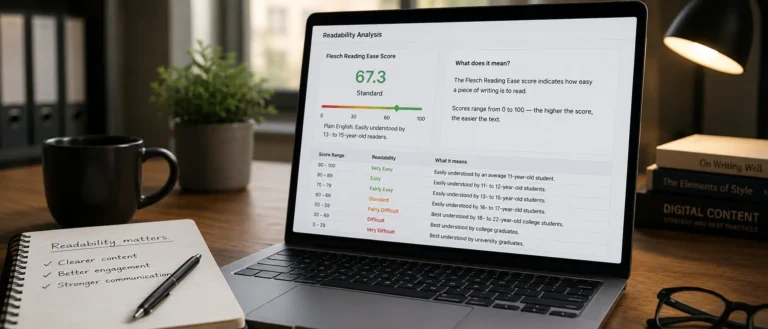
This tool reuses the same vowel group syllable heuristic as our readability scorer: words of three letters or fewer count as one syllable, a trailing silent e, ed, or consonant plus es is stripped, a leading y is dropped, and what remains is scanned for runs of one or two vowels via /[aeiouy]{1,2}/g. Total syllables then feed into the same 1948 Flesch Reading Ease equation, 206.835 - 1.015 * (words/sentences) - 84.6 * (syllables/words), giving a live 0 to 100 ease score and a plain language level label as you type.
| Metric | Rule used |
|---|---|
| Longest word | Tracked by comparing cleaned word length while iterating the word array once |
| Average word length | Total letters across all cleaned words divided by word count, one decimal |
| Average sentence length | Word count divided by sentence count, rounded to the nearest whole word |
| Keyword density | Words of three or more letters, excluding a fixed stopword list, ranked by frequency, top eight shown with percent of total words |
hello-world is one word. The syllable and Flesch calculations clean each token down to letters before analyzing it, which does not change the word count but does mean punctuation-heavy text, quotes, ellipses, parenthetical asides, will not distort the reading ease score even though it can distort a naive sentence count.Extra tools built into the panel
Word or character limit bar
Set a target limit and unit, the tool renders a live progress bar that turns orange past 85 percent and red at or over 100 percent of the limit, useful for meta descriptions, tweet length, or any hard character cap.
Find and count
A separate search field runs a case-insensitive regex match of your query against the full text and reports the exact occurrence count, independent of the keyword density table above it.
- Brysbaert, How many words do we read per minute?, 2019 is the meta-analysis behind commonly cited adult silent reading speed figures used across reading time estimators.
- Flesch-Kincaid readability tests for the 1948 Reading Ease formula this tool computes live.
- MDN on String.split for the regex splitting behavior behind the word, sentence, and paragraph counts.
Limits people write to
Trimming an essay down to a professor’s word limit, keeping a meta description under its character cap, timing how long a video script or speech will actually take to deliver, checking a cover letter reads at an approachable difficulty level before sending it, and scanning a draft’s own keyword density before you paste it somewhere search engines will index. The find and count field alone is useful for confirming how many times a name or term appears without scrolling through a long document manually.
Questions About Word Counter Online Free
Yes. Completely free with no signup, no limit on text length and no data sent anywhere.
Based on an average reading speed of 200 words per minute for general text. Academic or technical text may take longer.
Hyphenated words like well-known are counted as one word, which matches how most style guides count them.
Yes. Twitter limits posts to 280 characters. The character count includes spaces by default.
Yes. Word splitting is based on whitespace which works for most Latin-script languages. CJK languages may not split accurately.
From the blog
Writing about writing tools
Readability scoring, keyword density and the rest, examined properly.