

What Does Flesch Reading Ease Score Mean? A Full Breakdown
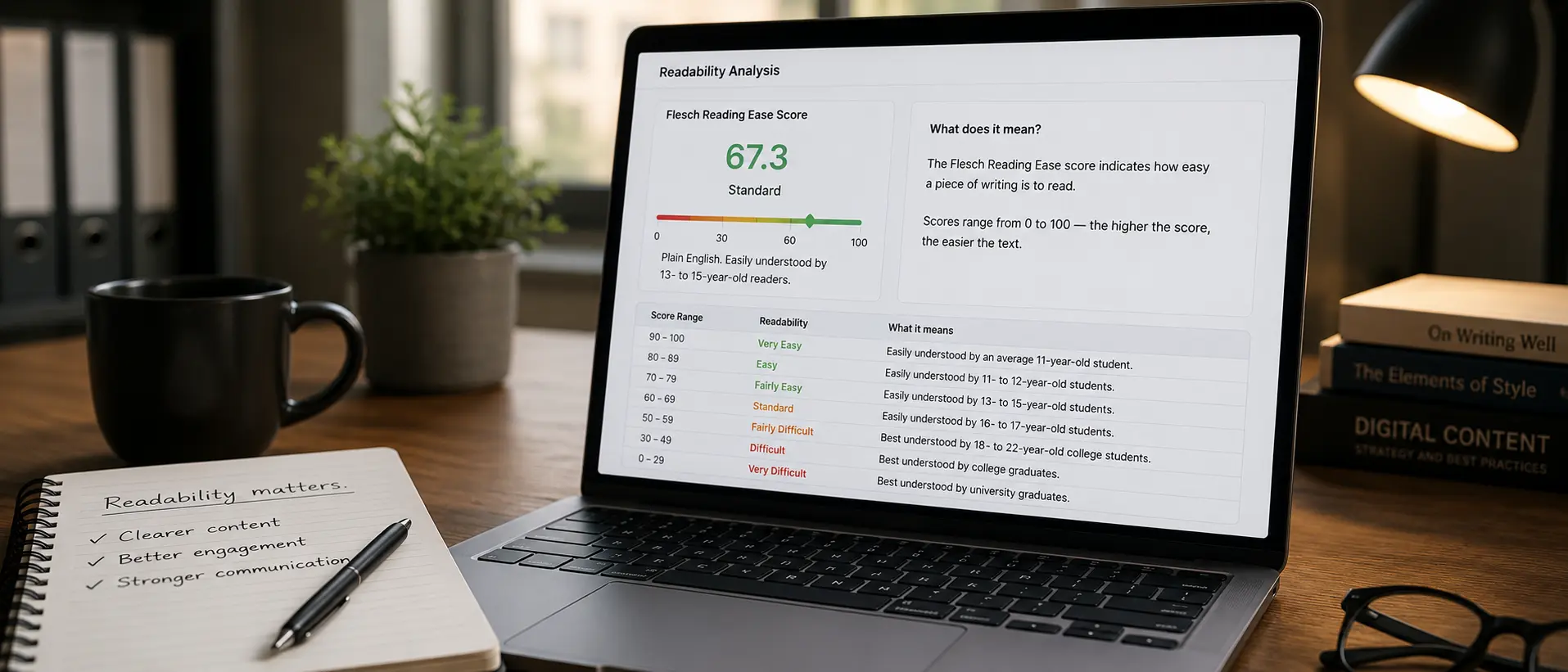
A Flesch reading ease score is a number from roughly zero to one hundred that estimates how easy a piece of text is to read, based on sentence length and syllable count. Higher numbers mean easier text: a score in the sixties reads like plain conversational English, while a score above ninety reads like a children’s book. A score below thirty usually signals dense academic or legal writing that only a specialist would read comfortably. Once you know where your number falls on that scale, you can tell instantly whether your writing matches the audience you actually want to reach.
How the score is actually calculated
The Flesch reading ease formula looks at two things only: the average number of words per sentence and the average number of syllables per word. It does not care about grammar, tone, or whether your argument makes sense. That is exactly why what does Flesch reading ease score mean is a question worth answering carefully, because the number can be misleading if you treat it as a full quality grade rather than a rough proxy for sentence and word complexity. Shorter sentences built from shorter words push the score up. Long sentences packed with multisyllable words push it down, even if the writing itself is clear and well organized.
Reading a score of sixty in context
A score between sixty and seventy is generally described as plain English, the level most newspapers, blog posts, and product pages aim for. It corresponds roughly to text an eighth or ninth grade student could read without strain. If your homepage or blog post lands here, you are in good company with most mainstream web content, and you likely do not need to simplify further unless your audience is especially young or unfamiliar with the topic.
What does Flesch reading ease score mean at the extremes
At the high end, scores above ninety describe very simple text, the kind found in early readers or basic safety instructions, built from short words and short sentences. At the low end, scores below thirty describe text so dense it typically requires a college degree to parse comfortably, common in legal contracts, academic journals, and technical standards documents. Neither extreme is wrong on its own, since the right score always depends on who is reading and why.
Score ranges mapped to reading level and genre
| Score range | Reading level | Typical genre |
|---|---|---|
| 90 to 100 | Fifth grade | Children’s books, basic instructions |
| 80 to 89 | Sixth grade | Conversational blog posts |
| 70 to 79 | Seventh grade | General fiction, marketing copy |
| 60 to 69 | Eighth and ninth grade | Newspapers, most web content |
| 50 to 59 | Tenth to twelfth grade | Trade publications, some journalism |
| 30 to 49 | College level | Business reports, industry analysis |
| 0 to 29 | College graduate | Legal text, academic papers, scientific studies |
Common mistakes when chasing a specific number
Writers who fixate on hitting a particular score sometimes chop every sentence down to the same short length, which produces text that reads like a list of commands rather than natural prose. Varying sentence length actually helps both the score and the reading experience, since a mix of short and medium sentences tends to average out favorably while still sounding human. Another common mistake is swapping in shorter synonyms that change the meaning slightly, which can hurt clarity even as the number improves. The goal is never the number itself, it is a reader who finishes the page without getting tired or confused partway through.
How the score interacts with search visibility
Search engines do not use Flesch reading ease as a direct ranking signal, but easier text tends to keep visitors on a page longer, and longer time on page is associated with better performance in search results over time. Pages written far above a general audience’s comfort level often see visitors leave quickly, which can indirectly hurt how a page performs even though no algorithm is reading the score itself. Treating readability as a user experience question, rather than purely a technical one, keeps the incentives lined up correctly.
A short checklist for interpreting your own score
- Match your target score to your actual audience, not to an arbitrary benchmark someone else set.
- Aim for the sixty to seventy range for most public facing web pages and marketing content.
- Treat a very low score as a signal to shorten sentences before you rewrite entire paragraphs.
- Recheck the score after editing, since one long sentence can pull the whole passage down noticeably.
- Remember the score ignores clarity of meaning, so read your text aloud alongside checking the number.
Check your own score in seconds
Instead of guessing where your writing falls on the scale, paste it into the Readability Scorer and see your exact reading ease number along with sentence and word statistics that explain how it was calculated.
Open the Readability ScorerRelated tools for finishing the job
A readability score is only useful alongside a few other checks. Run your draft through the Word Counter to see whether your sentences are actually as long as they feel, and use the Keyword Density Checker to confirm you have not repeated a term so often that it hurts flow and, in turn, your score. Both pair naturally with the reading ease number since a piece can score well on ease while still overusing a phrase. If you want to browse every text tool on the site in one place, visit the text and content tools page, or check the ConvertNow blog for more writing focused breakdowns like this one.
Key takeaway
A Flesch reading ease score is a quick, mechanical signal about sentence and word length, not a full verdict on quality. Use the sixty to seventy range as a general target for public content, but always weigh the number against who is actually going to read it. When you want to check where a page or paragraph currently stands, run it through the Readability Scorer and adjust from there.
FAQ: What Does Flesch Reading Ease Score Mean
What does Flesch reading ease score mean exactly?
It is a number from roughly zero to one hundred that estimates how easy text is to read based on average sentence length and average syllables per word, with higher numbers meaning easier text.
What is a good Flesch reading ease score for a blog post?
Most blog posts and general web content aim for a score between sixty and seventy, which corresponds to plain conversational English readable by most adults without strain.
Is a higher Flesch reading ease score always better?
Not always. A very high score can mean writing that feels too simple for a technical or expert audience, so the right score depends on who you expect to read the content.
Why is my readability score lower than expected?
Long sentences and multisyllable words both pull the score down, so a single overly long sentence can lower the average even if the rest of the text is simple.
How is Flesch reading ease different from Flesch Kincaid grade level?
Both formulas use the same sentence length and syllable count inputs, but Flesch reading ease produces a zero to one hundred score while Flesch Kincaid grade level converts that same data into a United States school grade number.
Does Flesch reading ease measure grammar or meaning?
No. The formula only counts sentence length and syllables, so it cannot detect grammar mistakes, unclear arguments, or factual errors in the text.
What score should academic or legal writing target?
Academic and legal writing commonly scores below thirty because of long sentences and technical vocabulary, and that is expected given the specialist audience those documents serve.
How can I quickly raise my reading ease score?
Break long sentences into two shorter ones and swap complex multisyllable words for simpler alternatives where the meaning stays the same.