
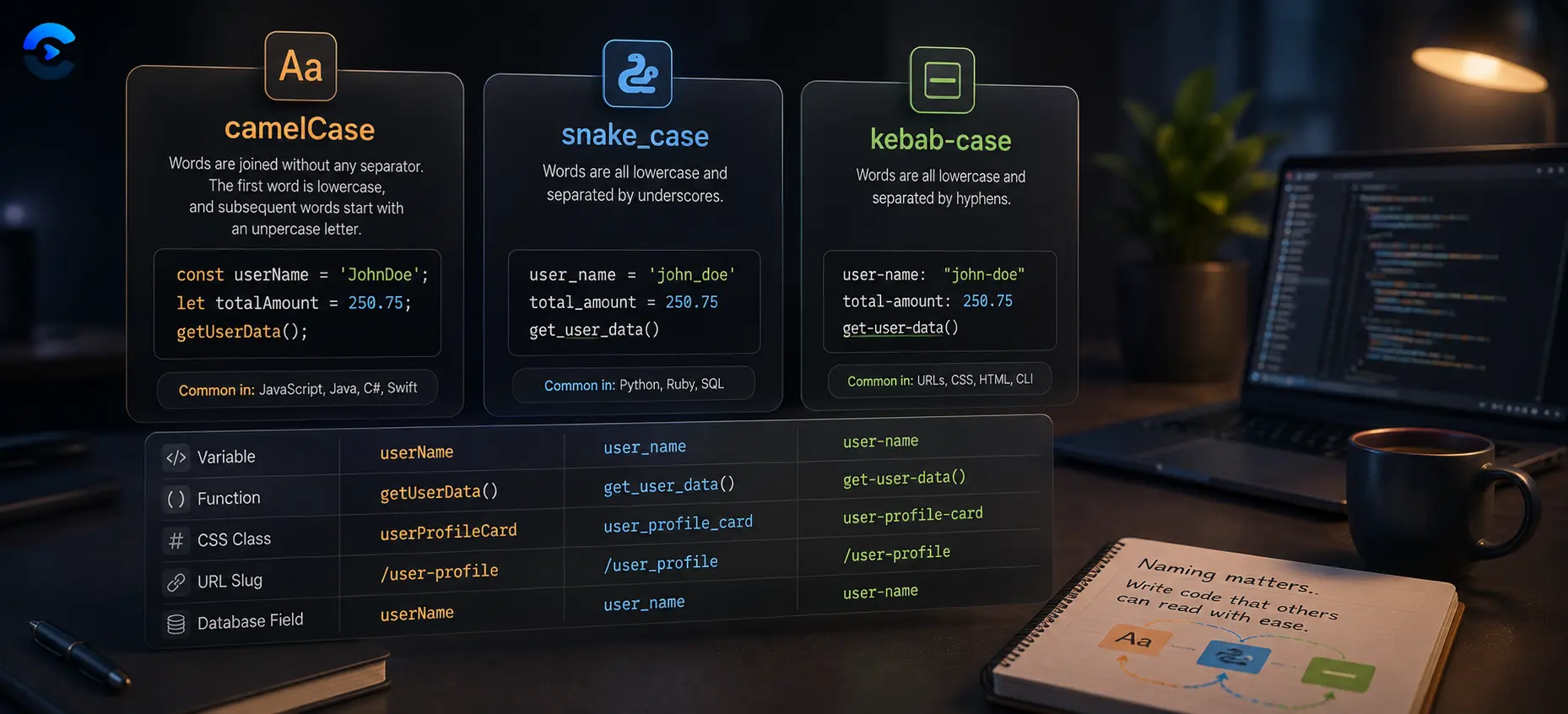

camelCase vs snake_case vs kebab-case Naming Styles
The choice between camelcase vs snake_case vs kebab-case usually is not a matter of taste. Each style is the accepted standard in a specific context: camelCase for JavaScript variables, snake_case for Python and database columns, and kebab-case for URLs. Once you know which context you are writing for, the naming style mostly picks itself.
camelcase vs snake_case vs kebab-case: mapping each style to its home
Naming conventions did not appear at random. Each one grew out of the syntax rules or readability needs of a specific ecosystem, and using the wrong one in the wrong place tends to look out of place immediately to anyone familiar with that language.
camelCase in JavaScript
JavaScript variables and function names commonly use camelCase, where the first word is lowercase and each following word starts with a capital letter, such as “totalPrice” or “getUserName”. This style avoids spaces and underscores while still keeping multi word names readable at a glance.
snake_case in Python and databases
Python style guides recommend snake_case for variables and function names, where words are lowercase and joined with underscores, such as “total_price”. Database column names almost always follow this same pattern, partly because many database systems treat identifiers as case insensitive, which makes camelCase risky since capitalization can silently get lost.
kebab-case and where it dominates
Web addresses cannot contain underscores reliably across every system, and spaces are not allowed at all, so kebab-case became the standard for URL slugs, file names, and CSS class names. Search engines and browsers treat kebab-case links as clean and readable, which is part of why blog post URLs almost always look like this rather than using camelCase or snake_case.
| Naming style | Common home |
|---|---|
| camelCase | JavaScript variables and functions |
| snake_case | Python code and database columns |
| kebab-case | URL slugs, file names, CSS classes |
| PascalCase | Class names in many languages |
A short checklist for picking one
- Check what the language or platform’s own style guide already recommends.
- Match existing code in the same file or project rather than introducing a new style.
- Use kebab-case for anything that becomes part of a URL.
- Stay consistent across an entire project once a style is chosen.
To sum up camelcase vs snake_case vs kebab-case in one place, keep the core idea in mind as you apply it: check the actual numbers for your situation rather than relying on a rule of thumb alone, and revisit the calculation whenever the underlying inputs change. Small details often change the outcome more than people expect, so it pays to redo the math once your numbers shift. A quick recheck now saves a bigger correction later, especially once real data replaces an early estimate. Keep the process simple and repeatable so you can run it again next time without relearning the steps. Write down the inputs you used so you can compare results later and spot any change over time.
Getting comfortable with camelcase
Getting this right matters because small errors compound the longer they go unnoticed, and a quick sanity check now saves a bigger correction later. Write down the inputs and assumptions you used so you can compare results later and spot exactly what changed if the numbers look different next time. Treat any online tool as a way to confirm your own reasoning rather than a black box, since understanding the logic behind the number is what actually builds confidence. Real world data is rarely as clean as a textbook example, so expect to make small adjustments once you apply the same method to your own numbers. Keep the process simple and repeatable so you can run it again next month or next year without relearning the steps from scratch. A second pair of eyes, or a second tool, is a cheap way to catch a mistake before it turns into a bigger problem downstream.
Most people get this wrong the first time not because the concept is hard, but because a small step gets skipped under time pressure. Once the basic method clicks, the same logic tends to show up again in other parts of the same field, which makes the extra few minutes spent learning it worthwhile. Getting this right matters because small errors compound the longer they go unnoticed, and a quick sanity check now saves a bigger correction later. Write down the inputs and assumptions you used so you can compare results later and spot exactly what changed if the numbers look different next time.
Switch between naming styles instantly
The Case Converter turns any text into camelCase, snake_case, kebab-case, or several other styles in one click, so renaming a batch of variables or slugs does not mean retyping everything by hand.
Open the Case ConverterRelated tools for finishing the job
Naming decisions often show up alongside a couple of related tasks. If a name needs to travel safely inside a URL, the URL Encoder Decoder makes sure special characters do not break the link. Turning a blog title into a clean kebab-case address is exactly what the Slug Generator is built for. You can find more writing and formatting tools on the text and content tools page.
Key takeaway
None of these styles is better on its own. The right choice depends entirely on where the name will live. Convert between them instantly with the Case Converter whenever you switch contexts.
FAQ: camelCase vs snake_case vs kebab-case Naming Styles
What is the main difference between camelCase, snake_case, and kebab-case?
camelCase joins words with capital letters and no separator, snake_case joins them with underscores, and kebab-case joins them with hyphens.
Which naming style does JavaScript use by convention?
JavaScript variables and functions typically use camelCase, such as “getUserName” or “totalPrice”.
Why do Python developers prefer snake_case?
Python’s own style guide recommends snake_case for readability, and it has become the standard convention across most Python codebases.
Why are URLs almost always written in kebab-case?
URLs cannot reliably contain underscores or spaces across every system, so kebab-case became the safest and most readable option for slugs.
Can I mix naming styles within one project?
It is best to stay consistent within a single language or context, though a project can reasonably use different styles for different purposes, such as snake_case in a database and kebab-case in URLs.
Does the naming style affect performance?
No, naming style is purely a readability and convention choice and has no effect on how code or a URL actually performs.