About This Tool
Fill, contain, or cover: three ways to fit an image into a box
Resizing an image is one line of code, ctx.drawImage(img, 0, 0, width, height), but the interesting part is what happens when your target dimensions don’t share the source’s aspect ratio. This tool implements three distinct fit strategies for that mismatch, the same three concepts CSS uses for object-fit, and it runs every one of them through the Canvas API locally, batch processing an entire folder of images without ever uploading a file.
The three fit modes
Fill
The canvas is set to exactly your target width and height, and the source is stretched to match with a single drawImage call. If the target aspect ratio differs from the source, the image distorts, this mode never crops or letterboxes, it just stretches.
Contain
The scale ratio is Math.min(targetW/srcW, targetH/srcH), the smaller of the two axis ratios, so the entire source fits inside the target box without cropping. The output canvas is sized to the scaled image itself, not the requested box, which is why contain output dimensions can differ slightly from what you typed.
Cover
The scale ratio flips to Math.max(targetW/srcW, targetH/srcH), the larger ratio, so the scaled image fully covers the target box and overflows on one axis. The overflow is then centered and clipped by drawing the scaled image at a negative offset equal to half the excess.
// cover mode: scale up, then center-crop by offsetting the draw position
var ratio2 = Math.max(targetW / srcW, targetH / srcH);
var scaledW = Math.round(srcW * ratio2);
var scaledH = Math.round(srcH * ratio2);
var offX = Math.round((scaledW – targetW) / 2);
var offY = Math.round((scaledH – targetH) / 2);
canvas.width = targetW;
canvas.height = targetH;
ctx.drawImage(img, -offX, -offY, scaledW, scaledH);
Notice cover never actually crops pixels off in a separate step, it draws the oversized image at a negative coordinate so the canvas boundary itself does the clipping. Anything outside the 0,0 to targetW,targetH rectangle simply never gets painted.
Aspect ratio lock and pixel-quality interpolation
When the lock is on, typing a width recalculates height as Math.round(val * origH / origW) against the first loaded image’s original ratio, and vice versa for height, so the proportions never drift. The actual upscaling or downscaling quality comes from the browser’s own image smoothing, which the canvas applies automatically using a bilinear or bicubic-like filter depending on the browser, there’s no custom interpolation code in the tool itself, it relies on the platform’s default resampling.
| Mode | Output size | Distortion risk |
|---|
| Fill | Exactly your target | Yes, if ratios differ |
| Contain | May be smaller than target on one axis | None |
| Cover | Exactly your target | None, crops instead |
Percent mode ignores the width and height fields entirely. Switching to percentage mode recalculates each image’s target size individually from its own original dimensions, origW * pct / 100, so a 10-image batch with mixed source sizes produces proportionally resized outputs at different pixel dimensions from each other, unlike pixel mode where every output shares the same target box.
Batch processing
Every loaded file is resized independently and in parallel, each with its own onload callback, and results are collected into an array before the download-all button becomes available.
Format conversion
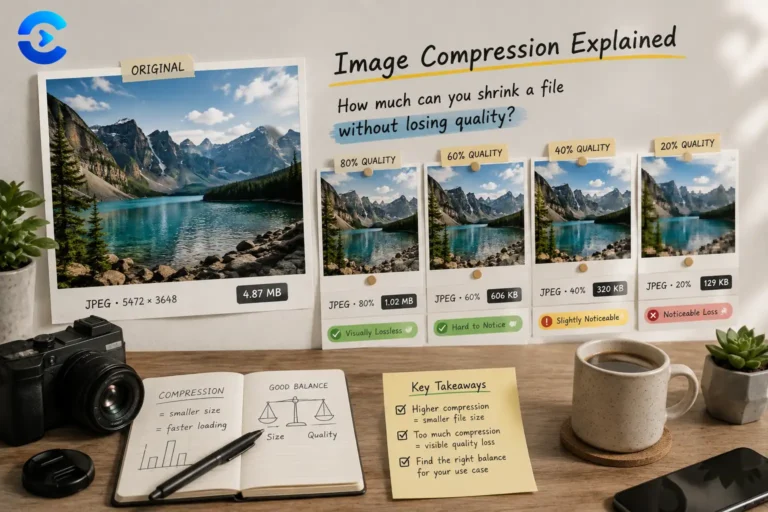
The output MIME type can differ from the input, so a batch of PNGs can be resized and exported as JPEG or WebP in the same pass, with quality only applied when the target format supports it.
ZIP download
When more than one file is processed, results are bundled with JSZip into a single archive; if that library isn’t available, the tool falls back to firing sequential downloads spaced 600ms apart.
Canvas drawImage, client-side only
Fill, contain, cover fit modes
Batch resize with ZIP export
Resizing jobs in practice
Batch resizing a folder of product photos to a marketplace’s required dimensions, cropping a set of portraits to a uniform square avatar size with cover mode, shrinking camera photos to fit an email attachment limit, generating a consistent thumbnail grid where every image needs the exact same box regardless of source aspect ratio, or converting a batch of screenshots to WebP at a smaller footprint while resizing them down for a documentation site.