

Salary to Hourly: 8 Easy Steps, Exact Rate, No Guesswork
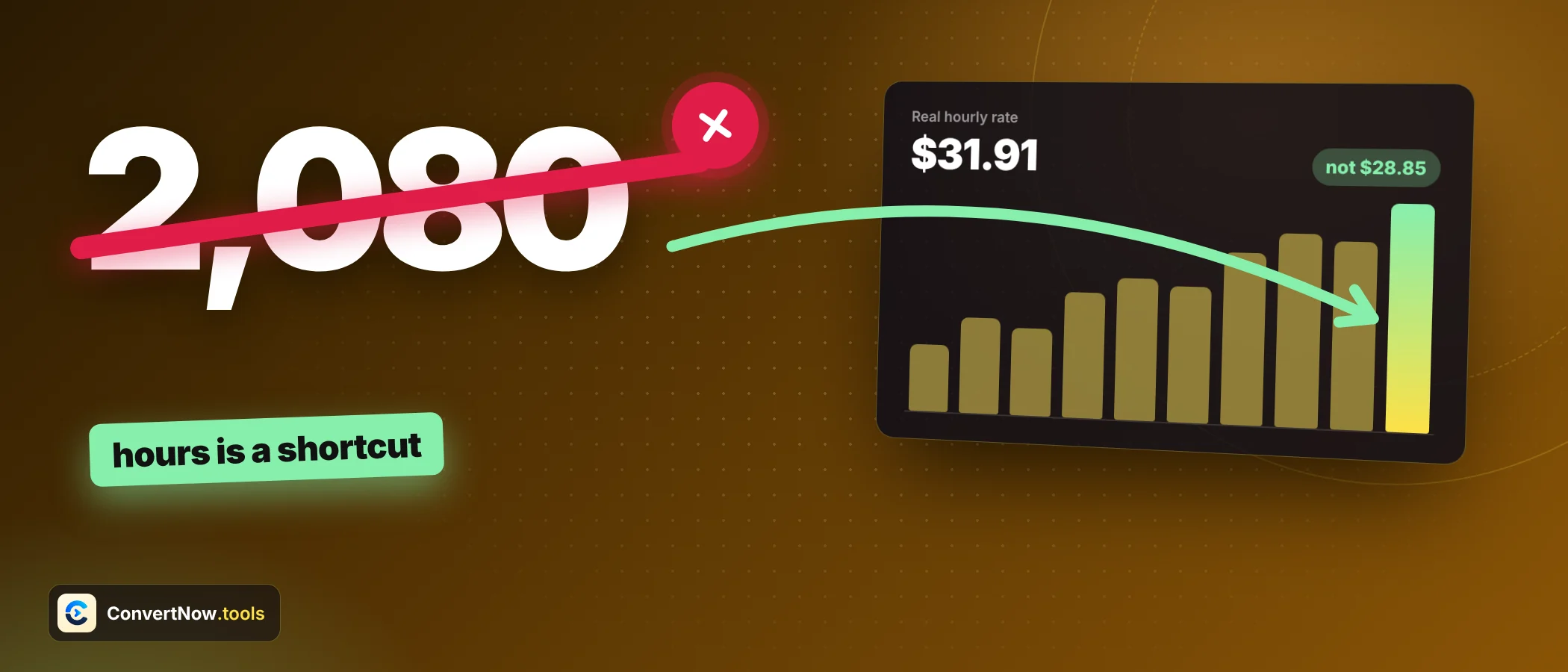
To go from salary to hourly, you must decide how many hours you really work in a year. The usual shortcut divides by 2,080 and ignores time off, which understates the rate. A 60,000 salary comes out at 28.85 an hour that way, but the true figure for many people is 30.00.
The rest of this page is a playbook. Gather four inputs, run the arithmetic in order, check the result, and only then use it to compare offers or set a rate. You can run every step in the Salary to Hourly Converter as you read.
Salary to hourly: frequently asked questions
How do I convert salary to hourly?
Divide your annual pay by your real working hours, which are hours per day times days per week times working weeks. A 60,000 salary over 2,000 hours is 30.00 an hour.
Is 2,080 the right number of hours for a year?
It is 40 hours times 52 weeks and assumes no time off. If you take paid leave or holidays, your working hours are lower and your true hourly rate is higher.
What is 60,000 a year per hour in a salary to hourly conversion?
It is 28.85 with 2,080 hours and 30.00 with 10 paid days off. The difference comes from how many hours you count.
How do I compare a salary with a freelance rate?
Convert the salary to an hourly rate, add what a freelancer must cover themselves such as benefits and taxes, then divide by hours you can actually bill. Those inputs are your own estimates.
Does unpaid overtime lower my hourly rate?
Yes. The same pay spread across more hours gives a smaller rate. A 45 hour week on 60,000 gives 26.67 instead of 30.00.
Is a salary to hourly rate gross or net?
Gross, meaning before tax and deductions. Use a take home calculation to see the net amount.
Why the 2,080 hour shortcut misleads a salary to hourly conversion
The number 2,080 is 40 hours times 52 weeks. It assumes no vacation, no sick days and no public holidays. Most employees are paid for those days, but they are not hours worked. Spread the same salary across fewer working hours and the hourly figure rises.
| Paid days off per year | Working weeks | Working hours | Hourly rate |
|---|---|---|---|
| 0 | 52 | 2,080 | 28.85 |
| 10 | 50 | 2,000 | 30.00 |
| 15 | 49 | 1,960 | 30.61 |
| 20 | 48 | 1,920 | 31.25 |
| 25 | 47 | 1,880 | 31.91 |
| 30 | 46 | 1,840 | 32.61 |
Each extra week of paid leave raises the hourly equivalent by roughly 0.6 on this salary. That matters when you compare an offer with more vacation against one with a slightly higher base.
Step 1: Gather four inputs
Everything depends on four facts. Write them down before you touch a calculator, and use the real schedule, not the contract headline.
Public holidays that fall on working days are paid time off. Leaving them out inflates your working hours and lowers the hourly rate you calculate.
Step 2 to 5: Run the arithmetic in order
- Turn days off into weeksDivide paid days off by days per week. Ten days on a 5 day week is 2 weeks.
- Step 3: Find working weeks and daysSubtract those weeks from 52. That gives 50 weeks. Multiply by 5 to get 250 working days.
- Step 4: Find working hoursMultiply working days by hours per day. 250 times 8 is 2,000 hours.
- Step 5: Divide for salary to hourlyAnnual pay divided by working hours. 60,000 ÷ 2,000 is 30.00. Daily is 60,000 ÷ 250 = 240, and monthly is simply 60,000 ÷ 12 = 5,000.
| Unit | Result | Derivation |
|---|---|---|
| Annual | 60,000 | Input |
| Monthly | 5,000.00 | 60,000 ÷ 12 |
| Weekly | 1,200.00 | 60,000 ÷ 50 working weeks |
| Daily | 240.00 | 60,000 ÷ 250 working days |
| Hourly | 30.00 | 60,000 ÷ 2,000 working hours |
Notice the weekly figure. Dividing by 52 would give 1,153.85, but a worker who is on leave for 2 weeks earns the year across 50 weeks of actual work. Choose one method and use it on both offers you compare.
The whole salary to hourly conversion as a formula
workWeeks = 52 - (paidDaysOff / daysPerWeek)
workDays = workWeeks * daysPerWeek
workHours = workDays * hoursPerDay
hourly = annual / workHoursStep 6: Test four different schedules
Good rules hold across schedules. These four cases show how the same method handles part time work, a long holiday allowance and a compressed week.
| Schedule | Annual pay | Days off | Working hours | Hourly rate |
|---|---|---|---|---|
| Full time, 8 hours, 5 days | 52,000 | 0 | 2,080 | 25.00 |
| Full time with 34 days off, 8 hours, 5 days | 85,000 | 34 | 1,808 | 47.01 |
| Part time, 6 hours, 4 days | 32,000 | 20 | 1,128 | 28.37 |
| Compressed week, 10 hours, 4 days | 78,000 | 15 | 1,930 | 40.41 |
The part time worker earns less in total yet gets 28.37 an hour, which is higher than the full time 25.00 above. Only the hourly rate lets you compare these jobs fairly.
Step 7: Account for unpaid hours
If a salaried job regularly runs past its contract hours, the real rate falls. A 60,000 salary at 8 hour days gives 30.00. The same salary for a 45 hour week across 50 weeks is 2,250 hours, so the rate is 26.67 an hour.
Contract hours
- 40 hour week, 50 weeks
- 2,000 hours
- 30.00 per hour
Actual hours
- 45 hour week, 50 weeks
- 2,250 hours
- 26.67 per hour
Track your real hours for 4 to 12 weeks, then divide your pay by the average. In the United States, the Department of Labor explains that overtime rules for covered employees rest on a regular rate worked out from total weekly pay divided by hours worked, and exemptions vary, so check the rules for your own role.
Step 8: Compare with a freelance rate
An employee salary includes paid leave and benefits. A freelancer has neither, and cannot bill every hour. Suppose a job pays 70,000, which is 33.65 an hour at 2,080 hours or 36.46 with 20 days off. A freelancer who wants the same pay plus 30 percent for benefits and taxes needs 91,000. If they can bill 1,300 hours a year, the rate must be 70.00 an hour.
| Item | Salaried job | Freelance equivalent |
|---|---|---|
| Yearly income needed | 70,000 | 91,000 (30% added) |
| Paid hours or billable hours | 1,920 | 1,300 |
| Rate per hour | 36.46 | 70.00 |
The 30 percent and the 1,300 billable hours are assumptions, not rules. Replace them with your own tax, benefits and working pattern. The method stays the same.
Quick reference for common salaries
If you only need a ballpark, use this table. The three columns match zero days off, 10 days off and 25 days off on an 8 hour, 5 day schedule. Pick the column closest to your time off and read across.
| Annual salary | 2,080 hours (0 days off) | 2,000 hours (10 days off) | 1,880 hours (25 days off) |
|---|---|---|---|
| 30,000 | 14.42 | 15.00 | 15.96 |
| 45,000 | 21.63 | 22.50 | 23.94 |
| 60,000 | 28.85 | 30.00 | 31.91 |
| 75,000 | 36.06 | 37.50 | 39.89 |
| 90,000 | 43.27 | 45.00 | 47.87 |
| 120,000 | 57.69 | 60.00 | 63.83 |
A handy shortcut: with 10 days off on a standard week, divide the salary by 2,000. Drop three zeros and halve it to land close: 60,000 gives 60 and half of 60 is 30.
Mistakes that skew the conversion
| Mistake | What it does | Fix |
|---|---|---|
| Using a gross salary that includes a bonus you may not get | Raises the hourly rate | Convert base pay and bonus separately |
| Counting breaks you are not paid for as paid hours | Raises the working hours and lowers the rate | Use only paid hours per day |
| Treating a month as 4 weeks | Makes the year 48 weeks and overstates weekly pay | Divide annual pay by 12 for months, by working weeks for weeks |
| Leaving out public holidays | Lowers the hourly rate | Add holidays to paid days off |
| Mixing gross and net figures | Makes two jobs impossible to compare | Compare gross to gross, then compare take home |
The monthly slip deserves one more line. Dividing 5,000 by 4 weeks of 40 hours gives 31.25 an hour, which is too high. A month averages about 4.33 weeks, so monthly pay times 12 divided by 2,080 gives 28.85. Always go through the annual figure when you convert salary to hourly.
Checklist: verify your result
For the amount that reaches your account, run the same salary through the Take Home Pay Calculator. To work out how much a raise is worth, the Percentage Calculator turns a pay rise into a percentage in one step.
Enter pay in any unit, set your hours and time off, and see annual, monthly, weekly, daily and hourly figures together. The tool runs in your browser.
Open the Salary to Hourly ConverterSources: US Department of Labor: overtime pay under the FLSA, Fact Sheet 23