

KM/H to MPH Explained: A Simple Guide With 12 Examples
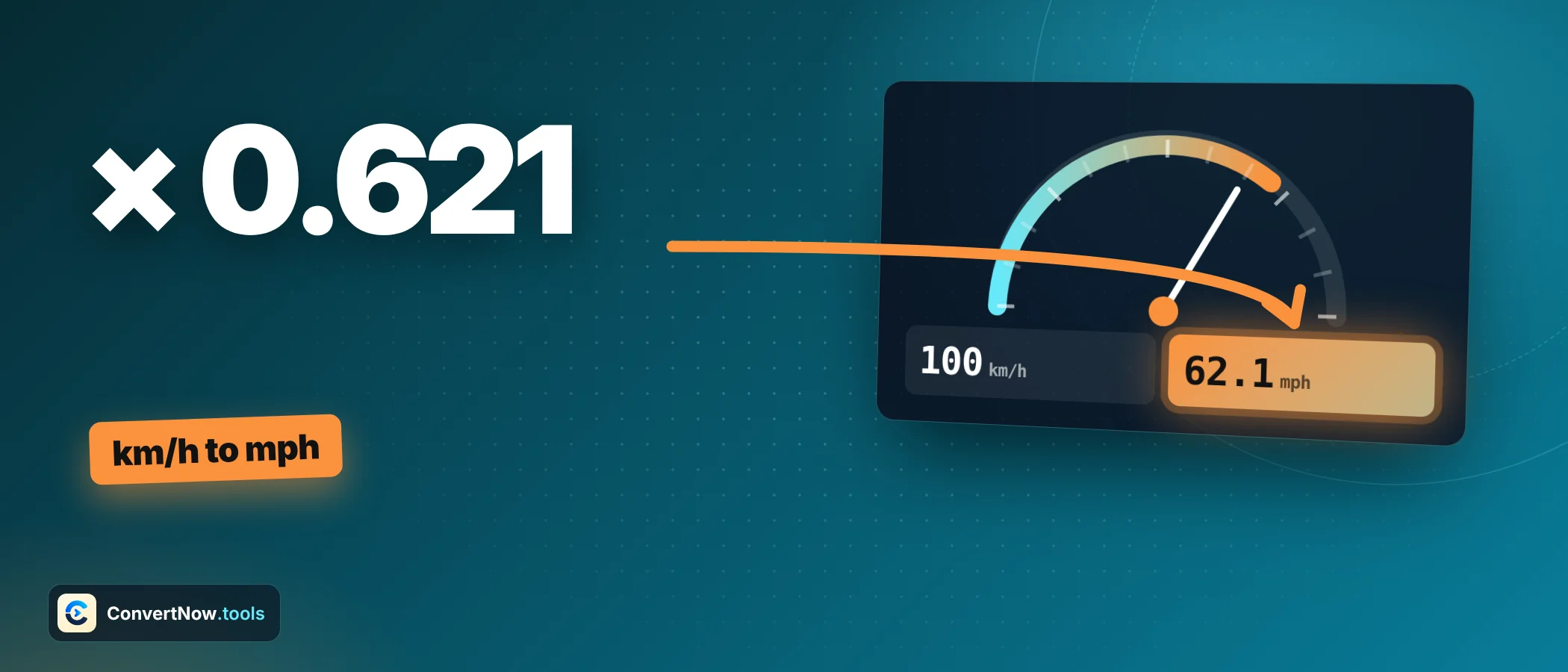
If you have ever stared at a foreign road sign and wondered how fast 100 really is, you needed km/h to mph. The answer is that 100 km/h equals 62.14 mph. This guide builds the idea from the ground up, so even the strange units, like knots and Mach, make sense by the end.
What speed actually is
Speed is distance covered divided by the time it took. Drive 120 kilometres in 2 hours and your average speed is 60 km/h. That is all the idea needs. Every speed unit is a distance unit over a time unit.
This also explains why there are so many of them. A country that measures roads in miles and time in hours gets miles per hour. One that uses kilometres gets kilometres per hour. Scientists prefer metres and seconds, and sailors have a unit of their own.
The units you will meet alongside
| Unit | Symbol | Equals in m/s | Where you see it |
|---|---|---|---|
| Metres per second | m/s | 1 | Science and engineering |
| Kilometres per hour | km/h | 0.277778 | Roads in most countries |
| Miles per hour | mph | 0.44704 | US and UK roads |
| Knot | kn | 0.514444 | Ships and aircraft |
| Feet per second | ft/s | 0.3048 | Ballistics, sport |
| Mach | Mach | about 343 | Fast aircraft |
| Speed of light | c | 299,792,458 | Physics |
The m/s column is the secret. If every unit knows its value in metres per second, any two units can be linked through that number. The Speed Converter works exactly this way, using one hub unit and two multiplications.
130 times 0.621371 is 80.78 mph. The 78 figure comes from the 60 percent shortcut, which runs low.
Mach 1 equals the local speed of sound, and that changes with temperature. 343 m/s applies to air at 20 degrees Celsius.
How km/h to mph works, step by step
Take a speed limit of 100 km/h. First turn it into metres per second: 100 divided by 3.6 gives 27.78 m/s. Then divide by the metres per second in one mph, which is 0.44704. The result is 62.14 mph.
- Start with km/h to mph inputExample: 100 km/h.
- Convert to m/sDivide by 3.6. That gives 27.78 m/s.
- Convert to mphDivide by 0.44704. That gives 62.14 mph.
- Shortcut for the same km/h to mph jobMultiply 100 by 0.621371 directly. Same answer, one step.
The shortcut factor is nothing more than 1 divided by 1.609344. A mile is exactly 1.609344 kilometres, fixed by international agreement, so the factor does not drift.
Twelve examples in both directions you can reuse
| km/h | mph | Typical meaning |
|---|---|---|
| 30 | 18.64 | School zone |
| 50 | 31.07 | Town speed limit |
| 80 | 49.71 | Rural road |
| 100 | 62.14 | Fast rural road |
| 120 | 74.56 | Motorway |
| 130 | 80.78 | Motorway limit in some countries |
| mph | km/h | Typical meaning |
|---|---|---|
| 20 | 32.19 | Residential street |
| 30 | 48.28 | Built up area |
| 40 | 64.37 | Single carriageway |
| 60 | 96.56 | Rural limit |
| 65 | 104.61 | Interstate in some states |
| 70 | 112.65 | Motorway limit |
Mental shortcuts
You will not always have a tool. Three tricks cover most cases, and each trades a little accuracy for speed.
| Shortcut | How | Answer for 100 km/h | Error |
|---|---|---|---|
| Take 60 percent | Multiply by 0.6 | 60 | 3.4% low |
| Five eighths | Divide by 8, times 5 | 62.5 | 0.6% high |
| Divide by 1.6 | Use a calculator or halve and adjust | 62.5 | 0.6% high |
Use five eighths. To find 80 km/h, divide by 8 to get 10, then times 5 to get 50. The true answer is 49.71, so you are within a third of a mph.
Why two systems still exist
The mile began as the Roman mille passus, a thousand paces. The kilometre arrived with the metric system, which France introduced in the 1790s. Most countries later moved their roads to kilometres. The United States and the United Kingdom kept miles on their signs, so a driver crossing from France to England, or from Canada to the US, meets the km/h to mph question at the border.
Cars solve part of this. Many speedometers show both scales, with the second one in smaller print. Rental cars from abroad often show only one, which is when a quick mental conversion saves a fine.
Speed in daily life
Numbers feel real when they match something you know. A brisk walk is about 1.4 m/s. A runner finishing a marathon in 3 hours 30 minutes averages 12.06 km/h. And 88 feet per second is exactly 60 mph, a handy fact for anyone who works with ft/s.
| Situation | m/s | km/h | mph |
|---|---|---|---|
| Brisk walk | 1.4 | 5.04 | 3.13 |
| Marathon in 3 h 30 min | 3.35 | 12.06 | 7.49 |
| Town traffic limit | 13.89 | 50 | 31.07 |
| Motorway | 33.33 | 120 | 74.56 |
| Ship at 20 knots | 10.29 | 37.04 | 23.02 |
Type any speed once and read it in all 14 units, from cm/s to the speed of light.
Open the Speed ConverterMistakes beginners make
- Multiplying when they should divide. Going from km/h to mph makes the number smaller. If your answer grew, flip the factor.
- Using 1.6 in both directions and calling it exact. The true value is 1.609344, and the gap grows at high speeds.
- Treating mph and knots as the same. One knot is 1.15 mph, so a 20 knot wind is 23 mph.
- Reading Mach as a fixed speed. It is a ratio, and the base speed of sound changes with temperature.
- Mixing speed with distance. A road of 100 km is not 100 km/h.
A quick reality test fixes the first mistake. A car at 100 km/h should be around 62 mph. If you see 160 on your screen, the factor was upside down.
Where knots and Mach come from
A knot is one nautical mile per hour. The nautical mile is exactly 1,852 metres, so a knot is 1.852 km/h or 1.1508 mph. The name comes from the old sailing method of tossing a log on a knotted line and counting the knots that ran out. The Wikipedia article on the knot gives the full history.
Mach is different. It compares an object to the local speed of sound, which changes with air temperature. At 20 degrees Celsius sound moves at about 343 m/s, so Mach 1 is 1,234.8 km/h or 767.3 mph. At the cruising height of airliners, around 11 kilometres, sound is slower at about 295 m/s. A jet at Mach 0.85 there flies at roughly 903 km/h.
| Mach | At 20 C sea level (343 m/s) | At 11 km altitude (295.07 m/s) |
|---|---|---|
| 0.5 | 617 km/h | 531 km/h |
| 0.85 | 1,050 km/h | 903 km/h |
| 1.0 | 1,235 km/h | 1,062 km/h |
| 2.0 | 2,470 km/h | 2,125 km/h |
The fastest thing there is
Light in a vacuum travels at exactly 299,792,458 m/s. That is 1,079,252,849 km/h. The number is exact because the metre itself has been defined from it since 1983. Nothing in the speed table beats it, and the table ends there.
- Speed
- Distance divided by time.
- Velocity
- Speed with a direction attached.
- m/s
- Metres per second, the SI unit of speed.
- Knot
- One nautical mile per hour, 1.852 km/h.
- Mach number
- A speed divided by the local speed of sound.
- Hub unit
- A single unit all others convert through, such as m/s.
Test what you learned
Keep going
Speed ties into other measures. The Length Converter handles the miles and kilometres underneath, and the Fuel Efficiency Converter uses the same mile to kilometre ratio for MPG. Every one of them builds on km/h to mph thinking.
Frequently asked questions about km/h to mph
How do I convert km/h to mph?
Multiply by 0.621371. For 90 km/h the answer is 55.9 mph.
How many km/h is 60 mph, the reverse of km/h to mph?
Sixty mph is 96.56 km/h. Multiply miles per hour by 1.609344.
What is 1 knot in km/h?
One knot is exactly 1.852 km/h, or about 1.15 mph.
What is the difference between speed and velocity?
Speed is how fast you move. Velocity adds the direction, so it can change even when the speed stays the same.
How do I convert m/s to km/h?
Multiply by 3.6. A speed of 10 m/s is 36 km/h.
Is Mach 1 always the same speed?
No. It follows the speed of sound, which falls as air gets colder. At sea level and 20 degrees Celsius it is about 1,235 km/h.
Sources: Wikipedia: Knot (unit)