

HP to kW Wrong? 7 Easy Fixes for Real Power Errors
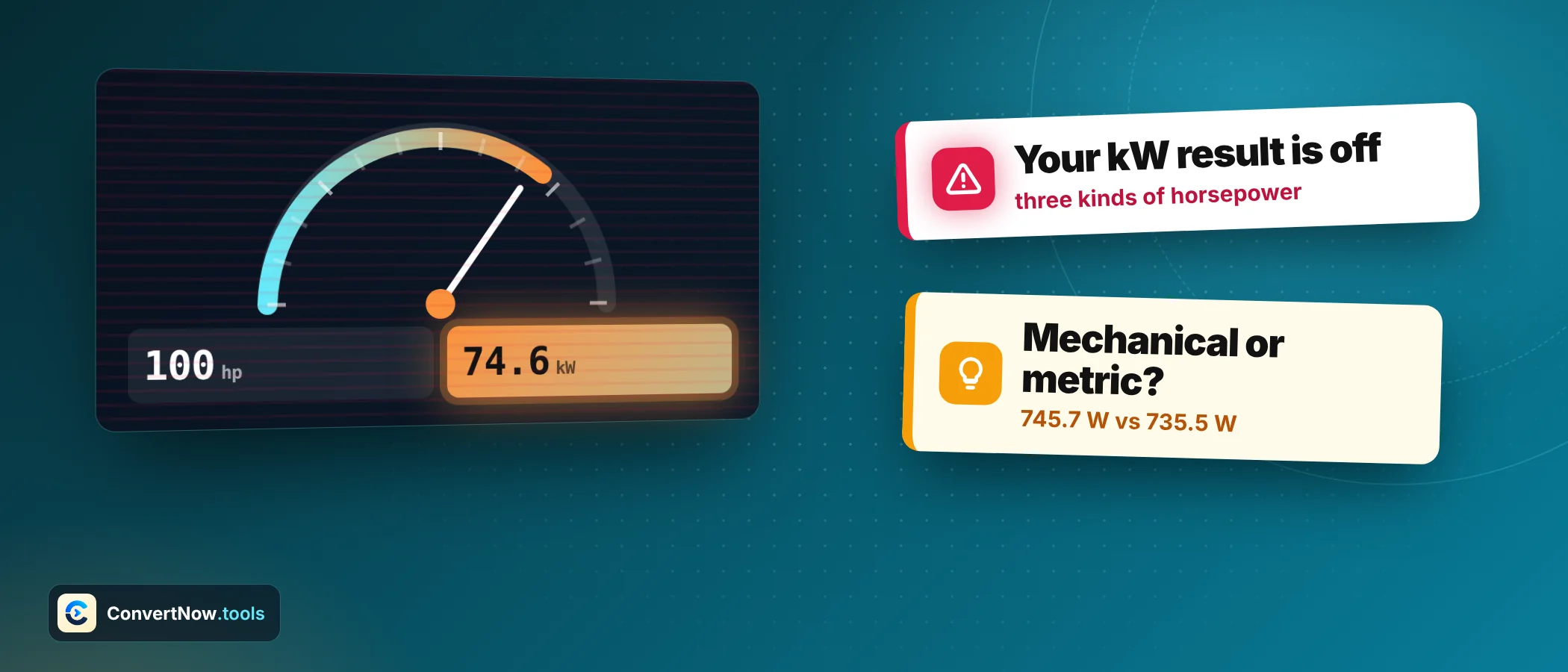
You converted hp to kw, compared the answer with a brochure, and the two numbers disagree. Before you blame the calculator, check this: the gap almost always comes from one of seven causes, and each one has a quick test. The most common is simply that there are three different horsepower units.
Use the symptom table below to find your case, then read the matching section. The Power Converter holds all three horsepower values separately, which makes each test easy to run.
What this guide covers
- Symptom table: why your hp to kw result looks wrong
- Cause 1: Three horsepower units, three answers
- Cause 2: Prefix and case slips
- Cause 3: Rated output versus power drawn
- Cause 4: Cooling tons are not weight
- Cause 5: Power mixed with energy
- Cause 6: Rounded rules of thumb
- Cause 7: Torque quoted instead of power
- A full diagnosis, start to finish
- Why three horsepower values exist at all
- A diagnostic checklist for hp to kw problems
Symptom table: why your hp to kw result looks wrong
| Symptom | Likely cause | Quick fix |
|---|---|---|
| Off by about 1.4 percent | Metric PS used instead of mechanical hp | Check for PS, CV or hp(M) on the source |
| Off by about 0.04 percent | Electrical hp (746 W) mixed with mechanical | Use 0.746 for motor ratings, 0.7457 for engines |
| Off by exactly 1,000 | kW and W confused | Move the decimal three places |
| Off by a factor of 1,000,000 | MW versus mW or W | Read the case of the letters |
| Wall power is higher than the rating | Rating is output, not input | Divide by motor efficiency |
| Cooling number is far too small | Ton of refrigeration read as mass | Use 3.517 kW per ton |
| kW answer turns into kWh | Power and energy mixed | Multiply kW by hours for kWh |
Cause 1: Three horsepower units, three answers
Mechanical horsepower comes from James Watt and equals 550 foot pounds per second, which is 745.69987 watts. Metric horsepower, written PS or CV, is 75 kilogram force metres per second, or 735.49875 watts. Electrical horsepower is defined as exactly 746 watts. The horsepower article on Wikipedia lists all three.
| Rating | Mechanical hp | Metric PS | Electrical hp |
|---|---|---|---|
| 10 | 7.457 kW | 7.355 kW | 7.460 kW |
| 100 | 74.570 kW | 73.550 kW | 74.600 kW |
| 150 | 111.855 kW | 110.325 kW | 111.900 kW |
| 200 | 149.140 kW | 147.100 kW | 149.200 kW |
| 300 | 223.710 kW | 220.650 kW | 223.800 kW |
A European sports car listed at 300 PS makes 220.65 kW. Convert that as if it were mechanical hp and you would claim 223.7 kW, which overstates the output by 3 kW. In mechanical hp the car is 295.9. The fix: find the letters printed after the number.
US engine ratings use mechanical hp. German and many Asian car listings use PS. US electric motor plates often use electrical hp. If the source never says, assume mechanical and note that you did.
Cause 2: Prefix and case slips
The letters carry the scale. A kilowatt is 1,000 W. A megawatt is 1,000,000 W. A milliwatt is 0.001 W, so 1 MW equals 1,000,000,000 mW. One wrong letter and your hp to kw answer moves by three, six or nine places.
Test: a household car engine must land between 20 and 500 kW. A result of 0.1 kW or 100,000 kW means a prefix error, not a physics surprise. Sanity checks like this catch most typing mistakes before they reach a report.
Cause 3: Rated output versus power drawn
A motor labelled 10 hp delivers 7.457 kW at the shaft. It draws more from the wall because no motor is perfect. At 90 percent efficiency the input is 7.457 divided by 0.90, which is 8.29 kW. At 92 percent it is 8.11 kW.
| Efficiency | Shaft output | Input from the wall | Cost per hour at 0.30 per kWh |
|---|---|---|---|
| 85% | 7.457 kW | 8.77 kW | 2.63 |
| 90% | 7.457 kW | 8.29 kW | 2.49 |
| 92% | 7.457 kW | 8.11 kW | 2.43 |
| 95% | 7.457 kW | 7.85 kW | 2.35 |
So when an electricity bill looks higher than your hp to kw maths predicts, the gap is not an error. It is the efficiency loss, and the correct conversion has one more step.
Cause 4: Cooling tons are not weight
A ton of refrigeration is a rate of heat removal. It equals 3.5169 kW, or 12,000 BTU per hour. A 3 ton air conditioner therefore removes 10.55 kW of heat. Someone who reads that ton as 1,000 kg will get a meaningless result.
| Power | Watts | BTU per hour | Tons of refrigeration |
|---|---|---|---|
| 1 kW | 1,000 | 3,412 | 0.284 |
| 3 kW | 3,000 | 10,236 | 0.853 |
| 7.034 kW | 7,034 | 24,000 | 2.0 |
| 10.55 kW | 10,551 | 36,000 | 3.0 |
150 times 735.49875 divided by 1,000 is 110.32 kW. The 111.9 figure would apply to electrical hp, which is a different unit.
Cause 5: Power mixed with energy
A watt is a rate. A watt hour is an amount. A 2 kW heater running for 3 hours uses 6 kWh. If you try to convert that 6 to horsepower, the answer has no meaning because the units describe different things.
Test: ask whether the number has a time period built into the unit. kWh does, so it is energy. kW does not, so it is power. For energy work, the Energy Converter is the right page.
Pick the exact horsepower type, enter your value, and see watts, kW, BTU per hour, tons and more in one table.
Open the Power ConverterCause 6: Rounded rules of thumb
Many people use 0.75 for hp to kw. It is quick, and it is wrong by 0.58 percent. On a 100 hp engine that rule gives 75 kW instead of 74.57 kW. Fine for a rough estimate, poor for a datasheet.
Use at least four digits: 0.7457 for mechanical hp. If your input already came from a rounded source, do not convert it twice. Convert once from the original figure.
Cause 7: Torque quoted instead of power
Engine sheets show peak power and peak torque together. Torque is in newton metres, not kilowatts, and the two peak at different engine speeds. If your converted number looks too big, check that you picked the power line. Torque conversions live on the Torque Converter page.
A full diagnosis, start to finish
Here is a realistic case. An importer reads 180 hp on a used German van and a US spec sheet that lists 134.2 kW. The importer converts 180 to kW by hand, gets 134.2, and moves on. Later the registration papers show 132.4 kW. Which number is right?
- Read the unit on the originalThe German papers say 180 PS, not 180 hp. That means the metric unit.
- Redo the conversion180 times 735.49875 divided by 1,000 gives 132.39 kW. The registration is correct.
- Find the original slip134.2 kW came from 180 times 0.7457, the mechanical factor. The 1.8 kW gap is the 1.4 percent difference between the two horsepower units.
- Fix the listingQuote both: 132.4 kW, which is 177.5 mechanical hp. Buyers can then compare it with US engines honestly.
That example shows why the hp to kw step cannot be done blind. The number alone is not enough. The unit label is half of the data, and it takes five seconds to read.
Why three horsepower values exist at all
Each unit grew from a local need. James Watt set the mechanical figure in the late 1700s when he sold steam engines by comparison with horses. Continental Europe built its own definition around the kilogram force and the metre, because that was the engineering system on the ground. Electrical horsepower arrived later as a clean round number so motor makers could convert in their heads.
The result is a small but real spread: 735.5 W, 745.7 W and 746 W. Standards bodies favour the watt for exactly this reason, and the BIPM defines it as one joule per second. A quoted kilowatt never changes with the country, which is why checking the kW column first is a good habit.
A diagnostic checklist for hp to kw problems
Hp to kw questions answered
How do I convert hp to kW?
Multiply mechanical horsepower by 0.7457. For example, 150 hp is 111.86 kW. For metric PS use 0.7355 instead.
How many kW is 1 hp?
One mechanical horsepower is 0.74570 kW. One metric horsepower is 0.73550 kW. One electrical horsepower is exactly 0.746 kW.
How do I convert kW to hp?
Divide kilowatts by 0.7457 for mechanical hp. So 100 kW is 134.1 hp, or 135.96 PS in metric terms.
Is PS the same as hp?
No. One PS is 735.49875 W and one mechanical hp is 745.69987 W. The mechanical unit is 1.4 percent larger.
How many BTU per hour is 1 kW?
One kilowatt equals about 3,412 BTU per hour. A 3 kW heater therefore gives out about 10,236 BTU per hour.
What is a ton of refrigeration in kW?
One ton of refrigeration is 3.517 kW, which equals 12,000 BTU per hour. It describes cooling capacity, not weight.
Sources: Wikipedia: Horsepower