Readability Scorer — Flesch-Kincaid, Gunning Fog & SMOG Index
Analyze your text with five readability formulas at once: Flesch-Kincaid, Gunning Fog, SMOG, ARI, and Coleman-Liau. Get a consensus reading grade level, word stats, and highlighted long sentences instantly.
Text Statistics
Flesch Reading Ease
0 = hardest 100 = easiest. Target 60-70 for general web content.
Flesch-Kincaid Grade
U.S. school grade level needed to understand this text.
Consensus reading level:
Most Frequent Words (excluding stopwords)
Text Preview — highlighted sentences are 25+ words long and may hurt readability
How this readability scorer computes five separate formulas from one syllable heuristic
Readability formulas all reduce to the same two ingredients: how long your sentences are and how long your words are, expressed as syllables. The formulas themselves are simple linear equations published decades ago. The genuinely hard part, the part no formula’s paper actually solves, is counting syllables in code without a dictionary. This tool uses a vowel group heuristic to estimate syllables, then feeds that estimate into five classic readability equations at once.
Every calculation happens in your browser as you type or click analyze. No text is transmitted anywhere.
The syllable heuristic
This is the piece that makes or breaks every score below it, so it is worth reading closely.
cat or the is unreliable at that length.
/(?:[^laeiouy]es|ed|[^laeiouy]e)$/ removes a trailing silent e, a trailing ed, or a trailing es that follows a consonant, since these endings usually do not add a spoken syllable in English.
y is stripped since it behaves as a consonant at the start of a word, not a vowel.
/[aeiouy]{1,2}/g counts runs of one or two vowel characters as a single syllable each. This is the vowel group heuristic: consecutive vowels like the ea in read collapse into one count, which approximates how English syllables actually cluster around vowel sounds.
This is a heuristic, not a lookup against a pronunciation dictionary like CMUdict. It gets common English words right and occasionally misses on irregular ones, silent letter clusters, or loanwords. That is the same tradeoff the original pen and paper formulas made: they were designed to be computed by a human with a ruler and a word list, so an approximation this close to the original spirit is appropriate.
Flesch Reading Ease and Flesch-Kincaid Grade Level
Rudolf Flesch published the Reading Ease formula in 1948 in his paper A New Readability Yardstick. The Flesch-Kincaid Grade Level variant was developed later, in 1975, for the United States Navy to grade technical manuals. Both use the same two inputs, average sentence length in words and average syllables per word, with different weights.
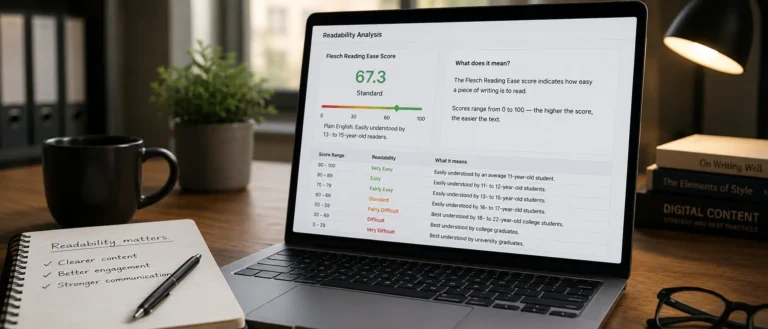
| Ease score | Reading level |
|---|---|
| 90 to 100 | Very easy, 5th grade |
| 70 to 89 | Easy to fairly easy, 6th to 7th grade |
| 60 to 69 | Standard, 8th to 9th grade |
| 30 to 59 | Fairly difficult to difficult, high school to college |
| 0 to 29 | Very confusing, graduate and professional level |
Three more formulas, computed alongside
Gunning Fog Index
Robert Gunning published this in 1952. It weighs complex words, defined here as any word with three or more estimated syllables, alongside sentence length: 0.4 * (asl + 100 * complexWords / words). It was built for business writing, so it leans harder on penalizing long, jargon heavy words.
SMOG Index
G. Harry McLaughlin’s 1969 formula, 1.0430 * sqrt(complexWords * (30 / sentences)) + 3.1291. It only activates with three or more sentences in this tool, since the square root scaling to a 30 sentence sample becomes unstable on very short passages.
Automated Readability Index
Developed for the US Air Force in 1967, and unlike the others it uses characters per word instead of syllables per word: 4.71 * (chars/words) + 0.5 * (words/sentences) - 21.43. Character counting sidesteps the syllable heuristic entirely for this one metric.
Coleman-Liau Index
Published in 1975 by Meri Coleman and T.L. Liau, also character based: 0.0588L - 0.296S - 15.8, where L is letters per 100 words and S is sentences per 100 words. It was designed to be easy to compute by a typewriter operator counting letters, no syllable estimation required.
The tool averages the five grade level outputs, Flesch-Kincaid Grade, Gunning Fog, SMOG, ARI and Coleman-Liau, into a single consensus grade level, rounded to one decimal, so no single formula’s blind spot dominates the headline number.
A worked readability score
Input: “The cat sat on the mat. It was a sunny day.” Result: Flesch Reading Ease around 116, capped and displayed at 100 since the formula can exceed its nominal range on very short simple sentences, labeled Very Easy, with a Flesch-Kincaid Grade Level near or below 0.
Reading time is estimated separately at Math.ceil(words / 238) minutes, where 238 words per minute reflects published averages for adult silent reading speed in English.
- Flesch-Kincaid readability tests covers the history and exact coefficients of both formulas.
- Gunning fog index for Robert Gunning’s original 1952 method.
- SMOG grading for McLaughlin’s 1969 paper and its 30 sentence sampling design.
- Automated Readability Index for the character based US Air Force formula.
- Coleman-Liau Index for the 1975 letters and sentences per 100 words method.
Who needs a readability score
Checking a blog draft against an 8th grade reading level target before publishing, scoring patient facing medical instructions where plain language rules apply, grading a legal disclaimer for a general audience, testing whether onboarding copy in an app is simple enough for new users, and comparing two versions of the same paragraph to see which one actually reads easier rather than just guessing.
FAQ: Readability Scorer
For general web content, aim for a Flesch Reading Ease score between 60 and 70, which corresponds to a grade level of 7 to 9. This is readable by most adults without feeling oversimplified. Marketing copy and landing pages often target 70 to 80. Academic or technical writing may sit below 50.
The Flesch-Kincaid test produces two scores. The Reading Ease score runs from 0 to 100 — higher means easier to read. The Grade Level score maps the text to a U.S. school grade, so a score of 8 means an 8th-grader could understand it. Both use average sentence length and average syllables per word as inputs.
The Gunning Fog Index estimates the years of formal education needed to understand a piece of writing on a first read. It weighs average sentence length and the percentage of complex words — those with three or more syllables. A score of 12 corresponds to a high school senior. Most popular publications target a Fog score below 12.
SMOG (Simple Measure of Gobbledygook) focuses entirely on polysyllabic words — those with three or more syllables — and ignores sentence length. It was designed for health communication and tends to produce slightly higher grade estimates than Flesch-Kincaid. It is considered more accurate for texts above a 6th-grade level.
The two fastest wins are shorter sentences and simpler words. Break any sentence over 20 words in two. Replace multi-syllable words with shorter synonyms where meaning is not lost. Use active voice. Avoid jargon unless your audience demands it. After editing, paste your text back into this readability scorer to measure the improvement.
Yes. The readability scorer is completely free with no word limits and no account required. All calculations run in your browser so your content stays private.
From the blog
Writing about writing tools
Readability scoring, keyword density and the rest, examined properly.