About This Tool
How this word counter measures ten metrics from the same block of text
A word counter looks like a single number, but this tool is running roughly ten independent measurements on every keystroke: words, characters with and without spaces, sentences, paragraphs, lines, syllables, unique words, reading time, speaking time, and a Flesch reading ease score. Each one uses a slightly different regex or counting rule, and knowing those rules explains why Mr. Smith arrived. can confuse a naive sentence counter.
All counting happens locally in your browser on every input event. Nothing about your draft is ever transmitted.
The counting rules, one by one
Words
A word is any run of text between spaces that holds at least one letter or digit, so stray symbols like & or ... are not counted. Hyphenated terms like well-known, contractions like don't and numbers like 3.14 count as one word. An em dash or en dash with no spaces around it still separates two words. Chinese and Japanese characters count as one word each, the same convention Microsoft Word uses, and Thai, Lao, Khmer and Myanmar text is split with your browser's built in word segmenter.
Characters
Characters are counted the way you see them, so an emoji with a skin tone, a flag or an accented letter counts as one character instead of the two to eleven code units JavaScript stores. A second count leaves out every space, tab and line break, which is the number many character limit fields enforce.
Sentences and paragraphs
A sentence ends at a period, question mark, exclamation mark or ellipsis followed by a space or the end of the text. Runs like ?! count once. Titles and abbreviations such as Mr., Dr. and e.g., single initials, and decimals like 3.14 do not end a sentence. A heading or list item on its own line counts as its own sentence. Paragraphs are blocks of text separated by a blank line.
Unique words
Each word is trimmed of surrounding punctuation and lowercased before it is compared, so Word, and word count as the same unique word. Accented and non Latin letters are kept, so café and cafe stay different words.
// reading and speaking time, as the tool computes them
function fmtTime(words, wpm){
var secs = Math.max(1, Math.round(words / wpm * 60));
if (secs < 60) return secs + ' sec';
var m = Math.floor(secs / 60), s = secs % 60;
return s ? m + ' min ' + s + ' sec' : m + ' min';
}
// default reading speed 200 wpm, adjustable; speaking fixed at 130 wpm
The reading speed defaults to 200 words per minute but is a configurable field, since reading speed varies by content type and audience. Speaking time is fixed at 130 words per minute, a figure that lines up with typical conversational and presentation speaking pace, useful for estimating how long a script will take to read aloud.
Syllables and the Flesch score, shared logic with the readability scorer
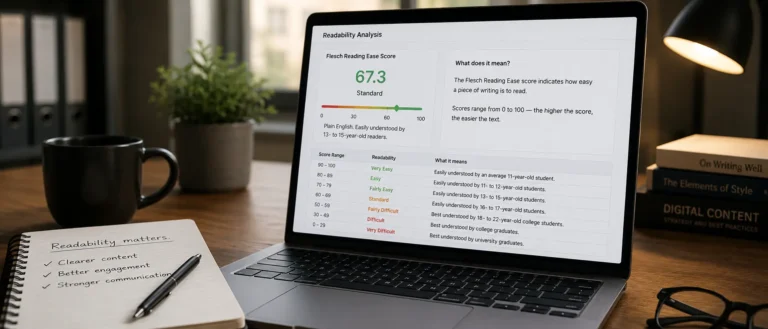
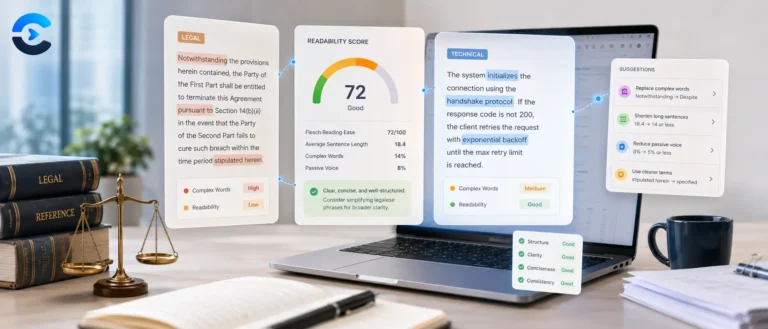
This tool uses the same syllable counter as our readability scorer. It counts vowel groups, then corrects them with rules for silent endings, common prefixes and suffixes such as -ly, -ment and -ology, and a list of irregular words like people and recipe. Checked against the CMU Pronouncing Dictionary on real web copy it agrees on about 99 percent of words. Total syllables then feed into the 1948 Flesch Reading Ease equation, 206.835 - 1.015 * (words/sentences) - 84.6 * (syllables/words), giving a live ease score and a plain language level label as you type. Very simple text can score above 100 and very dense text below 0; the tool shows the real value. The score is only shown for English text.
| Metric | Rule used |
|---|
| Longest word | Tracked by comparing cleaned word length while iterating the word array once |
| Average word length | Total letters across all cleaned words divided by word count, one decimal |
| Average sentence length | Word count divided by sentence count, to one decimal |
| Top keywords | Words of three or more letters, excluding a list of about 120 common English stopwords, ranked by frequency, top eight shown with percent of total words |
Every number comes from the same word list. Words, unique words, syllables, top keywords and the Flesch score all use one tokenizer, so hello-world is one word everywhere and quotes, brackets or ellipses around a word never change the result.
Extra tools built into the panel
Word or character limit bar
Set a target limit and unit, the tool renders a live progress bar that turns orange from 85 percent and red once you go over, and it tells you how many words or characters you are over. You can count characters with or without spaces, useful for meta descriptions, social posts, or any hard character cap.
Find and count
A separate search field counts every case-insensitive match of your query in the full text, and also tells you how many of those are whole words, so cat in category is easy to tell apart.
Words, characters, sentences, paragraphs
Syllables and unique words
Reading time at configurable wpm
Flesch Reading Ease
Limits people write to
Trimming an essay down to a professor's word limit, keeping a meta description under its character cap, timing how long a video script or speech will actually take to deliver, checking a cover letter reads at an approachable difficulty level before sending it, and scanning a draft's own keyword density before you paste it somewhere search engines will index. The find and count field alone is useful for confirming how many times a name or term appears without scrolling through a long document manually.