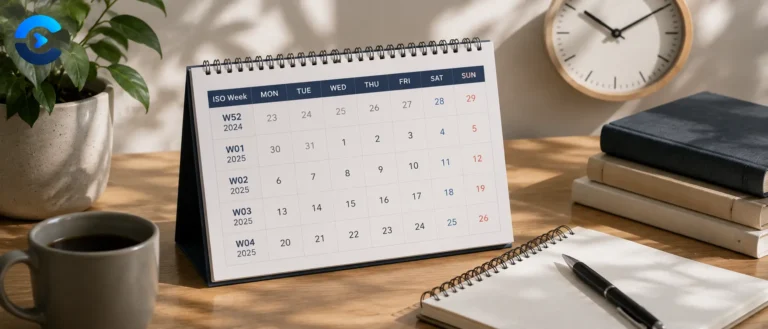
Week Number Calculator Find ISO & Custom Week Numbers Free
Find the ISO 8601 week number, US week number, or any custom week for any date. Set your own week start day or fiscal year start month and get the full week date range instantly.
Week numbers, and the Thursday rule that decides them
Ask a German logistics planner and a US retail analyst what week it is and you will often get different numbers. They are both correct within their own system. Week numbering is not one standard, it is at least three, and they disagree by up to a week at the start of every year.
This calculator handles all three: ISO 8601, the US Sunday start convention, and a fully custom scheme where you choose the start day and the fiscal year opening month.
The ISO 8601 rule, stated plainly
Week 1 is the week containing the first Thursday of January. Equivalently, it is the week containing 4 January, and equivalently again, it is the first week with the majority of its days in the new year. All three phrasings give the same answer. Weeks always run Monday to Sunday.
Look at 1 January 2027. It falls on a Friday, so its week’s Thursday sits back on 31 December 2026. That makes the whole week part of 2026, numbered week 53. ISO week 1 of 2027 does not begin until Monday 4 January. This is why the tool reports a week year separately from the calendar year. They are not always the same.
The three schemes side by side
- Weeks run Monday to Sunday
- Week 1 contains the first Thursday
- Always 52 or 53 weeks, never a partial week
- Days at the year boundary can belong to the neighbouring year
- Standard across Europe, and in most software libraries
- Weeks run Sunday to Saturday
- Week 1 always contains 1 January
- Can produce a partial week 1 of a single day
- Some years show 54 numbered weeks
- Common in North American payroll and retail reporting
- You pick the start day of the week
- You pick the month the fiscal year opens
- Week 1 begins on the first chosen weekday on or before the fiscal start
- Matches 4-4-5 retail calendars and public sector fiscal years
- Useful when your finance system does not use January
How ISO week numbers are computed
The classic implementation shifts the date to the Thursday of its own week, then counts weeks from the start of that Thursday’s year. Doing the shift first is what makes the year boundary resolve itself with no special cases.
Working in UTC matters. Build these dates in local time and a daylight saving transition inside the range can shift a division by one, producing an off by one week number a couple of times a year in affected zones.
ISO week date notation
ISO 8601 defines a complete date format built on weeks rather than months, which the tool outputs alongside the number.
This notation is genuinely useful in manufacturing and logistics, where a delivery slot is a week rather than a day. It also sorts correctly as plain text, which the month based format does not always manage across year boundaries.
Everything else the tool reports
| Field | Definition |
|---|---|
| Week range | The start and end dates of the week under the scheme you selected |
| Week year | The year the week belongs to under ISO rules, which can differ from the calendar year in late December and early January |
| Day of year | Ordinal position from 1 to 365, or 366 in a leap year. Also called the Julian day in aviation and manufacturing, though that is a misuse of the astronomical term. |
| Days left in year | Total days in the year minus the ordinal day |
| Quarter | Calendar quarter, month index divided by three plus one |
| Week progress | Position within the week as a percentage, relative to your chosen start day |
| Year progress | Ordinal day divided by days in year |
Getting week numbers in other tools
| Environment | ISO week |
|---|---|
| Excel | =ISOWEEKNUM(A1). The older WEEKNUM defaults to the US scheme, so use the ISO function unless you specifically want US numbering. |
| Google Sheets | =ISOWEEKNUM(A1), same behaviour as Excel |
| PostgreSQL | EXTRACT(WEEK FROM d) is ISO. Pair it with EXTRACT(ISOYEAR FROM d) or your year boundaries will be wrong. |
| Python | d.isocalendar() returns year, week and weekday as a tuple |
| Shell | date +%V for ISO week, %G for ISO year, %U for the US week |
| Java | WeekFields.ISO.weekOfWeekBasedYear() |
Standards and references
- ISO 8601 defines both the week rule and the week date notation.
- ISO week date covers the 53 week years, the 400 year cycle and the full arithmetic.
- Excel ISOWEEKNUM for the spreadsheet equivalent and its return behaviour.
- Python isocalendar returns a named tuple since 3.9.
- 4-4-5 calendar explains the retail fiscal calendars the custom mode is designed to match.
- Luxon weekNumber and date-fns getISOWeek for JavaScript implementations.
Where week numbers get used
Manufacturing schedules and shift rosters, delivery and lead time quotes across European supply chains, sprint planning, payroll periods, retail sales reporting against a 4-4-5 calendar, academic term structures, and any dashboard that trends performance week over week. If you have ever received a quote promising delivery in KW34, that is Kalenderwoche, the German term for ISO week 34.
Questions About the Week Number Calculator
ISO week numbers are defined by the ISO 8601 international standard. Weeks run Monday to Sunday, and Week 1 is the week that contains the year’s first Thursday. Because of this, a year can have 52 or 53 weeks, and Week 1 may start in late December of the prior calendar year. ISO week numbers are used in most of Europe, in logistics, and in most ERP and calendar systems.
The US system starts weeks on Sunday and always treats January 1 as belonging to Week 1, regardless of what day it falls on. This can make Week 1 as short as one day. The ISO and US systems can differ by up to two week numbers at the start and end of the year. Check both outputs in the calculator to compare them side by side.
Click the Today button at the top of the calculator. It instantly shows today’s week number in ISO 8601, US, or your custom format, along with the full date range for the current week, the day of year, and both week and year progress bars.
Yes, under ISO 8601. A year has 53 ISO weeks when January 1 falls on a Thursday, or when it is a leap year and January 1 falls on a Wednesday or Thursday. This happens roughly every 5 to 6 years. 2015, 2020, and 2026 are recent examples of 53 week years.
A fiscal week counts weeks within a financial year that does not start on January 1. UK companies often start in April, US federal agencies in October, and retail companies may use a 4 to 5 to 4 calendar starting in February. Switch to Custom mode and set the fiscal year start month to match your organization’s calendar year.
The ISO 8601 week date format is YYYY-Www-D. For example, 2024-W24 to 3 means the year 2024, week 24, Wednesday (day 3, with Monday as day 1). The calculator shows this formatted value in the results, and you can copy it with one click.
Under ISO 8601, if January 1 falls on a Friday, Saturday, or Sunday, that week does not contain a Thursday in the new year, so it belongs to the last week of the previous year. Week 1 of the new year then starts on the following Monday, which falls in December of the prior year.
No. All calculations run entirely in your browser using JavaScript. No date you enter is sent to any server or stored anywhere. You can use this tool without an internet connection after the page initially loads.
From the blog
Date and time, explained properly
Longer write ups on the calendar problems these tools solve, from ISO week numbering to scheduling across time zones.