

Time Zone Converter Wrong? 9 Fast Fixes That Really Work
When a time zone converter gives an answer that looks one hour wrong, the converter is usually not the culprit. Nine well known causes explain nearly every bad result, and each has a quick check. This guide lists the symptoms, the cause behind each and the fix.
Work through the symptoms table, then use the checklist near the end before you send an invite.
Nine time zone converter symptoms and their fixes
| # | Symptom | Likely cause | Fix |
|---|---|---|---|
| 1 | Result is one hour off, only some weeks of the year | The two regions change clocks on different dates | Convert for the exact date, not a rule of thumb |
| 2 | Result is off by 30 or 45 minutes | Zone with a fractional offset, for example India or Nepal | Use a named zone and show minutes |
| 3 | Same abbreviation gives different answers | Abbreviations collide, for example CST or IST | Pick a city based zone such as Asia/Kolkata |
| 4 | A meeting time does not exist | Spring forward skipped the hour | Move the meeting out of the skipped hour |
| 5 | A time appears twice | Fall back repeated the hour | Add the offset or use UTC for the instant |
| 6 | A weekly meeting moves by an hour | Stored as a UTC time instead of local time and zone | Store local time plus the zone name |
| 7 | Day of the month is wrong | The result crossed midnight | Read the date, not only the time |
| 8 | Everything is off for one user | Device or browser zone setting is wrong | Check the system zone and reload |
| 9 | A country result is suddenly wrong | The rule changed and the data is old | Update the tz database or the app |
Pick two cities and a date and this time zone converter reads the real offset from your browser, which carries the IANA database. Nothing you enter is sent to a server.
Open the Time Zone ConverterFix 1: A moving gap between two cities
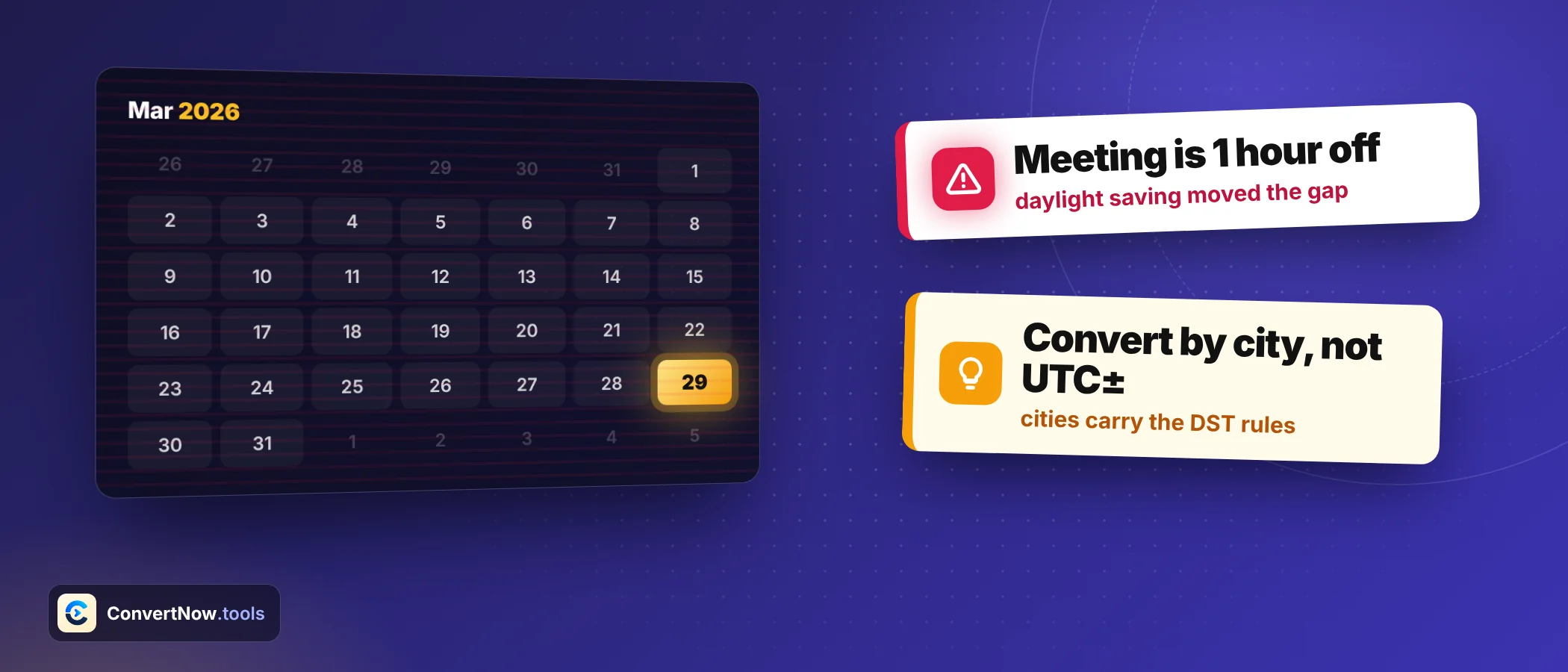
This is the most common reason a time zone converter seems wrong. New York and London are usually five hours apart. For a few weeks every spring and autumn they are four, because the United States and Europe move their clocks on different dates.
| Event | Date | Weekday |
|---|---|---|
| US clocks go forward | 8 March | Sunday |
| Europe clocks go forward | 29 March | Sunday |
| Europe clocks go back | 25 October | Sunday |
| US clocks go back | 1 November | Sunday |
So in 2026 the gap is four hours from 8 March to 28 March, which is 21 days, and again from 25 October to 31 October, which is 7 days. Here is one 9:00 meeting in New York, converted on three dates.
| Date | London | Berlin | Kolkata | Tokyo |
|---|---|---|---|---|
| 2 March (before any change) | 14:00 | 15:00 | 19:30 | 23:00 |
| 10 March (US changed, Europe not yet) | 13:00 | 14:00 | 18:30 | 22:00 |
| 30 March (both changed) | 14:00 | 15:00 | 18:30 | 22:00 |
Look at Kolkata. India keeps one offset all year, so its gap moves with New York, while London and Berlin stay put. A time zone converter that stores one fixed offset per city would be wrong in two of the three rows.
Here is a planning rule that follows from the table. When you invite people from three regions, run the time zone converter for the exact date and never copy a slot from last month. Pick the date, convert once for every guest, and read each local time aloud. A 9:00 start in New York lands at 15:00 in Berlin on 2 March, yet at 14:00 in Berlin on 10 March, simply because the United States moved its clocks first.
The same logic helps with deadlines. A form that closes at 17:00 in New York on 6 March 2026 closes at 07:00 on 7 March in Tokyo. The same 17:00 close on 9 March, after the US change, is 06:00 on 10 March in Tokyo. A good time zone converter helps here too. State the zone name in the invite, and let each guest see their own local time.
Fix 2: Fractional offsets
Not every zone sits on a whole hour. If your result is 30 or 45 minutes away from what you expected, one of these zones is probably in the pair. Any decent time zone converter handles them, but a hand calculation often does not.
| Zone | Offset | Region |
|---|---|---|
| Asia/Kolkata | UTC+5:30 | India, one zone for the whole country |
| Asia/Kathmandu | UTC+5:45 | Nepal |
| Asia/Tehran | UTC+3:30 | Iran, which stopped using daylight saving in 2022 |
| Asia/Kabul | UTC+4:30 | Afghanistan |
| Australia/Adelaide | UTC+9:30 | South Australia, one hour more in summer |
| Pacific/Chatham | UTC+12:45 | Chatham Islands |
Fix 3: Abbreviations cause confusion
CST can mean Central Standard Time in North America, China Standard Time or Cuba Standard Time. IST can mean India, Ireland or Israel. About 400 abbreviations are in use, and many clash. Before you type an abbreviation into a time zone converter, ask which country it refers to.
| Abbreviation | Meaning | Offset |
|---|---|---|
| CST | Central Standard Time, North America | UTC-6 |
| CST | China Standard Time | UTC+8 |
| CST | Cuba Standard Time | UTC-5 |
| IST | India Standard Time | UTC+5:30 |
| IST | Israel Standard Time | UTC+2 |
A name such as Europe/London encodes the full history and the future rules of that region. An abbreviation or a fixed offset only describes one moment.
Fixes 4 and 5: The hour that vanishes and the hour that repeats
Twice a year the clock itself breaks the rule that every time zone converter assumes, that every wall time happens once. When clocks spring forward, one hour is skipped. When they fall back, one hour happens twice.
Spring forward
- Clocks jump from 01:59 to 03:00
- 02:30 does not exist that day
- Most systems roll a 02:30 meeting to 03:30
Fall back
- Clocks go from 01:59 back to 01:00
- 01:30 happens twice
- Two different instants share one wall time
The practical fix when a time zone converter flags such a time is to avoid scheduling inside that window, or to record the instant in UTC alongside the local time so there is no doubt which one you meant.
Fix 6: A recurring meeting drifts by an hour
Say a London standup runs at 09:00. If a tool saves it as 09:00 UTC, it is correct in winter, since London matches UTC then. After the clocks go forward in March, 09:00 UTC reads 10:00 in London. The meeting seems to move, although the stored value never changed. A time zone converter shows this drift if you test a date after the change.
Safe rule for recurring events
store: local_time = 09:00
store: zone = Europe/London
compute the UTC instant for each date when you display it
unsafe: store utc_time = 09:00 once and repeat itFixes 7 to 9: Day changes, device settings and stale data
Time zones also decide the calendar day. Noon on Tuesday in Kiritimati, which sits at UTC+14, is 11:00 on Monday in Niue at UTC-11. That is a 25 hour gap, the widest on Earth, and it explains many wrong day results. Always read the date next to the time.
If one person sees a wrong time and everyone else does not, check their device setting. A laptop left on a home zone while travelling shifts every conversion made in the browser. Finally, rules change. Countries add, drop or move daylight saving, and the tz database is updated by hand several times a year. An old operating system can hold old rules, so test a second time zone converter if results disagree.
Diagnostic checklist for a wrong result
Where to try it next
For a quick view of many cities at once, try the World Clock. If your input is a raw timestamp, the Unix Timestamp Converter turns it into a readable date first.
New York is on UTC minus 4 and London is still on UTC plus 0, so the gap is 4 hours. After Europe moves on 29 March it returns to 5 hours.
Questions about using a time zone converter
Why does my time zone converter show the wrong hour?
The most common reason is daylight saving. The gap between two regions changes when they switch clocks on different dates, so always convert for the exact date.
What is the difference between EST and America/New_York?
EST is a fixed winter offset of UTC minus 5. America/New_York is a named zone that switches between EST and EDT as the rules require.
Why are some zones 30 or 45 minutes off?
Several regions chose offsets that are not whole hours, such as India at 5 hours 30 minutes and Nepal at 5 hours 45 minutes.
How should I store times in software behind a time zone converter?
Store instants in UTC and the zone name for anything a person scheduled by wall clock. Convert to local time only when you display it.
Does every country use daylight saving?
No. Many places use none, and some have stopped, which a time zone converter must know. Rules change, so rely on a current tz database.
Why does a recurring meeting move by one hour?
It was likely saved as a UTC time. Save the local time and the zone name instead, so the meeting follows the clock.
Sources: IANA: Time Zone Database