

Japanese Date Converter: 3 Methods Compared, Best Pick
Choosing a Japanese date converter comes down to one question: can you tolerate being wrong on a handful of days? Adding 2018 to a Reiwa year works for most dates. It fails on the days when an era changes hands, and those are the days that tend to sit on birth certificates, leases and filings.
Below are the three Japanese date converter approaches people use, the exact days where they split, and a decision table for picking one.
Questions about the Japanese date converter and era dates
What year is Reiwa 5?
Reiwa 5 is 2023. Add 2018 to the Reiwa year to get the Western year.
Is Reiwa 1 the same as Reiwa gannen?
Yes. The first year of an era is written 元年, read gannen, and it means year one.
When did Heisei end?
Heisei ended on 30 April 2019, and Reiwa began on 1 May 2019.
Why is 1989 both Showa 64 and Heisei 1?
The Showa era ended on 7 January 1989 and Heisei began on 8 January 1989. The first seven days belong to Showa and the remaining 358 to Heisei.
Can I trust the add 2018 rule instead of a Japanese date converter?
It is right for the year in most cases, but it cannot name the era on the four overlap years. Use full dates when it matters.
What does R5.12.15 mean in a Japanese date converter?
It is the short code for Reiwa 5, December 15, which is 15 December 2023.
The five modern eras every Japanese date converter must know
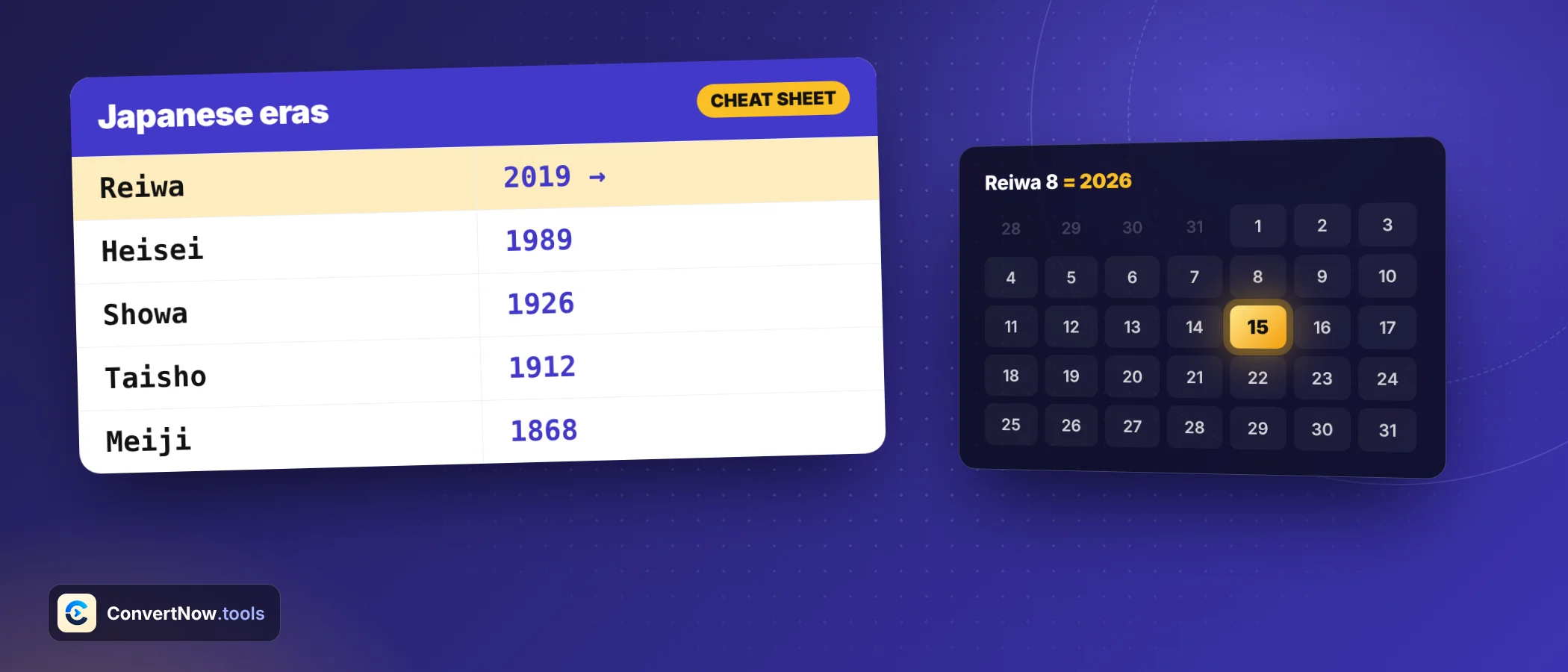
Japan counts years from the start of an emperor reign. Every era restarts at year one, and the first year is written 元年, read gannen. Eras do not begin on 1 January. They begin on the day of accession, so one Western year can carry two era names.
| Era | Romaji | Code | First day | Last day |
|---|---|---|---|---|
| 明治 | Meiji | M | 1868-10-23 | 1912-07-29 |
| 大正 | Taisho | T | 1912-07-30 | 1926-12-24 |
| 昭和 | Showa | S | 1926-12-25 | 1989-01-07 |
| 平成 | Heisei | H | 1989-01-08 | 2019-04-30 |
| 令和 | Reiwa | R | 2019-05-01 | Ongoing |
The overlap years are well documented. The year 1912 is both Meiji 45 and Taisho 1. The Heisei start is cleaner, since 昭和64年1月7日 and 平成元年1月8日 are consecutive days with no shared date. Sources differ by a day on the Meiji and Taisho handover, since the changeover happened around midnight, so the table lists the last full day under the older era.
Method 1: add an offset to the year
This is the cheat sheet most pages give. Take the era year and add a fixed number to reach the Western year. It is fast and you can do it in your head.
| Era | Add this | Example | Result |
|---|---|---|---|
| Reiwa | 2018 | 令和5年 | 2023 |
| Heisei | 1988 | 平成31年 | 2019 |
| Showa | 1925 | 昭和64年 | 1989 |
| Taisho | 1911 | 大正15年 | 1926 |
| Meiji | 1867 | 明治45年 | 1912 |
The method is correct as long as you only want the year. It stops being correct when the year alone does not tell you the era, which happens in four Western years.
| Year | Earlier era | Days | Later era | Days |
|---|---|---|---|---|
| 1912 | Meiji 45 | 211 | Taisho 1 | 155 |
| 1926 | Taisho 15 | 358 | Showa 1 | 7 |
| 1989 | Showa 64 | 7 | Heisei 1 | 358 |
| 2019 | Heisei 31 | 120 | Reiwa 1 | 245 |
Take 2019. A person born on 30 April 2019 was born in Heisei 31, and a person born on 1 May 2019 was born in Reiwa 1. The offset method sees only 2019 and cannot say which. For an estimate that is fine. For a form it is a mistake.
Method 2: a lookup table
A step up from the offset is a table that lists each era with its start year. You look up the Western year, find the era, and subtract. It tells you the era name, which the offset does not.
The weakness is the same. A start year is a year, not a day. A table with 1989 for Heisei says nothing about the first seven days of January 1989, when the era was still Showa 64. If you use a table, make sure it lists full start dates, not just years.
Method 3: era boundaries built in
The third method stores each era as a start date and an end date. Given a full year, month and day, it picks the era whose range contains that date and subtracts the era start year. There is no special case for the overlap days, because the dates settle them.
Boundary aware converter
- Picks the era from year, month and day
- Returns 元年 for the first year
- Flags a date such as 昭和64年3月1日 that never existed
- Handles batches and both directions
Offset shortcut
- Needs only the year
- Cannot name the era on overlap years
- Accepts impossible dates without complaint
- Fine for a quick mental estimate
The extra cost of a Japanese date converter is small. The converter still takes one pasted date. It also reports its assumptions, such as filling in a missing day as the 1st, so you can see how the answer was produced.
Reiwa began on 1 May 2019, and the first year of an era is written 元年. The offset method gives 2019 minus 2018, which is 1, but it cannot tell you that April 30 would have been Heisei 31.
Decision table: which method fits your job
| Your job | Month and day matter? | Best method | Reason |
|---|---|---|---|
| Rough age or year of a building | No | Offset | Year is enough |
| Birth date on a form or certificate | Yes | Boundary converter | Born near an era change |
| Contract start or lease date | Yes | Boundary converter | Legal documents cite exact dates |
| Spreadsheet of mixed dates | Yes | Boundary converter with batch mode | Each row can be in either direction |
| Reading a driving licence code such as R5.12.15 | Yes | Boundary converter | Short codes need parsing |
| Documents before 1873 | Approximate | Specialist almanac | Lunisolar calendar, not a formula |
Worked check: five dates converted
| Western date | Weekday | Japanese date | Note |
|---|---|---|---|
1989-01-07 | Saturday | 昭和64年1月7日 | Last day of Showa |
1989-01-08 | Sunday | 平成元年1月8日 | First day of Heisei |
2019-04-30 | Tuesday | 平成31年4月30日 | Last day of Heisei |
2019-05-01 | Wednesday | 令和元年5月1日 | First day of Reiwa |
2023-12-15 | Friday | 令和5年12月15日 | Ordinary Reiwa date |
How the boundary check runs, step by step
Seeing the logic once makes the table above easy to trust. Here is the path a boundary aware Japanese date converter takes when you give it 1989-01-08 and ask for the era.
- Read the full dateYear 1989, month 1, day 8. The tool keeps all three parts, because the year alone is not enough.
- Find the era whose range holds the dateThe Showa range ends on 7 January 1989. The Heisei range starts on 8 January 1989. The date falls in Heisei.
- Subtract the era start yearHeisei starts in 1989, so the era year is 1989 minus 1989 plus 1, which is 1.
- Write year one as gannenThe result is 平成元年1月8日, not 平成1年1月8日.
- Check the reverse directionFeed 平成元年1月8日 back in and you should land on
1989-01-08again. A round trip that does not match is a sign of a typo.
The same steps cover any date. For 15 December 2023 the Reiwa range holds the date, the era year is 2023 minus 2019 plus 1, which is 5, and the answer is 令和5年12月15日.
Input shapes a good converter should read
Real documents rarely arrive in one clean style. A copy from a PDF may use full width digits. A bank export may use letter codes. A form may use kanji numerals.
| Style | Example | Where you see it |
|---|---|---|
| Full era name | 令和5年12月15日 | Official documents |
| Short code | R5.12.15 | Licences, bank records, legacy exports |
| Romanised | Reiwa 5/12/15 | Translations and visa paperwork |
| Western | 2023-12-15 | Systems and databases |
A good Japanese date converter reads all of these, folds full width digits to ASCII first, and decodes kanji numerals. It accepts 元年 and writes 元年 on output wherever the era year is 1. If a Western slash date such as 5/6/2023 is ambiguous, it picks a default, tells you which reading it used and gives a toggle to flip it.
Japan moved from its older lunisolar calendar to the Gregorian one on 1 January 1873. Dates before that point do not line up with Western months, so treat any conversion before 1873 as approximate.
Pick a method by role
You hold a scanned certificate with 平成元年. You need the exact Western date for the target language, so you want the month and day resolved, not only the year.
Use a boundary converter and keep the output line that shows the long Western form.
Staff records mix eras and codes. A birth date near 1 May 2019 or 8 January 1989 can land in the wrong reign if you add an offset.
Use batch mode to convert a column and read the notes for flagged rows.
Store ISO dates in your database and convert only for display. Keep the era as data with start dates, never as a bare year offset.
Test your code with the four overlap years in the table above.
Before 1873 you need a lunisolar almanac. A converter can mark the date as approximate, but it cannot replace a specialist source.
If your date arrives as a plain Western string in a regional style, run it through the Date Format Converter first. To turn a converted date into a count of days, use the Date Difference Calculator.
Open the Japanese date converter and paste any Japanese era date or Western date and get both directions, plus kanji numerals, ISO and weekday. Nothing leaves your browser.
Open the Japanese Date ConverterSources: Wikipedia: Japanese era name