
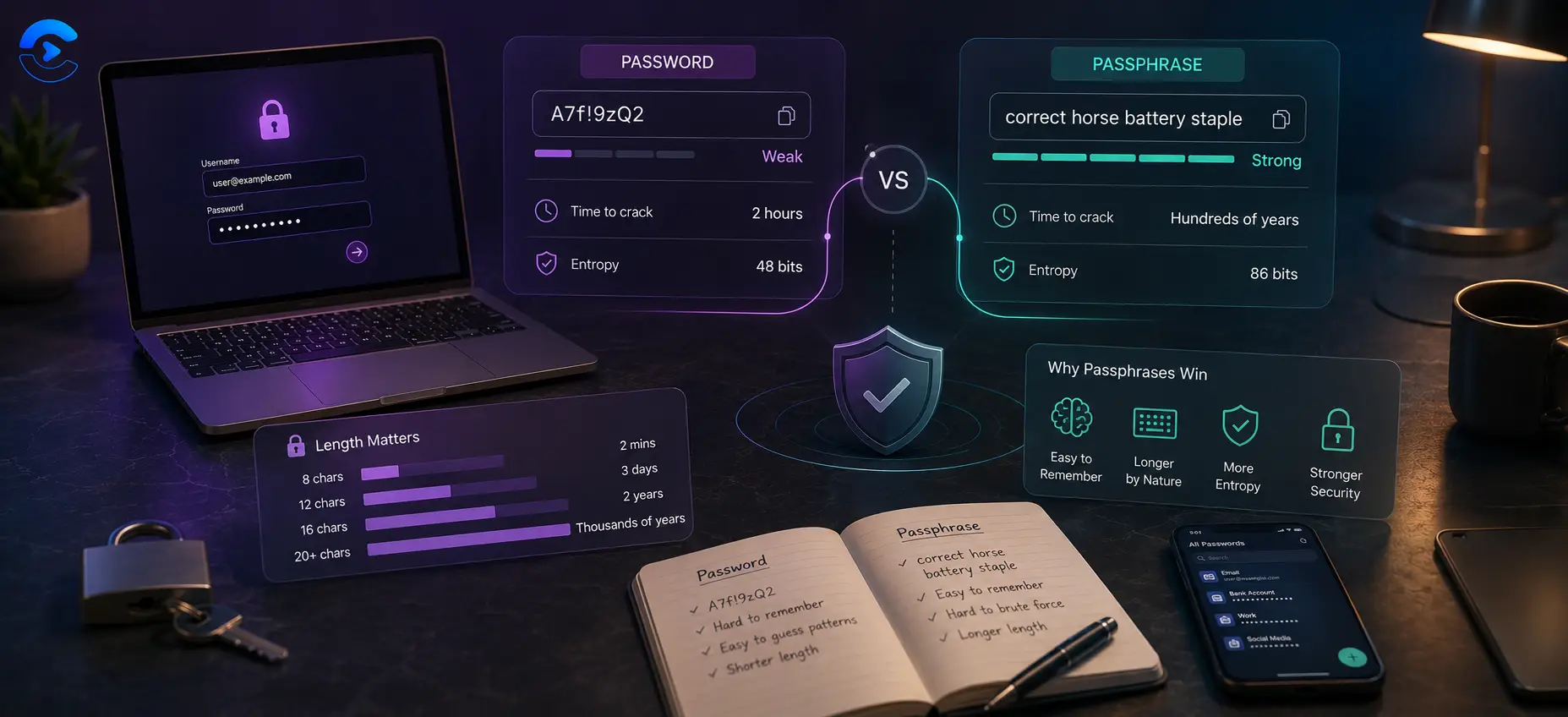

Passphrase vs Password Security: Which Wins on Entropy?
A four word random passphrase usually beats a complex ten character password on both entropy and memorability. Running the numbers, four words chosen randomly from a large word list can produce more than fifty bits of entropy, while a ten character password mixing uppercase, lowercase, numbers, and symbols typically produces somewhere between fifty and sixty five bits depending on true randomness. The passphrase reaches similar or better security while being far easier for a person to actually remember and type correctly, which is the real advantage once you compare both side by side.
Running the entropy math on both options
Entropy measures how many possible combinations an attacker would have to try before guessing your credential, expressed in bits. Each additional bit doubles the number of guesses required, so small differences in bit count translate to enormous differences in cracking time. When comparing passphrase vs password security directly, the calculation depends on the size of the pool each character or word is drawn from and how many characters or words are used.
The four word passphrase calculation
A common word list used for passphrase generation contains around seven thousand seven hundred words, which is roughly two to the power of thirteen. Choosing four words randomly from that list gives you four times thirteen, or about fifty two bits of entropy, assuming each word is chosen independently and randomly rather than picked by a person trying to sound clever. That fifty two bits already puts the passphrase in a range considered reasonably strong for most online accounts.
The ten character password calculation
A password using the full range of uppercase letters, lowercase letters, digits, and common symbols draws from a pool of about ninety five characters, which is roughly six and a half bits per character. Ten characters at six and a half bits each gives around sixty five bits of entropy, slightly ahead of the passphrase in raw math. But that number assumes every character was chosen with true randomness, which almost never happens with human generated passwords, since people favor familiar substitutions like replacing the letter O with a zero, which attackers already account for in their guessing tools.
Why the real world favors the passphrase
The math above assumes ideal randomness on both sides, but people are bad at generating random passwords by hand and good at making passphrases feel natural. A person asked to create a ten character password often ends up with a pattern based on a real word plus a capital letter and a symbol at the end, which cracking tools already anticipate and test first. A person asked to remember four random words, especially when a tool picks them, tends to actually remember them correctly and type them without hesitation, which lowers the odds of falling back to a weaker password out of frustration.
| Factor | Four word passphrase | Ten character complex password |
|---|---|---|
| Approximate entropy | About 52 bits | About 65 bits if truly random |
| Ease of memorization | High | Low |
| Risk of predictable patterns | Lower, if words are random | Higher, due to common substitutions |
| Typing error rate | Lower | Higher |
| Resistance to dictionary attacks | Strong, if word choice is random | Strong, if character choice is random |
How long would each actually take to crack
Translating bits of entropy into cracking time depends on how fast an attacker can test guesses, which varies widely depending on whether the target system is properly hashing stored credentials. Against a well protected system that limits guesses and uses a slow hashing algorithm, both the passphrase and the password at fifty or more bits would take an impractical amount of time to brute force, likely stretching into centuries even with dedicated hardware. The real risk in both cases usually comes from a leaked database of poorly hashed credentials rather than someone guessing one account at a time, which is why reusing either type of credential across multiple sites remains the bigger danger than the small entropy gap between the two approaches.
It is also worth noting that length matters more than complexity once you pass a reasonable threshold. Adding a fifth random word to a passphrase raises its entropy by about thirteen bits, a larger jump than most people achieve by adding one more symbol to a password, since the symbol pool is small compared to a full word list. This is part of why security researchers increasingly recommend length focused passphrases over strict character complexity rules that often just frustrate users without adding much real protection.
A short checklist for choosing between them
- Use a tool to generate either option rather than inventing one yourself, since human creativity introduces predictable patterns.
- Aim for at least four to six words if you choose a passphrase, or twelve or more characters if you choose a password.
- Never reuse the same passphrase or password across multiple accounts, regardless of which type you pick.
- Add a password manager to the mix so memorability becomes less important than raw randomness.
- Check the final entropy estimate a generator gives you before trusting it for a sensitive account.
Quick recap: Passphrase vs password security
Getting this right matters because small errors compound the longer they go unnoticed, and a quick sanity check now saves a bigger correction later. Write down the inputs and assumptions you used so you can compare results later and spot exactly what changed if the numbers look different next time. Treat any online tool as a way to confirm your own reasoning rather than a black box, since understanding the logic behind the number is what actually builds confidence. Real world data is rarely as clean as a textbook example, so expect to make small adjustments once you apply the same method to your own numbers.
Keep the process simple and repeatable so you can run it again next month or next year without relearning the steps from scratch. A second pair of eyes, or a second tool, is a cheap way to catch a mistake before it turns into a bigger problem downstream.
Generate either option with real randomness
Skip the guesswork and let the Password Generator build a truly random passphrase or complex password for you, so the entropy math actually holds up in practice.
Open the Password GeneratorRelated tools for finishing the job
Generating a strong passphrase or password is only the first step. Run whatever you create through the Password Strength Checker to see an independent estimate of its entropy, and if you are building authentication into an application, the HMAC Generator is useful for signing tokens securely alongside strong credentials. For every security tool on the site, visit the security tools page, and for more practical security comparisons, browse the ConvertNow blog.
Key takeaway
Neither option wins by a wide margin on entropy alone, but the passphrase tends to win in practice because people actually use it correctly and remember it without writing it down somewhere unsafe. Try building your own with the Password Generator and compare how each feels before you commit one to a sensitive account.
FAQ: Passphrase vs Password Security: Which Wins on Entropy?
Which wins on passphrase vs password security, a four word passphrase or a complex password?
A ten character complex password can score slightly higher in raw entropy math, but a random four word passphrase usually wins in practice because people remember and type it more accurately.
How many bits of entropy does a four word passphrase have?
Using a word list of about seven thousand seven hundred words, four randomly chosen words produce roughly fifty two bits of entropy.
How many bits of entropy does a ten character password have?
A ten character password using the full range of uppercase, lowercase, numbers, and symbols can reach around sixty five bits of entropy, but only if every character is chosen with true randomness.
Why do people create weaker passwords than the math suggests is possible?
People tend to use predictable patterns like a capital letter at the start and a symbol at the end, which cracking tools already anticipate, lowering real world entropy well below the theoretical maximum.
Is a passphrase easier to remember than a password?
Yes, most people find a sequence of ordinary words significantly easier to recall and type correctly than a string of unrelated characters and symbols.
Should I add numbers or symbols to a passphrase?
Adding a number or symbol can raise entropy further, but the bigger gain comes from using more random words rather than modifying a shorter passphrase with extra characters.
What is the minimum number of words recommended for a secure passphrase?
Most security guidance suggests at least four to six randomly chosen words for a passphrase used to protect an important account.