
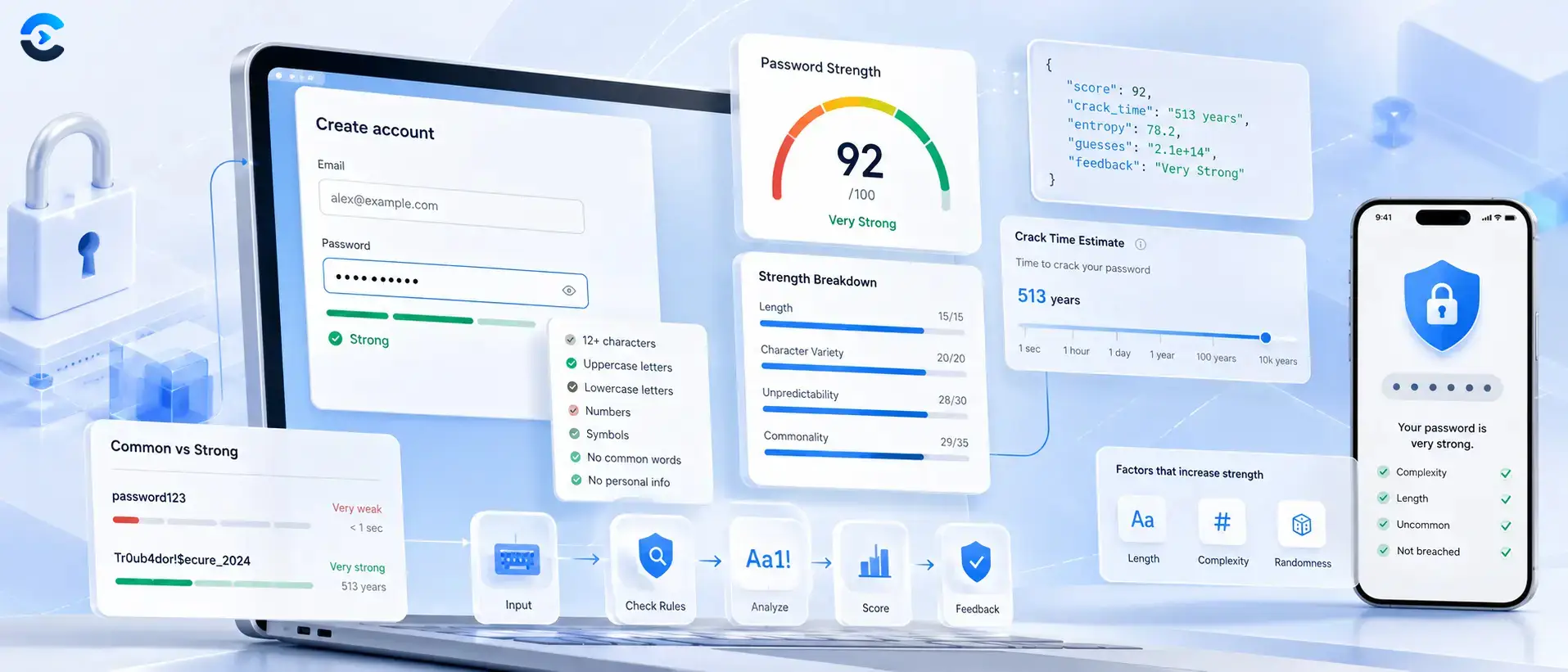

How Password Strength Is Measured (And Why It Matters)
Password strength is measured by combining four factors: length, character set variety, entropy (how many guesses an attacker would statistically need), and pattern detection that flags predictable substitutions and dictionary words. A strength meter is not just counting characters. It is estimating how long a real cracking tool would take to guess your password, which is why a short password full of symbols can score worse than a long plain sentence.
The four factors behind how password strength is measured
Most strength meters, from browser prompts to standalone checkers, blend a small set of signals into one score. None of them look at “complexity” the way people imagine. Here is what they actually check.
1. Length
Length is the single strongest factor. Every extra character multiplies the number of possible combinations an attacker has to try. A 16 character password is dramatically harder to brute force than a 9 character one, even if the shorter one has more symbol variety. This is why security guidance shifted years ago from “use weird characters” to “make it longer.”
2. Character set variety
A meter checks whether your password draws from multiple pools: lowercase letters, uppercase letters, numbers, and symbols. Using more pools increases the theoretical guess space per character. But this factor is weaker than most people assume, because variety alone does not stop an attacker who already expects people to swap “a” for “@” or add “1” at the end.
3. Entropy: the real measure of guesswork
Entropy is the core idea behind how password strength is measured, and it sounds more complicated than it is. In plain terms, entropy estimates how many attempts a computer would need to guess your password if it were trying every realistic possibility. Higher entropy means more attempts, which means more time. A password with low entropy might fall in seconds. One with high entropy could take longer than a human lifetime on the same hardware, even without heavy math to explain why.
Entropy is not just about character pool size. It also depends on unpredictability. A password built from random words, random casing, or a passphrase you invented has high entropy because there is no shortcut for a guessing tool. A password built from a common word plus a predictable substitution has much lower real world entropy, no matter how “complex” it looks on screen.
4. Pattern and dictionary detection
This is the factor that surprises people most. Strength meters run your password against lists of common passwords, dictionary words, keyboard patterns like “qwerty”, and known substitution tricks such as “@” for “a” or “0” for “o”. Attackers use these exact lists first, because most people reuse the same handful of tricks. A meter that skips this check will overrate passwords that a real attacker would crack in the first few minutes.
Why P@ssw0rd1 scores lower than a long random passphrase
This is the clearest way to see entropy versus perceived complexity in action. “P@ssw0rd1” looks strong at a glance. It has uppercase, lowercase, a symbol, and a number. But it is built from a single dictionary word with substitutions that cracking tools check automatically. A long passphrase made of unrelated words looks plain by comparison, yet it holds up far better because there is no pattern to exploit and the sheer length multiplies the guess space.
| Password | Looks like | Real strength | Why |
|---|---|---|---|
P@ssw0rd1 |
Complex, mixed characters | Weak | Based on a common word with predictable substitutions that cracking tools check first |
correct horse battery staple style |
Plain lowercase words | Strong | Long, unrelated words with no common pattern, giving it far more real guess space |
What actually makes a password hard to crack
Combine the four factors instead of maximizing just one. Aim for length first, at least twelve to sixteen characters. Mix in variety where it is easy to remember rather than forced. Avoid whole words tied to you, your pets, or your birthday, since those are the first guesses in any dictionary attack. Most importantly, do not rely on visual complexity as a stand in for real unpredictability.
If you also manage passwords for accounts across a team or family, generating fresh random passwords with a password generator removes the guesswork entirely, since you are not relying on your own pattern habits at all.
Check your own password against these factors
Reading about entropy and pattern detection is one thing. Seeing your own password scored against them is more useful. The Password Strength Checker breaks down length, character variety, estimated entropy, and common pattern matches in real time, right in your browser, so you can see exactly why a password scores the way it does before you use it anywhere.
Password strength is one piece of a bigger security habit. If you are storing or transmitting sensitive values and need a one way check instead of a reversible password, a hash generator covers that separate use case. For a broader set of security utilities, the security tools hub lists everything in one place, and the ConvertNow blog has more explainers like this one.
The short version
How password strength is measured comes down to length, variety, entropy, and whether your password matches a known pattern attackers already check first. A long unpredictable phrase will almost always beat a short password dressed up with symbols. Run your next password through the Password Strength Checker before you commit to it, and lean on a generator when you want a fresh one with no guesswork involved.
FAQ: How password strength is measured?
How is password strength measured exactly?
Strength meters combine length, character set variety, an entropy estimate of how many guesses an attacker would need, and a check against common patterns and dictionary words. The final score weighs all four rather than any single factor alone.
Is a longer password always stronger than a shorter one with symbols?
In most cases yes, because length multiplies the total guess space more than adding a symbol or two does. A short password with symbols can still be weak if it is based on a common word or pattern.
What is password entropy in simple terms?
Entropy is an estimate of how many attempts a computer would need to guess your password by trying realistic possibilities. Higher entropy means more attempts and more time required, which makes the password harder to crack.
Why does P@ssw0rd1 score as weak?
It is built from the common word “password” with substitutions that cracking tools already check for by default, such as swapping “a” for “@” and “o” for “0”. The visual complexity does not add real unpredictability.
Are passphrases better than traditional passwords?
Yes, in most cases a passphrase of several unrelated words is both easier to remember and harder to crack than a short password packed with symbols, because the length and unpredictability raise the entropy significantly.
Does adding numbers to the end of a word make it strong?
Not by much. Appending a number or two to a common word is one of the first patterns cracking tools test, so it adds very little real protection even though it changes how the password looks.
How many characters should a strong password have?
Twelve characters is a reasonable minimum today, and sixteen or more is safer, especially if you use a passphrase style. Length matters more than any single character type you add.
What is a dictionary attack?
A dictionary attack tries common words, known passwords, and predictable variations of them before attempting random guesses. It succeeds quickly against passwords based on real words, even with substitutions applied.
Can I check my password strength without saving it anywhere?
Yes, tools like the Password Strength Checker run the calculation in your browser, so you can test a password and see its length, variety, entropy, and pattern score without sending it anywhere.