

Readability Score for Technical Writing: When Low Is Fine
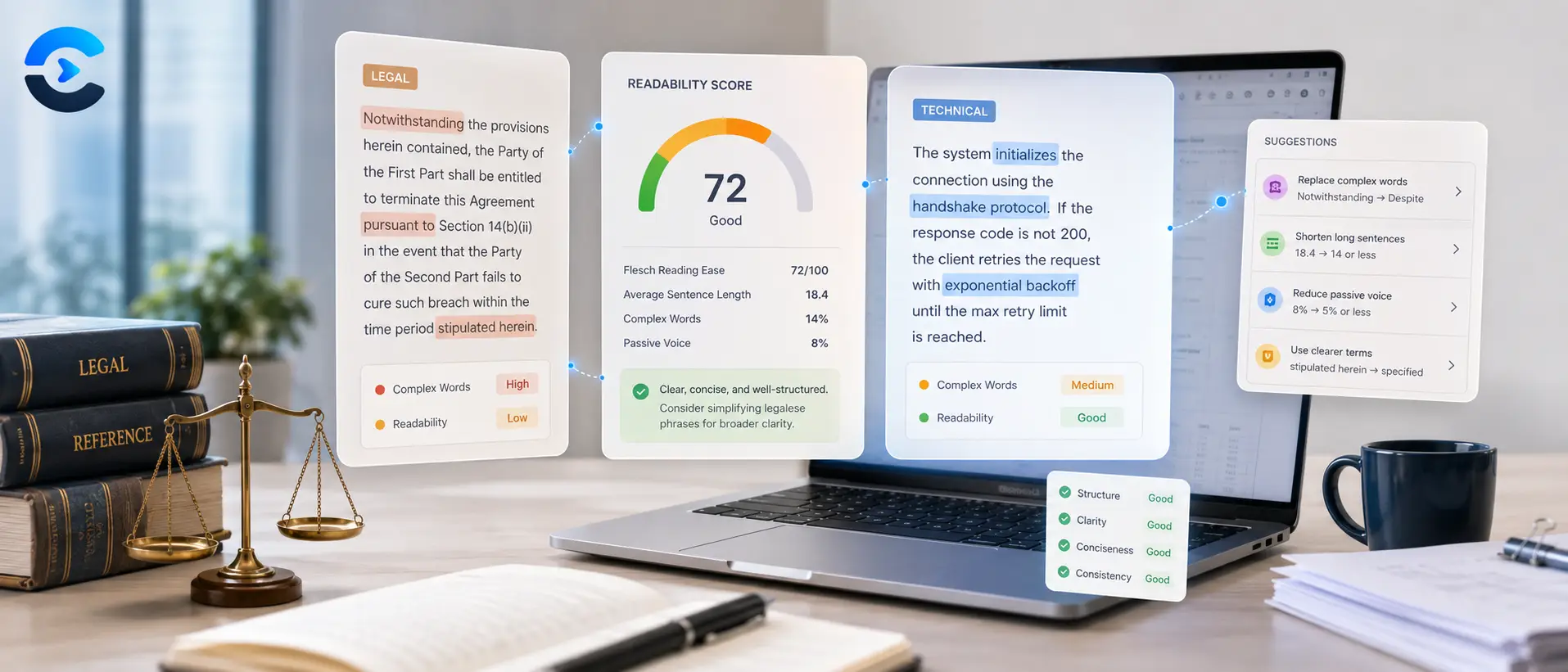
A readability score for technical writing will usually land lower than the scores you see praised in general blogging advice, and that is expected, not a failure. Formulas like Flesch Reading Ease and Flesch Kincaid Grade Level measure sentence length and syllable count, so a contract clause defining “indemnification” or a spec sheet citing “tensile yield strength” will always score as dense, because the vocabulary is precise on purpose. The real question is not whether the number is low. It is whether the document’s actual audience, a specialist, a court, a compliance officer, can read it without friction. If that audience follows it cleanly, a low score is fine. If your intended reader is a general customer or a patient, a low score is a warning sign worth fixing.
What readability formulas are actually measuring
Most popular readability formulas, including Flesch Reading Ease, Flesch Kincaid Grade Level, and the Gunning Fog Index, count three things: words per sentence, syllables per word, and sometimes the ratio of complex words to simple ones. None of them read for meaning. None of them know whether a sentence is accurate, whether it is legally required, or whether the reader already has the background to parse it in seconds.
That is a real limitation, not a hidden flaw. The formulas were built decades ago to flag needlessly bloated writing aimed at a general audience. They were never designed to judge a patent claim, a clinical trial protocol, or a statute. Feeding those documents into a generic checker will produce a low score almost every time, no matter how well written the document actually is for its intended reader.
Why the readability score for technical writing runs low by design
Precision requires specific words, and specific words are often long ones. “Terminate” instead of “end,” “notwithstanding” instead of “even so,” “aforementioned” instead of “this.” Each swap adds syllables and often adds clauses too, since legal drafting frequently needs to name exceptions and conditions inside the same sentence to avoid ambiguity. A shorter, punchier rewrite might read better on a formula but quietly drop a condition that changes what the clause actually permits.
Technical writing has a parallel problem. A materials engineer reading “yield strength” does not need it explained, and inserting a definition every time would slow down the one reader who actually needs the document fast: another engineer. Here, a low readability score for technical writing is a sign the document is speaking correctly to its actual audience, not a defect to chase down.
When a low score is a real problem, not a false alarm
The formula stops being irrelevant the moment your real audience shifts. A hospital consent form, a terms of service page a consumer has to agree to, or an insurance policy summary handed to a policyholder are technically “legal” documents, but the reader is not a lawyer. If a low score there comes from padding, nested clauses that could be split, or jargon that has a plain equivalent, that is a genuine clarity failure, and it can carry real consequences: signed forms nobody understood, support tickets from confused customers, or regulatory pressure under rules like the U.S. Plain Writing Act guidance for public facing government communication.
The test that actually matters is audience match, not a universal number. Ask who reads this document, what they already know, and what happens if they misread it. A score is only useful as a diagnostic once you have answered that question, because the same grade level number means something different in a surgical consent form than it does in a peer reviewed engineering standard.
A practical way to use the score instead of chasing it
Run the document through a scorer and read the sentence level detail, not just the headline number. Long sentences with multiple embedded conditions are worth a second look even in a contract, because splitting one sentence into two rarely removes meaning, it just removes the reader’s need to hold four clauses in memory at once. Passive voice flags deserve the same scrutiny: sometimes passive voice is correct in legal drafting to avoid assigning blame prematurely, and sometimes it is just a habit that hides who is responsible for an action.
Before you draft, it helps to check word count and pacing with a plain word counter, since documents that run long tend to accumulate the exact nested clauses that drag a score down for no real reason. If you are revising a policy document across several drafts, a text diff tool shows exactly what changed between versions, which matters when legal reviewers need to confirm a simplification did not alter meaning. And if you are producing the same clause in different formats, a case converter keeps defined terms consistent, since inconsistent capitalization of a defined term can create its own ambiguity in a contract.
Check the score, then check the context
Guessing at grade level from experience is unreliable, and manually counting syllables is tedious. Our free Readability Scorer gives you Flesch Reading Ease and grade level results instantly, along with sentence and word level detail, so you can decide with real numbers whether a low score fits your audience or needs a rewrite.
Open the Readability ScorerRelated tools for editing dense documents
Readability work rarely happens in isolation. If a document keeps repeating the same defined term more often than it should, a keyword density checker can flag that pattern quickly. Pair that with the word counter and text diff tool mentioned above when you are trimming a long clause down to something a reader can actually hold in their head. For more writing and formatting explainers like this one, browse the full set of text tools or check the ConvertNow blog.
The short version
A low readability score on a technical or legal document is not automatically a problem. Precision needs specific words, and specific words push the number down. What matters is whether your actual audience, specialist or general reader, can follow the text without friction. Run your document through the Readability Scorer, read the detail behind the number, and fix what genuinely confuses your real reader rather than chasing a score meant for a different kind of writing.
FAQ: Rreadability Score for Technical Writing
What is a readability score for technical writing supposed to tell me?
It tells you how dense your sentences and word choices are compared to general reading benchmarks, not whether the content is correct or appropriate for its intended reader. A low score on technical writing is common and often expected.
Is a low Flesch Reading Ease score always a bad sign?
No. Flesch Reading Ease penalizes long words and long sentences, which specialist vocabulary and legal precision both require. A low score only becomes a problem when the intended reader is a general audience rather than a specialist.
Should legal contracts aim for a lower grade level score?
Only if the audience needs it. Contracts read by lawyers can stay dense without harm. Contracts or summaries handed directly to consumers, such as terms of service or insurance summaries, benefit from a lower grade level because the reader is not a legal specialist.
Why does jargon lower my readability score even when it is necessary?
Readability formulas count syllables and sentence length, and technical terms tend to be longer words. The formula cannot tell that a term like “tensile yield strength” is precise and necessary rather than needlessly complex.
What is the difference between plain language and simplified language?
Plain language means the reader can find, understand, and act on the information the first time they read it, for their specific purpose. Simplified language just means shorter words and sentences, which does not always achieve the same goal if meaning gets lost.
Does the Plain Writing Act require every government document to score low on grade level?
The Plain Writing Act guidance focuses on clarity for the public facing documents ordinary citizens must use, not on hitting a specific numeric score. Internal or highly technical government documents are treated differently from public communication.
How do I know if my document’s low score is a real problem or fine as is?
Identify who actually reads the document and what happens if they misunderstand it. If the reader is a specialist who reads that vocabulary daily, a low score is fine. If the reader is a general customer, patient, or citizen, treat the low score as a signal to simplify.
Can I lower a grade level score without changing the legal meaning of a clause?
Often yes. Splitting long sentences with multiple conditions into two shorter sentences usually preserves meaning while lowering the score. Removing a defined term or a required exception, however, can change the legal effect, so any simplification of legal text should go through review.
What tool should I use to check readability for technical or legal writing?
A dedicated readability scorer that reports Flesch Reading Ease, grade level, and sentence level detail gives you more to work with than a single headline number. The Readability Scorer linked above provides that detail instantly for any pasted text.