
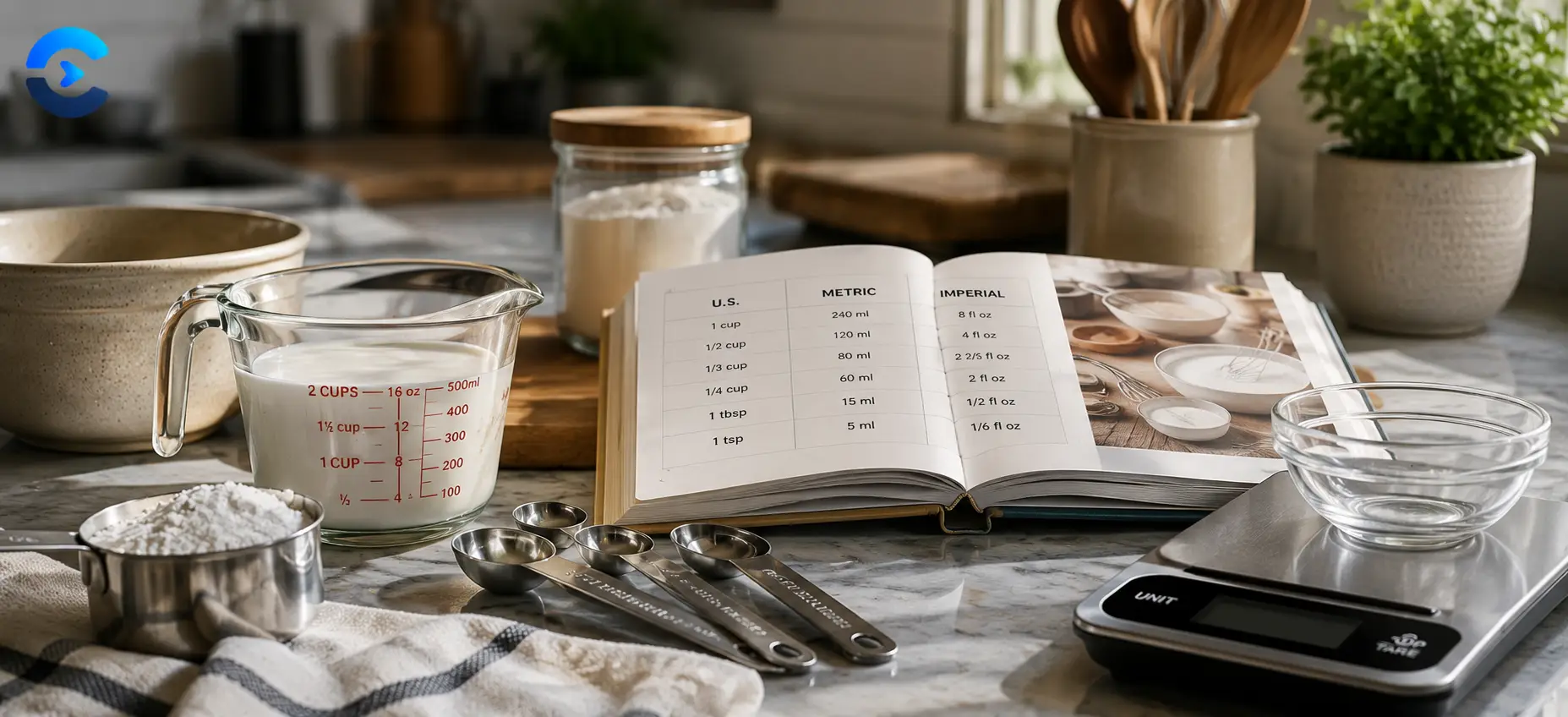

Why Recipes Use Different Measurement Systems Worldwide
Recipes use different measurement systems worldwide because two different goals are being served at once: professional and European bakers weigh ingredients in grams for accuracy and repeatable results, while US home cooks measure by volume in cups and tablespoons because it is faster and needs no scale. That split, weight versus volume, is the real root of most cross country recipe conversion headaches, since a cup of flour can weigh a different amount depending on how it was scooped.
The real reason recipes measure things differently
Every recipe is trying to describe a physical quantity of an ingredient, and there are two ways to do that: measure its mass (grams, ounces by weight) or measure the space it fills (cups, tablespoons, milliliters). Both work. They just trade off accuracy against convenience, and different kitchen cultures picked different sides of that trade decades ago.
Weight based measuring: what professionals and metric countries use
Professional bakers and most of Europe measure flour, sugar, and butter in grams because weight does not lie. A gram of flour is always a gram of flour, no matter how it settled in the bag or how firmly it got packed into a cup. This matters enormously in baking, where the ratio of flour to liquid to fat directly determines whether bread rises properly or a cake turns dense. Bakeries running the same formula hundreds of times a week cannot afford the drift that comes from scooping, so a kitchen scale became standard equipment rather than an optional extra.
Volume based measuring: why US home cooks default to cups
In the United States, home cooking grew up around cup and tablespoon sets rather than scales. Volume measuring is quick, requires no batteries or calibration, and a set of nesting cups is cheap and easy to store. For a home cook making dinner on a weeknight, the small accuracy loss rarely matters. The problem shows up specifically in baking, where small ratio errors compound into noticeably different texture, and that is exactly where the convenience of volume measuring starts working against the cook.
Why a cup of flour is not a fixed amount
This is the part that trips up most home bakers: a cup is a unit of volume, but flour is a compressible powder. How you fill the cup changes how much flour actually ends up in it. Scoop directly from the bag and you pack flour down, cramming in more than intended. Spoon it lightly into the cup and level it off, and you get noticeably less. Sifted flour is lighter still. The cup measurement never changes, but the real weight underneath it can swing by 20 percent or more.
| Method | Approximate weight per cup | Result if recipe expects 120g |
|---|---|---|
| Scooped and packed straight from the bag | 150 to 160 g | Too much flour, drier or denser bake |
| Spooned into cup, then leveled | 120 to 125 g | Close to intended, most consistent |
| Sifted before measuring | 100 to 110 g | Too little flour, wetter or flatter bake |
That is a real spread of roughly 50 grams between the heaviest and lightest version of the same cup, which explains why two people following the identical recipe can get different results. This is the actual mechanism behind why recipes use different measurement systems worldwide, and why the systems keep producing conversion friction: a scale removes the technique variable entirely, while a cup measurement always carries it.
Fahrenheit, Celsius, and the second layer of friction
Ingredient measuring is not the only place international recipes diverge. Oven temperatures split the same way, with US recipes written in Fahrenheit and most of the rest of the world using Celsius. Mixing the two up is not a small error either, since a recipe meant for 180C read as 180F will barely bake anything, and the reverse can burn a dish in minutes. If a recipe pulled from a European site lists an oven temperature that looks unfamiliar, a temperature converter settles it in seconds rather than guessing.
How to convert recipes between systems without guessing
The most reliable fix is simple: when a recipe gives weights in grams, use them directly rather than translating to cups. When it only gives cups, treat that measurement as approximate and expect some variation, especially in baking. For ingredients like sugar, butter, or liquids where density is more consistent than flour, converting between milliliters, ounces, and cups is far less risky. A dedicated volume converter handles those swaps cleanly, and pairing it with a weight converter lets you check both sides of a recipe, volume and mass, before you start mixing.
If you regularly cook from international sources, it is worth building the habit of converting the whole recipe up front rather than mid cook. Rounding errors and misread units are far easier to catch on paper than after the batter is already mixed. Sites that publish in one system usually have a printed conversion note, but when they do not, a quick pass through a unit converter before you start saves a wasted batch.
Convert recipe measurements accurately
Volume Converter
Switch between cups, tablespoons, milliliters, and liters for liquids and pourable ingredients where density stays fairly constant.
Open Volume ConverterWeight Converter
Convert grams, ounces, and pounds directly, the most reliable way to match a European or professional recipe exactly.
Open Weight ConverterRecipes read differently around the world because weight and volume solve different problems: weight gives repeatable accuracy, volume gives speed. If a bake keeps turning out wrong, the fix is usually as simple as switching to grams. Weigh your flour with the weight converter next time and see how much steadier the results become, or browse the ConvertNow blog for more cooking conversion guides.
FAQ: Why Recipes Use Different Measurement Systems Worldwide
Why do recipes use different measurement systems worldwide?
Recipes use different measurement systems worldwide because they serve different goals. Professional and European bakers weigh ingredients in grams for accuracy, while US home cooks measure by volume in cups because it is faster and needs no scale.
Why do professional bakers weigh flour instead of using cups?
Weighing flour removes the variation caused by scooping technique. A gram is always the same amount, while a cup can hold more or less flour depending on whether it was packed, spooned, or sifted. For recipes baked repeatedly, that consistency matters.
How much can a cup of flour vary in weight?
A packed cup of flour can weigh around 150 to 160 grams, while a spooned and leveled cup is closer to 120 to 125 grams, and a sifted cup can drop to around 100 grams. That is a swing of roughly 50 grams from the same one cup measurement.
Is volume measuring wrong or just less precise?
Volume measuring is not wrong, it is just less precise for dry, compressible ingredients like flour. It works fine for liquids and is faster for everyday cooking, which is why it remains standard in most US home kitchens.
What is the easiest way to convert cups to grams?
The most reliable approach is to use a weight converter alongside the ingredient’s known density, since a fixed cup to gram value only applies accurately to that one ingredient measured a specific way. For flour specifically, spooning and leveling gives the most predictable result.
Why do oven temperatures cause confusion between countries?
US recipes list oven temperature in Fahrenheit while most other countries use Celsius, and the two scales are numerically very different. Misreading one for the other can leave a dish badly underbaked or badly overbaked, so it is worth double checking with a temperature converter.
Does it matter more for baking than for cooking?
Yes. Baking relies on precise ratios between flour, liquid, and leavening to work correctly, so small measuring errors show up clearly in texture and rise. General cooking, like soups or stir fries, tolerates much more variation.
Should I buy a kitchen scale if I only bake occasionally?
A basic digital kitchen scale is inexpensive and removes most of the guesswork from baking, so it is worth it even for occasional bakers. If you are not ready to buy one, spooning and leveling your cup measurements is the next best option.