

Volume Converter Mistakes: 8 Easy Fixes for Exact Results
Unit ConvertersA volume converter gives a precise answer to the question you typed, but not always to the question you meant. The usual cause is that gallon, pint, ounce and cup each mean two different things depending on the country. This page lists eight mistakes, shows the wrong result next to the right one and gives the fix.
Each volume converter mistake below follows the same pattern: what goes wrong, the numbers, and what to do. You can check any of them with the Volume Converter, which keeps US, UK, metric and cooking units apart.
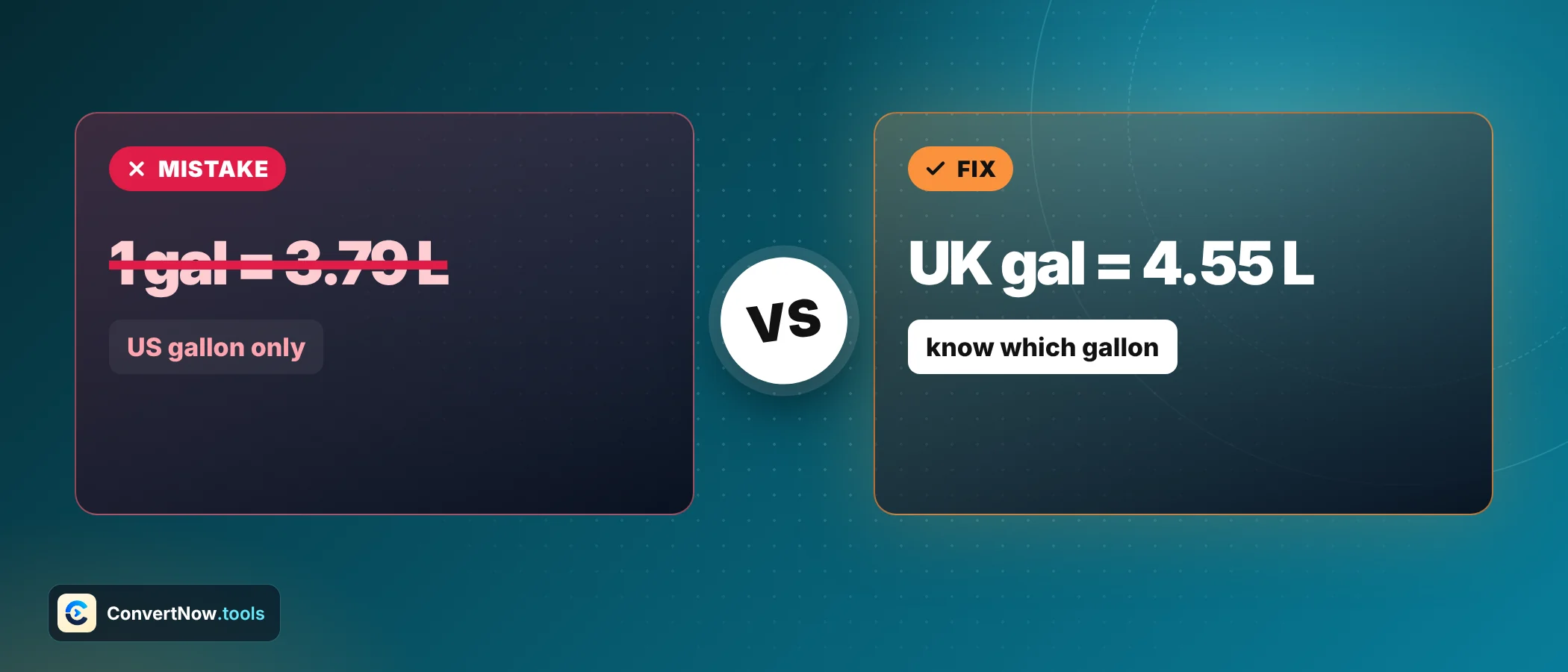
Mistake 1: Using the wrong gallon
A traveller reads that a rental car has a 12 gallon tank. In the US that is 45.42 litres. In the UK it would be 54.55 litres. Convert with the wrong gallon and you misjudge the range by 9.1 litres, which is roughly the size of a small jerry can.
| Case | Wrong conversion | Right conversion | Gap |
|---|---|---|---|
| 12 US gallon tank | 54.55 L (used UK gallon) | 45.42 L | 9.13 L |
| 60 L tank in gallons | 13.20 gal (used UK) for a US car | 15.85 US gal | 2.65 gal |
| 5 UK gallons as US | 5 gal | 6.00 US gal | 1.00 gal |
Fix: find the country of the source. If the text uses litres per 100 km, miles per gallon or pints, the country decides the gallon. The definitions are set out in the Wikipedia article on the gallon.
Mistake 2: Mixing US and UK fluid ounces
The US fluid ounce is 29.5735 mL. The UK fluid ounce is 28.4131 mL. That is a 4.1 percent gap. Small for one ounce, large for a drink or a dose of syrup.
| Amount | US result | UK result | Difference |
|---|---|---|---|
| 1 fl oz | 29.57 mL | 28.41 mL | 1.16 mL |
| 8 fl oz | 236.59 mL | 227.30 mL | 9.28 mL |
| 16 fl oz | 473.18 mL | 454.60 mL | 18.57 mL |
| 20 fl oz | 591.47 mL | 568.26 mL | 23.21 mL |
Fix: for medicine, use the millilitre marks printed on the measuring device and ignore ounces entirely. For recipes, set the volume converter to the unit set that matches the book.
Mistake 3: Assuming a pint is a pint
A US liquid pint is 16 fluid ounces, or 473.18 mL. A UK pint is 20 fluid ounces, or 568.26 mL. The difference of 95.08 mL makes a UK pint 20.1 percent larger, the same ratio as the gallon.
Before: wrong
- A recipe asks for 1 pint of milk
- Cook measures 473 mL from a US jug
- Sauce comes out thin, 20 percent short
After: right
- The recipe is British, so 1 pint is 568 mL
- Measure 568 mL, or about 2.4 US cups
- Sauce matches the original
Fix: when a British recipe says pint, set the volume converter to UK pints, 568 mL. When an American one says pint, set it to US pints, 473 mL.
Mistake 4: Treating a cup as 250 mL
The US customary cup is 236.59 mL. Nutrition labels round it to 240 mL. Australia, Canada and many recipe sites use a metric cup of 250 mL. The metric cup is 5.7 percent bigger than the customary one.
| Cup type | Millilitres | Compared with US cup |
|---|---|---|
| US customary | 236.59 | Baseline |
| US nutrition label | 240 | 1.4% larger |
| Metric | 250 | 5.7% larger |
Fix: for a 4 cup bread recipe in a volume converter, the gap between cup types is 53.6 mL of liquid, enough to change a dough. Use the system the author used, or switch to weight.
Mistake 5: Taking a tablespoon as 15 mL everywhere
The US tablespoon is 14.79 mL, the metric tablespoon is 15 mL, and the Australian one is 20 mL. Three Australian tablespoons of oil equal about 4.06 US tablespoons.
Three teaspoons make a tablespoon in the US and UK, so a US teaspoon is 4.93 mL while the metric teaspoon is 5 mL. A small gap in one spoon, a large gap in a recipe with eight of them.
Fix: before you use the volume converter, check where the recipe was written. When the dish is delicate, such as baking powder or yeast, a small scale in grams is safer than any spoon.
Mistake 6: Confusing fluid ounces with ounces of weight
A fluid ounce measures space. An ounce measures mass. One US fluid ounce of water has a mass of about 29.6 g, which is close to an ounce of weight at 28.35 g, and that near match fools people. Flour, honey and oil do not behave like water.
A cup of water holds 236.6 mL and weighs about 236.6 g. A cup of flour holds the same volume and weighs far less, because flour is lighter than water. A volume converter can turn cups into millilitres. It cannot turn them into grams without the density.
Fix: convert volume to volume with a volume converter, and mass to mass. For the second kind, use the Weight Converter.
Mistake 7: Slipping on cubic units
One cubic metre is 1,000 litres, not 100. A cubic foot is 28.32 litres. A cubic yard is 764.55 litres. A cubic inch is 16.39 mL. Mixing these is common when ordering soil, concrete or shipping space.
| Unit | Litres | Also equals |
|---|---|---|
| 1 cubic centimetre | 0.001 | 1 mL |
| 1 cubic inch | 0.016387 | 16.39 mL |
| 1 cubic foot | 28.3168 | 7.48 US gal |
| 1 cubic yard | 764.555 | 27 cubic feet |
| 1 cubic metre | 1,000 | 264.17 US gal |
Fix: remember that a cubic metre is a cube with edges of 10 decimetres, and 10 times 10 times 10 is 1,000 litres. A 2 metre by 1 metre by 0.5 metre bed holds 1 cubic metre, or 1,000 litres of soil.
Two UK pints are 2 times 568.26, or 1,136.5 mL. The 946 figure would apply to US pints.
Mistake 8: One barrel, one size
An oil barrel is 42 US gallons, or 158.99 litres. A US beer barrel is 31 US gallons, or 117.35 litres. The word barrel alone tells you nothing. The oil barrel is 35.5 percent larger.
Fix: always ask what is in the barrel. Crude oil, beer and some dry goods each use their own definition.
How a conversion gets from A to B
A good volume converter does not hold a table of every pair. It routes each unit through the litre. Enter 2 US gallons and the tool multiplies by 3.785411784 to get 7.57 litres. Then it divides by the factor of the target unit. To show UK gallons it divides 7.57 by 4.54609 and gets 1.67.
Seen this way, every mistake above is a wrong factor on one of the two steps. The maths is right. The label was wrong. That is why picking the unit variant matters more than any rounding choice, and why a volume converter that lists US and UK entries separately saves real errors.
All eight mistakes in one table
| Mistake | Size of the error | Fix |
|---|---|---|
| Wrong gallon | 20.1% | Name the country first |
| Wrong fluid ounce | 4.1% | Use mL on medicine |
| Wrong pint | 20.1% | Use 568 mL for UK, 473 mL for US |
| Wrong cup | Up to 5.7% | Match the recipe origin |
| Wrong tablespoon | Up to 35% | Use grams for baking |
| Volume treated as weight | Depends on density | Convert volume to volume |
| Cubic confusion | Up to 10 times | 1 cubic metre is 1,000 L |
| Wrong barrel | 35.5% | Ask what it holds |
A checklist before you trust any volume converter
Related checks
If your gallons come from a fuel rating, the Fuel Efficiency Converter handles the US and UK difference for MPG. For the distances on a tank range, the Length Converter is the next stop.
Use this volume converter to choose the exact unit variant, US, UK, metric or cooking, and see 25 units converted at once, with cooking measures shown for kitchen sized values.
Open the Volume ConverterFrequently asked questions
How many litres does a volume converter give for a US gallon?
Exactly 3.785411784 litres. The UK gallon is larger at 4.54609 litres.
How many mL are in a US cup?
One US customary cup is 236.59 mL. Labels often round it to 240 mL, and a metric cup is 250 mL.
Is a UK pint bigger than a US pint?
Yes. A UK pint is 568.26 mL and a US pint is 473.18 mL, so the UK pint is 20.1 percent larger.
How many litres are in a cubic metre?
One cubic metre is exactly 1,000 litres.
Does a volume converter treat fluid ounces and ounces as the same?
No. A fluid ounce measures volume and an ounce measures weight. Only water comes close to matching them.
How many litres are in an oil barrel?
A standard oil barrel is 42 US gallons, which is 158.99 litres.
Sources: Wikipedia: Gallon