

Kg to Lbs by Role: 6 Real Uses With Exact Factors
Converting kg to lbs takes one number, 2.20462, but what you do with the answer depends on who you are. A traveller cares about a baggage limit. A lifter cares about a loaded bar. A freight clerk cares about which kind of ton is on the invoice. This guide covers six roles, each with real tasks and checked figures.
The pound has been fixed at 0.45359237 kg since the international agreement of 1959, as the Wikipedia article on the pound records. Every kg to lbs result, and every other imperial mass unit in the Weight Converter derives from that single definition.
One kg to lbs table for everyone
| kg | lb | Pounds and ounces |
|---|---|---|
| 1 | 2.20 | 2 lb 3.3 oz |
| 5 | 11.02 | 11 lb 0.4 oz |
| 10 | 22.05 | 22 lb 0.7 oz |
| 20 | 44.09 | 44 lb 1.5 oz |
| 50 | 110.23 | 110 lb 3.7 oz |
| 75 | 165.35 | 165 lb 5.5 oz |
| 100 | 220.46 | 220 lb 7.4 oz |
Rounding the kg to lbs factor to 2.2 is fine for a quick look. At 100 kg the shortcut gives 220 lb against a true 220.46, which is 0.2 percent low. For anything that is billed, certified or medical, use the full factor.
Pick your role
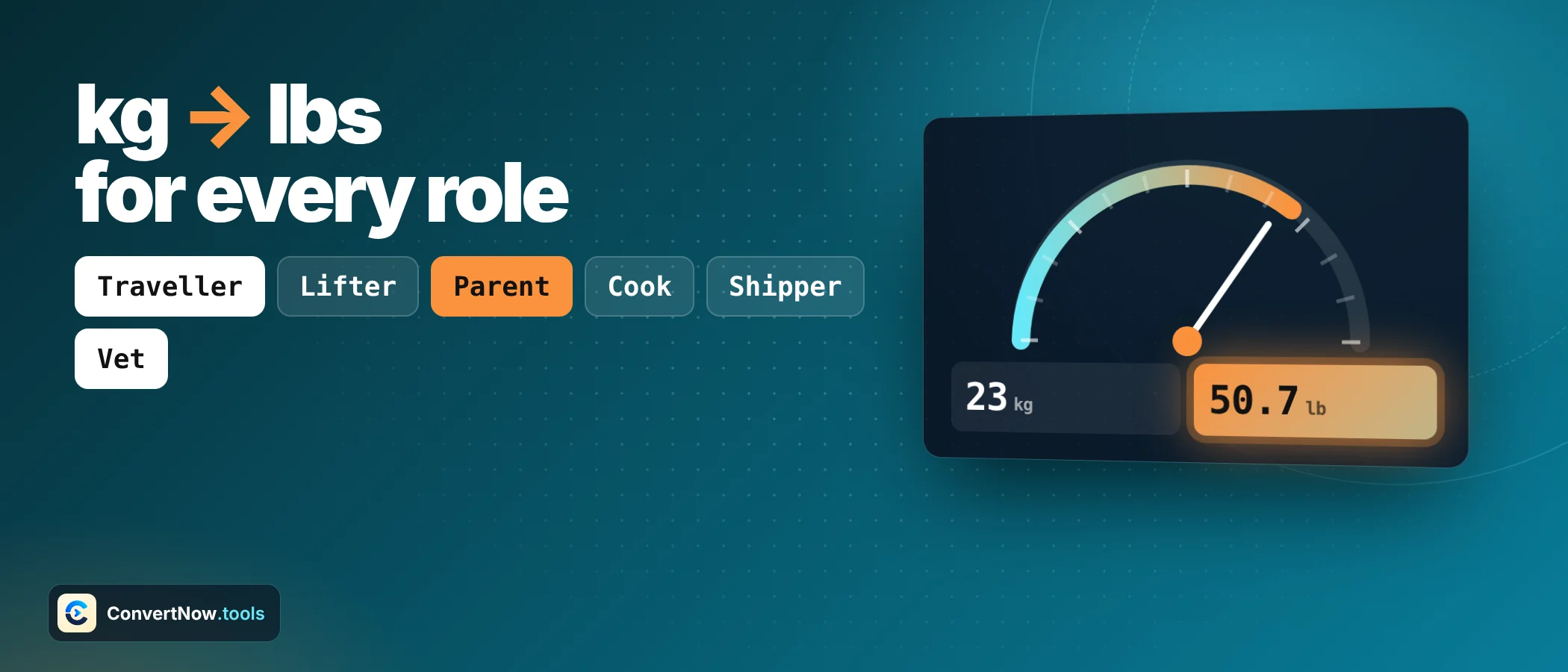
Your kg to lbs task is staying under a baggage limit. A 23 kg allowance is 50.71 lb, so a bag that shows 50 lb on a US scale is safely inside it. A 32 kg allowance is 70.55 lb.
Weigh at home on whichever scale you have, convert once and leave a margin of at least 1 kg. Airport scales vary slightly.
Your kg to lbs task is reading plates in two systems. A 20 kg bar is 44.09 lb and a 45 lb bar is 20.41 kg. A 100 kg total is 220.46 lb, not 220.
When you log lifts, store the original unit with each number. Converting back and forth from rounded values creates false progress.
Your task is making sense of birth weights. A 3.5 kg newborn weighs 7 lb 11.5 oz. Hospitals may report either form, so keep both.
Multiply kilograms by 2.20462 for pounds, then turn the decimal part into ounces by multiplying by 16.
Your task is turning ounces into grams. One ounce is 28.35 g, so 8 oz is 226.8 g and 12 oz is 340.2 g. A pound is 453.59 g.
Use weight for dry ingredients where you can. It is more repeatable than cups.
Your task is matching a parcel weight to a carrier rate table. A 2.5 kg parcel is 5.51 lb or 88.2 oz. Some carriers price in ounces for light parcels and in pounds above that.
Always round up to the next rate step, not down. A short weight can cause a surcharge.
Your task is telling three tons apart. A metric tonne is 1,000 kg, a US short ton is 907.18 kg and a UK long ton is 1,016.05 kg.
Read the unit on the document before converting. A 20 tonne load is 22.05 short tons but only 19.68 long tons.
A UK carrier may mean long tons. 20 times 1,016.05 kg is 20,321 kg. Confirm the unit with the sender, because a short ton would give 18,144 kg.
Traveller: staying inside the baggage limit
Limits are set in one unit and enforced on a scale that may use the other. The table shows common allowances in both.
| Allowance | kg | lb |
|---|---|---|
| Cabin bag | 7 | 15.43 |
| Checked bag, economy | 23 | 50.71 |
| Checked bag, heavy | 32 | 70.55 |
| Hand luggage, small | 10 | 22.05 |
Reverse kg to lbs for US sources: 50 lb is 22.68 kg and 70 lb is 31.75 kg. That means a 50 lb limit is 0.32 kg tighter than 23 kg. Pack to the lower of the two if you do not know which scale applies.
Lifter: plates and bars
Gym plates are marked in kilograms in most of the world and in pounds in the US. A metric bar is 20 kg and an American one is 45 lb. Mixing them in the same session changes the load by a small but real amount.
| Load | kg | lb |
|---|---|---|
| Empty metric bar | 20 | 44.09 |
| Empty US bar | 20.41 | 45 |
| Bar plus 2 plates of 10 lb | 29.48 | 65 |
| Bar plus 2 plates of 20 kg | 60 | 132.28 |
| 135 lb total | 61.23 | 135 |
| 225 lb total | 102.06 | 225 |
| 315 lb total | 142.88 | 315 |
If you log 225 lb, convert to 102.06 kg once, and then back, you will see 225.00. If you round to 102 first, you get 224.87. Keep the original unit in your notes.
Cook and baker: ounces, pounds and grams
Recipes from the US list ounces and pounds. Recipes from Europe list grams. The pound is 453.59 g, so a quarter pound is 113.4 g, which is the size of one US stick of butter. Cooks who already know kg to lbs can reach ounces by multiplying pounds by 16.
| Ounces | Grams | Pounds |
|---|---|---|
| 1 | 28.35 | 0.0625 |
| 4 | 113.40 | 0.25 |
| 8 | 226.80 | 0.5 |
| 12 | 340.19 | 0.75 |
| 16 | 453.59 | 1 |
| 35.27 | 1,000 | 2.20 |
The last row answers a common kg to lbs question: a 1 kg bag of flour is 35.27 oz, or 2 lb 3.3 oz. A pack sold as 2 lb holds 907 g, which is 93 g less than a 1 kg bag.
Online seller: matching a parcel to a rate table
Carriers publish rates in steps. A parcel that sits a few grams above a step costs the full next step, so the conversion decides the price. Weigh in the unit of your scale, run kg to lbs once, then round up to the next printed step.
| kg | lb | oz |
|---|---|---|
| 0.25 | 0.55 | 8.82 |
| 0.5 | 1.10 | 17.64 |
| 1 | 2.20 | 35.27 |
| 2.5 | 5.51 | 88.18 |
| 5 | 11.02 | 176.37 |
| 10 | 22.05 | 352.74 |
Notice that 0.5 kg is 17.64 oz, just over 1 lb. A seller who weighs 0.5 kg and assumes it fits a 16 oz step will be charged for the next one. Small gaps like this are why sellers keep a conversion table next to the packing bench.
Handle kg to lbs and more: convert between kilograms, pounds, ounces, stone and tons, and see every unit in a table with the target highlighted.
Open the Weight ConverterParent and patient: pounds, ounces and stone
In the UK and Ireland, body weight is often said in stone and pounds rather than kg to lbs. One stone is 14 lb or 6.35 kg. A person of 70 kg is 11 stone 0.3 lb, and 80 kg is 12 stone 8.4 lb. A person who says 11 stone 4 is 158 lb, or 71.67 kg.
| kg | lb | Stone and pounds |
|---|---|---|
| 60 | 132.28 | 9 st 6.3 lb |
| 70 | 154.32 | 11 st 0.3 lb |
| 80 | 176.37 | 12 st 8.4 lb |
| 90 | 198.42 | 14 st 2.4 lb |
| 100 | 220.46 | 15 st 10.5 lb |
For medical forms, skip kg to lbs and give the kilogram figure and write the unit out in full. Doses for children are normally based on kilograms.
Freight: three tons that are not the same
| Unit | Pounds | Kilograms | Where used |
|---|---|---|---|
| Metric tonne | 2,204.62 | 1,000 | Most of the world |
| US short ton | 2,000 | 907.18 | US trade |
| UK long ton | 2,240 | 1,016.05 | UK shipping, older docs |
The long ton is 12 percent heavier than the short ton, a gap of 108.86 kg per ton. On a 500 ton shipment, picking the wrong one hides 54 metric tonnes. Check the unit on the bill of lading before you do any kg to lbs maths.
Mental maths for kg to lbs
- Double the kilograms and add 10 percent. 70 kg gives 140 plus 14, which is 154 lb. The true value is 154.32.
- For pounds to kilograms, halve and take off 10 percent. 100 lb gives 50 minus 5, which is 45. True value 45.36.
- One pound is about 454 g, which helps with recipes.
Keep going
Cooks who use kg to lbs often need capacity too. The Volume Converter turns cups and pints into millilitres, and the Length Converter helps with package dimensions.
Frequently asked questions
How do I convert kg to lbs?
Multiply the kilograms by 2.20462. For example, 70 kg is 154.32 lb.
How many pounds are in a kilo?
One kilogram is 2.20462 pounds, or about 2 lb 3.3 oz.
How many kg is 1 stone?
One stone is 14 pounds, which is 6.35029318 kg.
How many grams are in an ounce?
One ounce is 28.3495 g. A pound of 16 ounces is 453.59 g.
What is the difference between a short ton and a long ton?
A short ton is 2,000 lb or 907.18 kg. A long ton is 2,240 lb or 1,016.05 kg.
Is weight the same as mass?
Strictly no. Mass is the amount of matter and weight is the force of gravity on it. In daily use the units kg and lb are applied to both.
Sources: Wikipedia: Pound (mass)