

PSI to Bar: 8 Step Playbook for Safe, Exact Readings
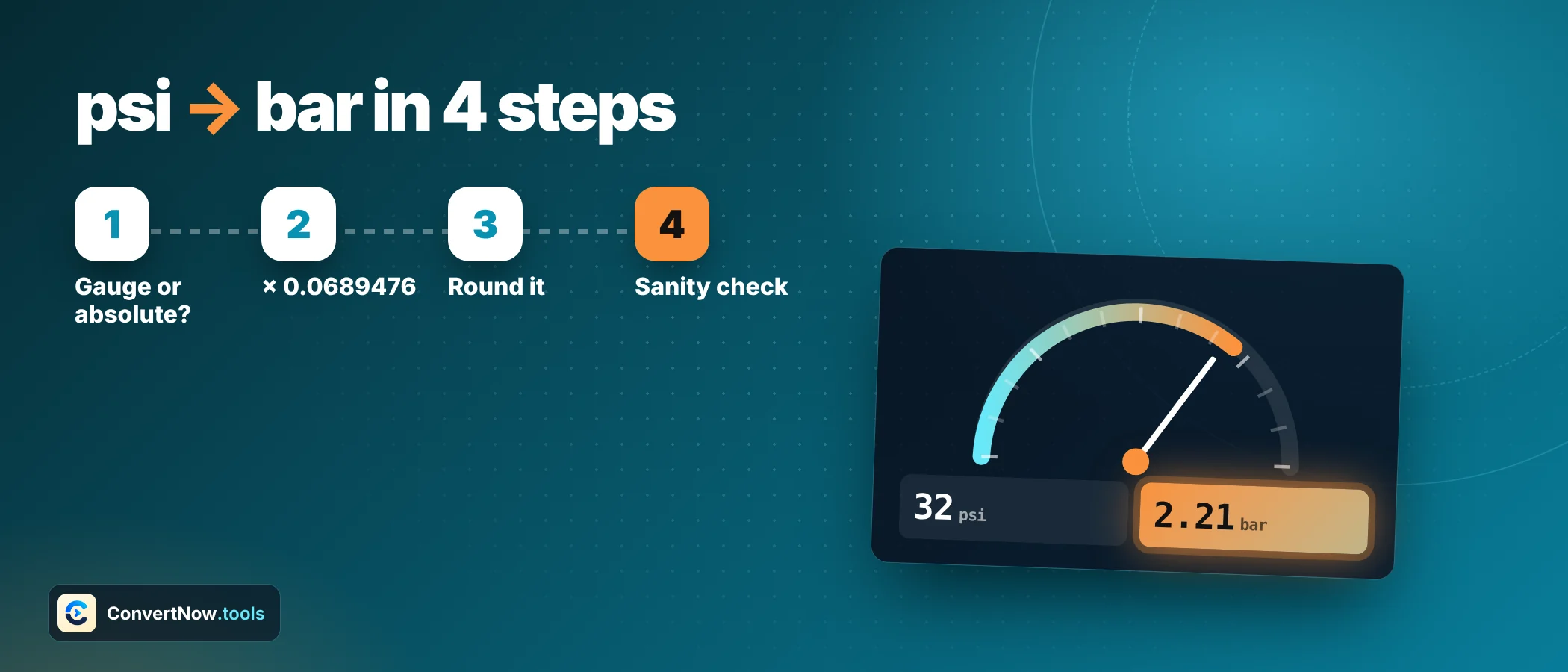
Converting psi to bar takes one multiplication, and getting it wrong can mean an under inflated tyre or an over filled cylinder. The factor is 0.0689476, so 32 psi is 2.21 bar. This playbook gives you that number and then the steps that keep the conversion trustworthy.
The method below works for tyres, compressors, hydraulics and medical readings. Each step has a reason, so you know what the step protects. If you want the figures without hand calculation, the Pressure Converter shows 19 units in one table.
The psi to bar playbook in eight steps
- Write the reading with its unitA bare 32 means nothing. Reason: most errors start when the unit is lost between the gauge and the notebook.
- Decide gauge or absoluteA gauge reads pressure above the air around it. Absolute counts from vacuum. Reason: the two differ by about 14.7 psi, or 1.013 bar, at sea level.
- Convert to pascals or use the direct factorOne psi is 6,894.757 Pa. One bar is 100,000 Pa. Reason: pascals are the hub unit, so two multiplications always work.
- Apply the psi to bar factorMultiply psi by 0.0689476 to get bar. Reason: multiplying is easier to check than dividing. The psi to bar factor never changes, so it is safe to memorise.
- Round for the taskTyres need one decimal, such as 2.2 bar. Hydraulics may need three. Reason: false precision is as bad as rounding too early.
- Compare against the limitCheck the result against the maximum on the tyre wall, tank plate or tool label. Reason: the conversion exists to enforce a limit.
- Convert backTake your bar answer, multiply by 14.5038 and confirm you get the psi you started with. Reason: it catches an upside down factor.
- Record both unitsWrite the psi and bar values side by side. Reason: the next person may read the other scale.
Enter a psi, bar, kPa, atm or mmHg value once and read all 19 units, ready to copy.
Open the Pressure ConverterStep 3 and 4: the factor, shown in use
The pascal sits at the centre of every pressure unit. That is why a psi to bar conversion works through 6,894.757 divided by 100,000, which is 0.06894757. Memorise 0.069 for estimates and use 0.0689476 for anything you will write down.
| Use | psi | psi to bar | kPa |
|---|---|---|---|
| Small car tyre | 32 | 2.21 | 220.6 |
| Loaded car tyre | 36 | 2.48 | 248.2 |
| Van tyre | 44 | 3.03 | 303.4 |
| Road bicycle tyre | 100 | 6.89 | 689.5 |
| Water mains, approx. | 60 | 4.14 | 413.7 |
| Pressure washer | 2,000 | 137.90 | 13,789.5 |
| Scuba tank, full | 3,000 | 206.84 | 20,684.3 |
On a 200 bar cylinder, 14.5 gives 2,900 psi. The accurate factor gives 2,900.75 psi. The 0.75 psi gap is small here, yet it grows on bigger numbers.
Step 2: Gauge versus absolute
Most tyre and tank gauges show gauge pressure. Physics formulas and weather data often use absolute pressure. Standard atmospheric pressure is exactly 101,325 Pa, which is 14.696 psi or 1.01325 bar. You can verify it on Wikipedia.
| Reading type | psi | bar | How to get it |
|---|---|---|---|
| Gauge (psig) | 32.0 | 2.21 | Read straight from the pump |
| Absolute (psia) | 46.7 | 3.22 | Gauge plus 14.696 psi |
Use gauge values whenever a manual says tyre pressure. Add the atmosphere only if the formula says absolute, such as a gas law calculation. Mixing the two is the second most common error after losing the unit.
Step 6: Check the limit before you trust the result
A conversion that lands slightly above a safe limit should change your plan, not your rounding. Here is the thing: a rated limit of 2.5 bar is 36.26 psi. A compressor set to 36 psi stays below it. One set to 37 psi does not.
| Rated limit | In psi | Your setting | Safe? |
|---|---|---|---|
| 2.5 bar | 36.26 | 36 psi | Yes, by 0.26 psi |
| 2.5 bar | 36.26 | 37 psi | No, over by 0.74 psi |
| 3.0 bar | 43.51 | 44 psi | No, over by 0.49 psi |
| 6.9 bar | 100.08 | 100 psi | Yes, by 0.08 psi |
Checklist one: before you convert psi to bar
Each line takes a few seconds. The unit family matters because mmHg and inches of water are columns of liquid, not force over area. They convert through pascals just like psi does, but they appear on blood pressure cuffs and weather charts, not on tyre gauges.
Step 5: Pick the right number of decimals
Precision should match what the instrument can show. A tyre gauge reads in steps of 1 psi, so 32 psi is 2.2 bar, not 2.2063. A lab sensor reading 1,013.25 hPa deserves two decimals. The rule: never report more digits than the source can support.
| Use | Instrument step | Report bar to |
|---|---|---|
| Car tyre | 1 psi | 1 decimal |
| Bicycle tyre | 5 psi | 1 decimal |
| Compressor | 0.1 bar | 2 decimals |
| Hydraulic test | 0.01 bar | 3 decimals |
| Weather | 0.1 hPa | 4 decimals (in bar) |
Other units you will meet
Not every gauge uses psi or bar. Older European equipment may show kgf/cm2, which is 0.980665 bar. A technical atmosphere is the same number. Medical devices use mmHg, where 120 mmHg is 2.32 psi, or 16.0 kPa. A weather barometer at 1,013.25 hPa corresponds to 29.92 inches of mercury.
Do not treat torr and mmHg as separate in daily use. They differ by about 0.14 parts per million, which no gauge can show. The Pressure Converter still keeps both entries, which matters only in laboratory work.
Worked example: psi to bar on a pressure washer
A pressure washer is sold in the US at 2,000 psi. You live in a country where the hose fittings and the safety guidance use bar. Run the playbook once, start to finish, and watch where each step earns its place.
- Unit and type2,000 psi, gauge, because a washer pump reports output above the surrounding air.
- Factor2,000 times 0.0689476 equals 137.9 bar.
- Limit checkThe hose is rated 160 bar working pressure. 137.9 is below it with a margin of 22.1 bar, about 14 percent.
- Back conversion137.9 times 14.5038 equals 2,000.0 psi. The loop closes.
Now suppose the hose were rated 120 bar. The same maths shows 137.9 bar is 17.9 bar over, so the washer should not be paired with that hose at all. The conversion did not change anything physical. It simply made a hidden problem visible before water started flowing.
Mistakes the playbook prevents
| Mistake | Result | Step that catches it |
|---|---|---|
| Divide instead of multiply | 32 psi becomes 464 bar | Step 7, convert back |
| Use gauge in a gas law | Answer off by 14.7 psi | Step 2, decide the type |
| Round 0.0689 to 0.07 | 32 psi shows 2.24 bar, 1.5 percent high | Step 4, full factor |
| Lose the unit in notes | Next person guesses | Step 1 and step 8 |
| Treat bar as one atmosphere | 1.3 percent error | Step 3, use pascals |
None of these errors needs special skill to make. They happen on a busy day, with a cold pump and a half read label. A written routine takes the guesswork out, and that is the whole value of a playbook.
Checklist two: after you convert
Related checks
Pressure is force per area, so the Area Converter helps when a spec uses square centimetres or square inches. Gas problems often need the Temperature Converter as well.
2.4 times 14.5038 equals 34.81 psi. The value 24 comes from ignoring the factor and 16.5 comes from dividing instead of multiplying.
The standard atmosphere is fixed at 101,325 Pa. That is 1.01325 bar, so it is close to, but not the same as, 1 bar.
Frequently asked questions
How do I convert psi to bar?
Multiply psi by 0.0689476. For example, 50 psi is 3.45 bar. That psi to bar factor holds for every value.
How many psi is 1 bar?
One bar is 14.5038 psi. For rough work 14.5 is close enough.
Is 2.2 bar the same as 32 psi in a psi to bar check?
Almost. 32 psi is 2.206 bar, and 2.2 bar is 31.9 psi. Tyre makers round to one decimal, so the two are treated as equal.
What is the difference between psig and psia?
Psig is gauge pressure above the surrounding air. Psia is absolute pressure measured from vacuum. Add about 14.7 psi to a psig value to get psia at sea level.
How is psi to bar different from psi to kPa?
Multiply psi by 6.894757. So 32 psi is 220.6 kPa. The psi to bar factor is the same number divided by 100.
Is bar the same as an atmosphere?
Not exactly. One standard atmosphere is 1.01325 bar, so the two differ by about 1.3 percent.