

How to Calculate GST: 9 Simple Rules, No Costly Errors
You have a price and a tax rate, and you need the other number. How to calculate GST depends on one question: does your amount already include the tax? Answer that first and the rest is a single multiplication or a single division.
The formulas are short, but the mistakes around them are not. Learning how to calculate GST well means learning where people slip. People subtract instead of dividing, split the tax wrongly between states, or apply a rate that changed. The nine rules below cover each of those, with a lookup table you can keep open while you invoice.
What this guide covers
- How to calculate GST: what it is and why the base matters
- Working in both directions
- Rule 1 to 3: start with the direction
- Rule 4 and 5: where the sale happens
- Rule 6 and 7: one rounding and the current rate
- Rule 8 and 9: item class, keeping tax out of cost
- Quick lookup: tax inside an inclusive price
- A worked invoice from start to finish
- Where mistakes still creep in
How to calculate GST: what it is and why the base matters
Goods and Services Tax replaced a stack of central and state levies in India on 1 July 2017. It is charged as a percentage of the taxable value, which is the price before tax. That price is the base. Everything else, the tax amount and the final total, is built from it.
Here is the thing. The tax is always a share of the base, never a share of the total. Once you hold that idea, the add and remove directions stop feeling like separate topics. They are the same relationship read forwards and backwards.
Working in both directions
Take a base of 12,500 rupees. At 18 percent the tax is 12,500 × 18 ÷ 100 = 2,250, and the total is 14,750. That is the forward direction, and it is the one most people know. Every method for how to calculate GST reduces to these two lines.
The reverse direction starts from the 14,750 and asks what the base was. You divide by 1.18 and land on 12,500. The tax is then the difference, 2,250. The table shows both directions at the three rates most invoices use today. That is how to calculate GST backwards in one step.
| Base amount | Rate | GST amount | Total with GST |
|---|---|---|---|
| 1,000 | 5% | 50.00 | 1,050.00 |
| 1,000 | 18% | 180.00 | 1,180.00 |
| 1,000 | 40% | 400.00 | 1,400.00 |
| 2,500 | 18% | 450.00 | 2,950.00 |
| 12,500 | 5% | 625.00 | 13,125.00 |
| 12,500 | 18% | 2,250.00 | 14,750.00 |
| 48,000 | 18% | 8,640.00 | 56,640.00 |
| 48,000 | 40% | 19,200.00 | 67,200.00 |
Rule 1 to 3: start with the direction
- Rule 1. Find out if the amount is inclusive. A shelf price in a shop is usually inclusive. A quotation from a supplier is often before tax. Guessing here shifts every later figure.
- Rule 2. To add GST, multiply the base by the rate and add it. Tax = base × rate ÷ 100. Total = base + tax. A base of 2,500 at 18 percent gives 450 of tax and 2,950 in total.
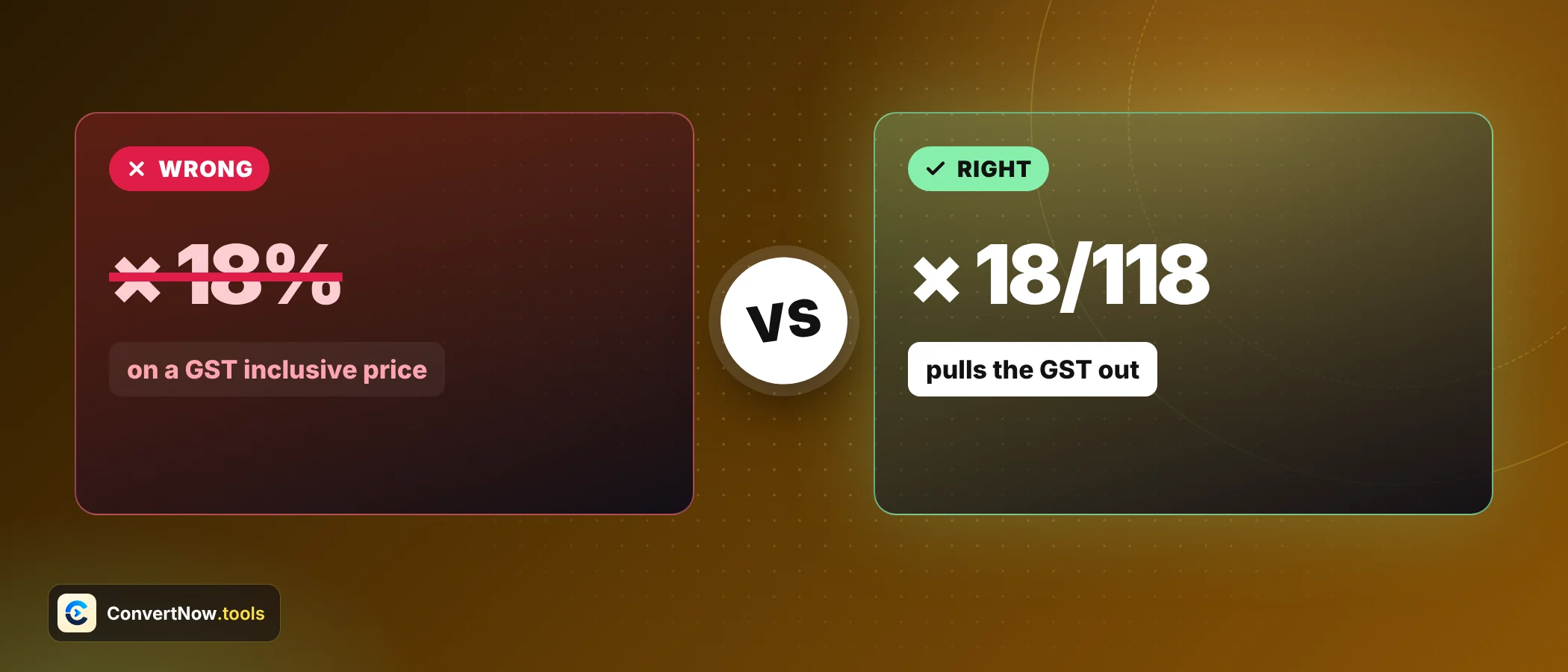
- Rule 3. To remove GST, divide. Never subtract the percentage. Base = inclusive amount ÷ (1 + rate ÷ 100). This is the rule people break most often.
Take 1,180 and subtract 18 percent. You get 967.60, which is wrong by more than 32 rupees. The 18 percent was charged on the base of 1,000, not on 1,180. Dividing by 1.18 returns exactly 1,000.
| Inclusive amount | Rate | Base (divide) | GST inside the amount | Wrong answer if you subtract |
|---|---|---|---|---|
| 1,050 | 5% | 1,000.00 | 50.00 | 997.50 |
| 1,180 | 18% | 1,000.00 | 180.00 | 967.60 |
| 5,900 | 18% | 5,000.00 | 900.00 | 4,838.00 |
| 2,800 | 40% | 2,000.00 | 800.00 | 1,680.00 |
| 14,000 | 18% | 11,864.41 | 2,135.59 | 11,480.00 |
Notice that the tax hidden inside an inclusive price is a smaller share of that price than the headline rate. At 18 percent it is 15.25 percent of the total. At 5 percent it is 4.76 percent. At 40 percent it is 28.57 percent. This matters when you learn how to calculate GST from a shelf price.
Rule 4 and 5: where the sale happens
- Rule 4. Inside one state, split the tax in half. The seller charges CGST for the Centre and SGST for the state, each at half the rate. At 18 percent that is 9 percent plus 9 percent. On a base of 1,000, you show 90 of CGST and 90 of SGST.
- Rule 5. Between two states, charge IGST at the full rate. The Centre collects it and shares it with the state of consumption. The buyer pays the same 180, shown on one line.
Intrastate sale (same state)
- Tax lines: CGST and SGST
- Each line is half the rate
- 18 percent shows as 9 plus 9
- Base 1,000 gives 90 plus 90
Interstate sale (different states)
- Tax line: IGST only
- One line at the full rate
- 18 percent shows as 18
- Base 1,000 gives 180
The buyer pays the same total either way. Only the accounting changes. If a vendor shows the wrong pair of lines for the location of supply, the invoice can cause trouble for the buyer when claiming credit, so check this before you accept a bill. Knowing how to calculate GST on both lines lets you spot a wrong pair at once.
Rule 6 and 7: one rounding and the current rate
- Rule 6. Round the money, not the steps. Whatever method you use to calculate GST, work with full precision and round only the figures you print. When you halve a tax amount, the two halves can disagree by a paisa. A base of 20.20 at 5 percent gives tax of 1.01. Half of that is 0.505, which rounds to 0.51 on each line and prints as 1.02 in total. Decide on one convention and apply it on every invoice.
- Rule 7. Use the rate in force on the date of supply. Rates change by notification. On 22 September 2025 the 12 percent and 28 percent slabs were removed, leaving 5 percent and 18 percent as the main rates, with 40 percent for a short list of luxury and sin goods. Old software, old price lists and old blog posts may still show the earlier slabs.
| Period | Main slabs | Notes |
|---|---|---|
| July 2017 to 21 Sept 2025 | 0, 5, 12, 18, 28 percent | Cess applied on top for some demerit goods |
| From 22 Sept 2025 | 0, 5, 18, 40 percent | 12 and 28 percent slabs removed |
| Special rates | 0.25 and 3 percent | Kept for items such as rough diamonds and gold |
Presets can lag behind a notification. If your item moved to another slab, type the rate yourself. The same formula works for any percentage, which also makes it usable for VAT at 20 percent or other rates.
Enter a base or an inclusive amount, pick a rate or type your own, and see CGST, SGST and IGST at once. Everything runs in your browser.
Open the GST CalculatorRule 8 and 9: item class, keeping tax out of cost
- Rule 8. The rate follows the item, not the seller. Goods carry an HSN code and services a SAC code. The same shop can sell one product at 5 percent and another at 18 percent. Look up the code on the official portal before quoting.
- Rule 9. Calculate cost on the base, not the total. If you are registered and can claim input credit, the GST you paid is not your cost. A supplier invoice of 11,800 at 18 percent means a cost of 10,000. If you are not eligible for credit, the full 11,800 is your cost.
Quick lookup: tax inside an inclusive price
When you want to know how to calculate GST in your head, start from an inclusive total and multiply by the fraction below to get the tax inside it. This is faster than finding the base first.
| Rate | Tax share of total | Fraction | Example total | Tax inside |
|---|---|---|---|---|
| 5% | 4.76% | 5 ÷ 105 | 2,100 | 100.00 |
| 18% | 15.25% | 18 ÷ 118 | 11,800 | 1,800.00 |
| 40% | 28.57% | 40 ÷ 140 | 7,000 | 2,000.00 |
How to calculate GST: plain formulas you can paste into a spreadsheet
Tax on base = base * rate / 100
Total from base = base * (1 + rate / 100)
Base from total = total / (1 + rate / 100)
Tax inside total = total - base
CGST = SGST = tax / 2
IGST = taxA worked invoice from start to finish
Here is how to calculate GST on a real invoice. A freelancer in Pune quotes 75,000 rupees for a design project at 18 percent. The client is in the same state, so the invoice shows CGST and SGST.
- Fix the baseThe quote is before tax, so the base is 75,000.
- Compute the tax75,000 × 18 ÷ 100 = 13,500.
- Split it13,500 ÷ 2 = 6,750 of CGST and 6,750 of SGST.
- Add up75,000 + 13,500 = 88,500 is the invoice total.
- Check by reversing88,500 ÷ 1.18 = 75,000. The numbers agree, so the invoice is clean.
If the client had been in another state, the only change would be one IGST line of 13,500. Same total, one fewer line. You can build the document itself with the Free Invoice Generator and check percentage steps with the Percentage Calculator.
Where mistakes still creep in
- Applying the rate to a discounted total when the law taxes the price before the discount. Check how your discount is documented.
- Mixing items at different rates on one bill and using a single rate for the whole amount. Calculate each line, then add.
- Treating a rounded price as exact. A shelf price of 999 at 18 percent has a base of 846.61, not a tidy number.
- Forgetting extra levies such as cess on certain goods, which sit outside the plain formulas above.
Questions on how to calculate GST
How to calculate GST at 18 percent on 1000?
Multiply 1,000 by 18 and divide by 100 to get 180. The total is 1,180. Inside one state, that 180 is 90 of CGST and 90 of SGST.
How to calculate GST when the price already includes it?
Divide the total by 1 plus the rate over 100. For 1,180 at 18 percent, divide by 1.18 to get a base of 1,000. Do not subtract 18 percent of the total.
What are the GST rates in India now?
Since 22 September 2025 the main rates are 5 percent and 18 percent, with 40 percent on a short list of luxury and sin goods and 0 percent on exempt items. A few special rates such as 0.25 and 3 percent remain.
What is the difference between CGST, SGST and IGST?
CGST and SGST are charged together on a sale within one state, each at half the rate. IGST is charged at the full rate on a sale between states.
Does the method for how to calculate GST also work for VAT?
Yes. VAT is also a percentage of the pre tax price, so the same add and remove formulas work. Enter the local VAT rate as a custom rate.
Why does my total from how to calculate GST differ by a paisa from the vendor invoice?
Rounding is the usual cause. Halving a tax amount can leave the two lines a paisa apart from the combined figure, so vendors pick a convention and stick to it.