
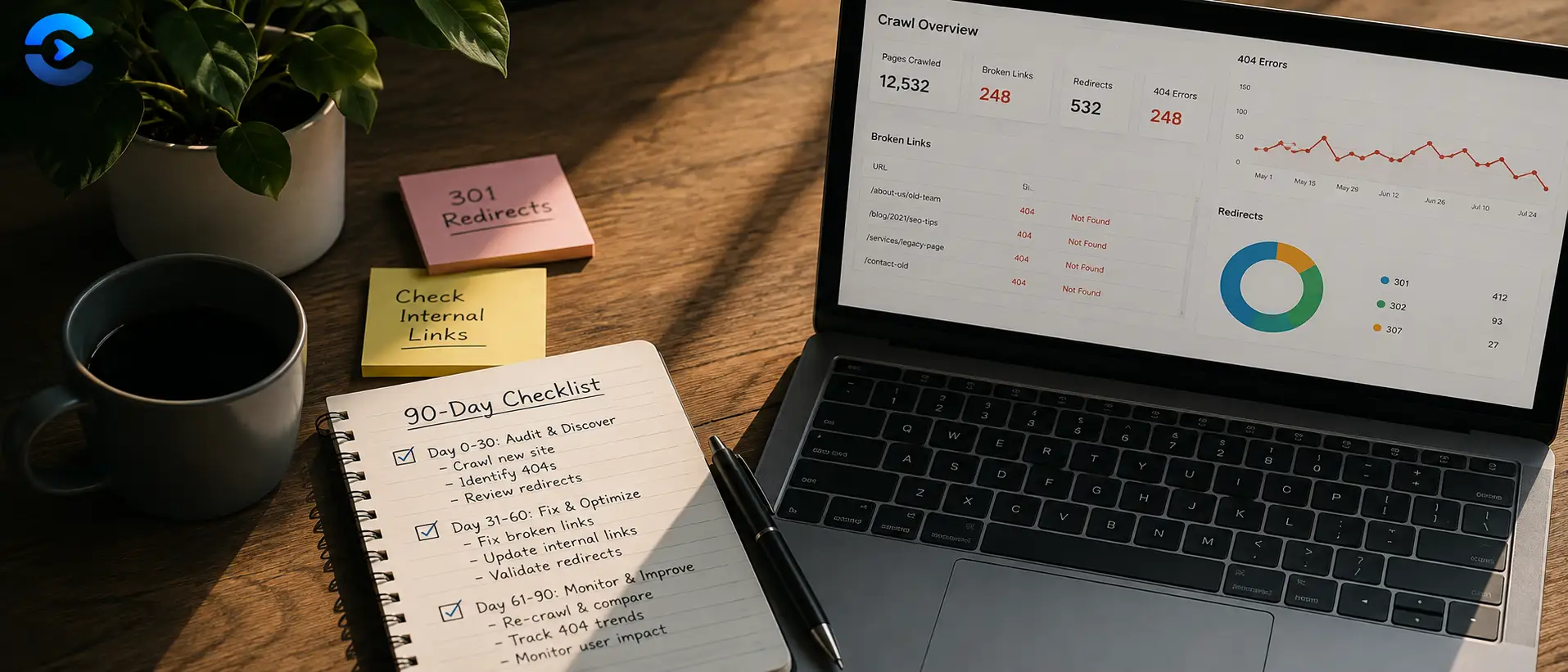

Broken Link Checklist After Site Migration: 90 Day Plan
A broken link checklist after site migration should not stop on launch day. Check again at day 1, week 1, day 30, and day 90, since old bookmarks, external backlinks, cached search results, and slow moving crawlers all surface broken paths at different speeds. Spreading checks across ninety days catches problems a single launch day scan will always miss.
Why broken links appear gradually, not all at once
A migration touches every URL on a site at the same time, but the consequences of that change do not surface all at once. Search engines recrawl pages on their own schedule. Visitors following old bookmarks or saved links show up over weeks, not hours. That is why a proper broken link checklist after site migration spreads checks across months instead of treating launch day as the finish line.
What breaks immediately
Internal navigation, main menus, and anything linked from the homepage should be checked the moment the new site goes live. These are high visibility paths, and a broken link here is noticed fast by real visitors.
What breaks slowly
Old blog posts linking to now moved pages, external sites linking to your old URL structure, and search engine cached snapshots all reveal problems on their own timeline. Some of these will not surface until a crawler revisits a page weeks after launch.
The ninety day monitoring schedule
| Checkpoint | What to check |
|---|---|
| Day 1 | Main navigation, homepage links, top landing pages, checkout or signup flows |
| Week 1 | Full site crawl for internal 404s, redirect chains, and orphaned pages |
| Day 30 | External backlinks from other sites, old bookmarked URLs, search console crawl errors |
| Day 90 | Long tail pages, seasonal content, and any links search engines only recently reindexed |
Checklist for each checkpoint
- Run a full site crawl and compare the broken link count against the previous checkpoint.
- Check search engine crawl error reports for new 404s that were not flagged manually.
- Verify old URLs redirect to their correct new destination, not just to the homepage.
- Spot check external sites that historically linked to your old URL structure.
- Log every fix so you can tell whether the problem count is trending down over time.
Quick answer: Broken link checklist after site migration
To sum up broken link checklist after site migration in one place, keep the core idea in mind as you apply it: check the actual numbers for your situation rather than relying on a rule of thumb alone, and revisit the calculation whenever the underlying inputs change. Small details often change the outcome more than people expect, so it pays to redo the math once your numbers shift. A quick recheck now saves a bigger correction later, especially once real data replaces an early estimate. Keep the process simple and repeatable so you can run it again next time without relearning the steps. Write down the inputs you used so you can compare results later and spot any change over time. This habit matters more as the stakes go up, since a small early error tends to compound the longer it goes unnoticed.
Getting comfortable with site migration
Getting this right matters because small errors compound the longer they go unnoticed, and a quick sanity check now saves a bigger correction later. Write down the inputs and assumptions you used so you can compare results later and spot exactly what changed if the numbers look different next time. Treat any online tool as a way to confirm your own reasoning rather than a black box, since understanding the logic behind the number is what actually builds confidence. Real world data is rarely as clean as a textbook example, so expect to make small adjustments once you apply the same method to your own numbers. Keep the process simple and repeatable so you can run it again next month or next year without relearning the steps from scratch. A second pair of eyes, or a second tool, is a cheap way to catch a mistake before it turns into a bigger problem downstream.
Most people get this wrong the first time not because the concept is hard, but because a small step gets skipped under time pressure. Once the basic method clicks, the same logic tends to show up again in other parts of the same field, which makes the extra few minutes spent learning it worthwhile. Getting this right matters because small errors compound the longer they go unnoticed, and a quick sanity check now saves a bigger correction later. Write down the inputs and assumptions you used so you can compare results later and spot exactly what changed if the numbers look different next time.
Run a full scan at every checkpoint
Catch broken paths before visitors or search engines do with the Broken Link Checker.
Open the Broken Link CheckerRelated tools for post migration monitoring
Broken links are only one migration risk. If pages feel slower after the move, the Page Speed Analyzer can confirm whether load times actually changed. Visual regressions are easy to miss too, so the Website Screenshot Tool is useful for comparing how key pages render before and after. Once the site is stable, resubmitting an updated XML Sitemap Generator file helps search engines recrawl the new structure faster. More monitoring tips live on the ConvertNow blog.
Key takeaway
Checking once on launch day is not enough. Spread checks across day 1, week 1, day 30, and day 90, and lean on the Broken Link Checker at each stage to catch what slipped through.
FAQ: Broken Link Checklist After Site Migration
When should I check for broken links after a site migration?
Check on day 1, again at week 1, then at day 30, and once more at day 90. Broken links surface at different speeds depending on how visitors and search engines find them.
Why do broken links appear weeks after launch instead of immediately?
Search engines recrawl pages on their own schedule, and visitors following old bookmarks or external links arrive gradually over time, not all at once on launch day.
What should I check on launch day?
Focus on main navigation, homepage links, top landing pages, and any checkout or signup flows, since these are the highest visibility paths on the site.
What should I check at the day 30 mark?
Review external backlinks from other sites, old bookmarked URLs, and crawl error reports from search console to catch problems that took time to surface.
What should I check at the day 90 mark?
Check long tail pages, seasonal content, and any links search engines only recently reindexed, since these are often the last to reveal migration issues.
Do redirects need to be checked separately from broken links?
Yes. A redirect that points to the wrong page or creates a chain is a different problem than a page returning a 404, so both should be verified at each checkpoint.
How do I know if my broken link count is improving over time?
Log the results from each checkpoint and compare them. A steadily declining count across day 1, week 1, day 30, and day 90 shows the migration is stabilizing.