
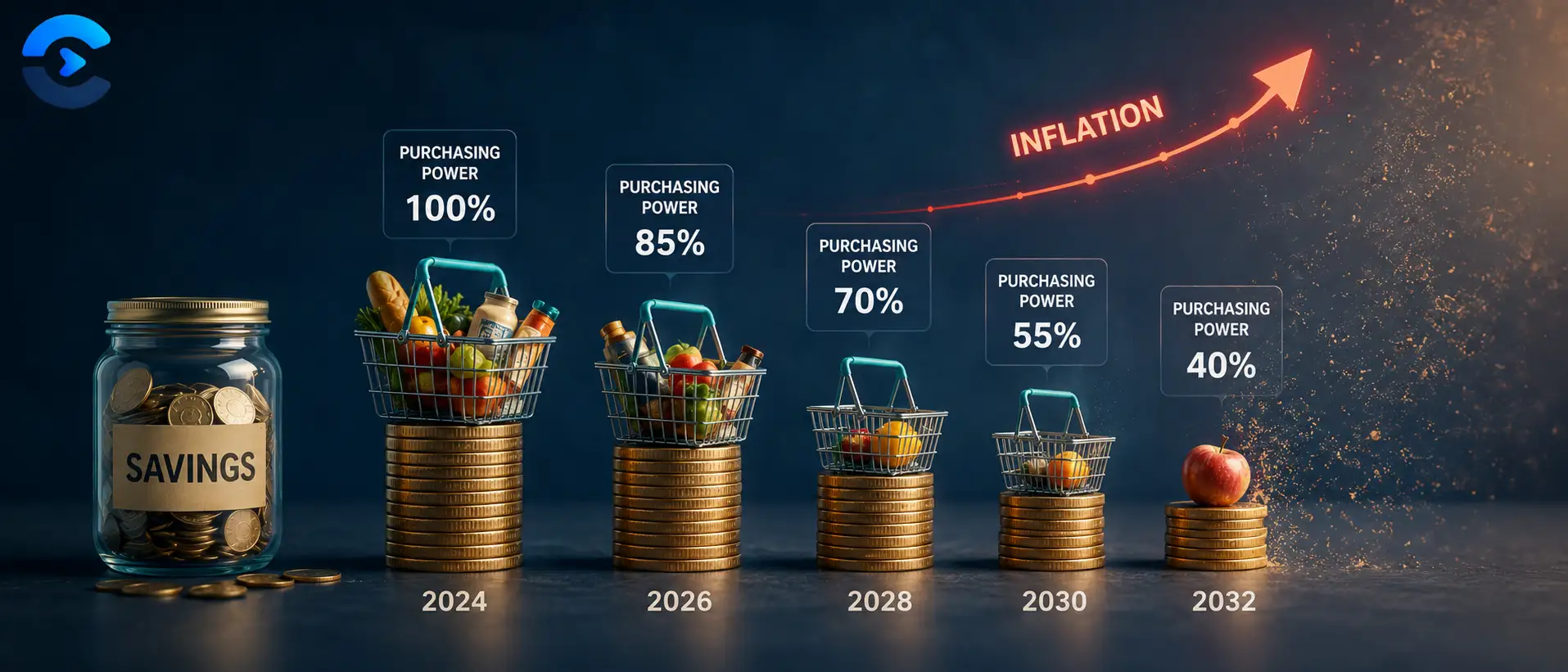

The Effect of Inflation on Savings, Shown With Real Numbers
The effect of inflation on savings is that cash sitting in a low interest account loses buying power every year, even while the account balance itself keeps growing. Ten thousand dollars earning 0.5 percent interest in a savings account, under an average 3 percent inflation rate, is worth roughly 7,820 dollars in today's purchasing power after ten years, and roughly 6,120 dollars after twenty. The number on the statement goes up, but what that number can actually buy goes down, and that gap is the real cost of leaving cash idle.
Tracking one savings balance across two decades
Start with 10,000 dollars sitting in a standard savings account earning 0.5 percent interest annually, a rate common at many large banks. After one year the balance grows to about 10,050 dollars, and after ten years of compounding it reaches roughly 10,511 dollars. On paper that looks like slow but steady progress. Now apply an average annual inflation rate of 3 percent, roughly the long run historical average in many developed economies, and convert that ending balance back into today's purchasing power.
The real value of that 10,511 dollar balance turns out to be close to 7,820 dollars measured in what the original 10,000 dollars could buy. The account never lost a dollar on the statement, yet it lost more than a fifth of its actual buying power.
What happens after twenty years
Extend the same scenario to twenty years. The nominal balance, still growing at 0.5 percent, reaches approximately 11,050 dollars. Under the same 3 percent inflation assumption, that balance is worth roughly 6,120 dollars in today's terms, a loss of almost 40 percent of its original purchasing power despite two decades of consistent interest payments. This is the quiet part of the effect of inflation on savings that a bank statement never shows directly: the number grows, but the value it represents can shrink at the same time.
Real return matters more than the printed rate
The printed interest rate on a savings account is called the nominal rate. What actually matters for your purchasing power is the real rate, which is roughly the nominal rate minus the inflation rate. A 0.5 percent nominal rate against 3 percent inflation produces a real return close to negative 2.5 percent, meaning the account is losing value in real terms every single year, regardless of how healthy the balance looks. Any savings vehicle with a real return below zero is quietly shrinking your future spending power, even as the number on screen keeps climbing.
The effect of inflation on savings is that cash sitting in a low interest account loses buying power every year, even while the account balance itself keeps growing.
Ten and twenty year comparison
| Time period | Nominal balance | Real purchasing power |
|---|---|---|
| Start | 10,000 dollars | 10,000 dollars |
| 10 years | Approximately 10,511 dollars | Approximately 7,820 dollars |
| 20 years | Approximately 11,050 dollars | Approximately 6,120 dollars |
See what your own savings will really be worth
The Inflation Calculator converts any amount into its future or past purchasing power using real inflation data, so you can see exactly how much value a fixed cash amount loses over any time period you choose.
Open the Inflation CalculatorA short checklist for protecting real value
- Always compare an account's interest rate against current and historical inflation, not in isolation.
- Calculate real return by subtracting inflation from the nominal rate before judging any savings product.
- Keep only what you need for near term expenses in low yield cash accounts.
- Consider inflation protected or growth oriented options for money you will not touch for years.
- Recheck purchasing power projections whenever inflation trends shift noticeably.
Compare cash against growth
Once you understand how much a fixed cash balance can lose to inflation, it helps to compare that against what a growth oriented account could return instead. The Compound Interest Calculator shows how a higher yielding account grows over the same time periods, so you can weigh real return against real inflation side by side. For more calculators covering loans, savings goals, and budgeting, browse the full set of Finance tools, and visit the ConvertNow blog for more posts on protecting money from quiet, long term loss of value.
Bottom line for savers
A growing balance is not the same as growing wealth. The real effect of inflation on savings only becomes visible when you compare the interest rate against inflation and look at purchasing power, not the number on the screen. Try the Inflation Calculator with your own savings amount to see the gap for yourself.
The effect of inflation on savings under different rates
The post above uses a 0.5 percent account and 3 percent inflation. Real life offers other combinations. Here we test more of them to show how the effect of inflation on savings changes when either number moves.
How does the effect of inflation on savings change with a better rate?
Take 10,000 dollars for 10 years. The table shows what each account is worth in today buying power, calculated by dividing the final balance by the cumulative price rise.
| Account rate | Inflation | Nominal balance | Real value | Effect of inflation on savings |
|---|---|---|---|---|
| 0.5 percent | 2 percent | 10,511 dollars | 8,623 dollars | Effect of inflation on savings: real loss of about 14 percent |
| 0.5 percent | 5 percent | 10,511 dollars | 6,453 dollars | Real loss of about 35 percent |
| 4 percent | 3 percent | 14,802 dollars | 11,014 dollars | Small real gain of about 10 percent |
| 4 percent | 5 percent | 14,802 dollars | 9,087 dollars | Real loss of about 9 percent |
| 5 percent | 5 percent | 16,289 dollars | 10,000 dollars | Effect of inflation on savings is neutral |
The last row is the whole lesson. When the rate equals inflation, the effect of inflation on savings cancels the interest exactly.
What is the exact formula for the effect of inflation on savings?
Subtracting inflation from the rate is a quick guide to the effect of inflation on savings. The exact real return is the nominal growth factor divided by the inflation factor, minus one. For 0.5 percent against 3 percent that is 1.005 divided by 1.03 minus 1, or negative 2.43 percent a year. The quick subtraction gave negative 2.5, close enough for planning, but the exact figure is what drives the effect of inflation on savings over decades.
How long until the effect of inflation on savings halves your money?
Use the rule of 72. Divide 72 by the inflation rate. At 3 percent, prices double in about 24 years, so cash loses half its buying power in that time. At 2 percent it takes 36 years. At 5 percent it takes about 14 years. The higher the rate, the faster the effect of inflation on savings bites.
- At 2 percent inflation, halving takes about 36 years.
- At 3 percent, about 24 years.
- At 5 percent, about 14 years.
- Keep an emergency fund in cash, but do not let the effect of inflation on savings grow by holding more than you need.
Does the effect of inflation on savings hit everyone equally?
No. Your personal inflation rate depends on what you buy. Rent, food and fuel rise at different speeds. A household spending most income on rent feels the effect of inflation on savings more than headline numbers show. Compare your own spending year on year to see your own figure.
| Saver | Habit | Exposure to the effect of inflation on savings |
|---|---|---|
| Holds six months of cash | Emergency fund only | Low effect of inflation on savings, since the balance is spent soon |
| Holds ten years of spending in cash | No investing | High, as the effect of inflation on savings compounds |
| Holds cash for a house deposit in 2 years | Short goal | Moderate effect of inflation on savings, so choose a safe product |
| Holds cash for retirement in 25 years | Long goal | Very high effect of inflation on savings over the full term |
What can you do about the effect of inflation on savings?
Compare your rate with inflation each year and move surplus cash to something that has a chance of beating it. Run your own numbers in the inflation calculator and project growth with the compound interest calculator. Seeing the effect of inflation on savings in dollars makes the decision easier than reading about it.
| # | Key takeaway |
|---|---|
| 1 | Always compare an account's interest rate against current and historical inflation, not in isolation. |
| 2 | Calculate real return by subtracting inflation from the nominal rate before judging any savings product. |
| 3 | Keep only what you need for near term expenses in low yield cash accounts. |
| 4 | Consider inflation protected or growth oriented options for money you will not touch for years. |
FAQ: The Effect of Inflation on Savings
What is the effect of inflation on savings held in cash?
Cash and low interest savings accounts lose purchasing power over time whenever inflation outpaces the interest earned, meaning the balance can grow in nominal terms while its real value shrinks.
How much value does 10,000 dollars lose to inflation in 10 years?
Under an average 3 percent inflation rate, 10,000 dollars sitting mostly idle loses roughly a fifth of its purchasing power over ten years, even while a small interest rate keeps the nominal balance rising.
What is real return and why does it matter more than interest rate?
Real return is the interest rate minus the inflation rate, and it reflects how much actual purchasing power an account gains or loses. A printed interest rate alone can look positive while the real return is negative.
Can a savings account have negative real return?
Yes, whenever the inflation rate is higher than the interest rate paid, the real return becomes negative, meaning the account loses buying power each year despite a rising balance.
Does keeping cash in a savings account protect against inflation?
Only partially. A savings account protects against some loss compared to holding physical cash with no interest at all, but if the rate paid is below inflation, purchasing power still declines over time.
What inflation rate should I use for long term planning?
Many planners use the long run historical average of around 3 percent for developed economies, though actual rates vary by country and by decade, so checking recent trends alongside the historical average is wise.
How can I check the effect of inflation on savings for my own numbers?
Enter your starting amount, expected interest rate, an inflation assumption, and a time period into an inflation calculator to see both the nominal balance and the equivalent purchasing power at the end of that period.
Sources and further reading
- US Bureau of Labor Statistics: CPI: official inflation data.
- Real interest rate on Wikipedia: nominal rate minus inflation, explained.