

Nm to Ft Lb Cheat Sheet: 45 Fast, Exact Torque Values
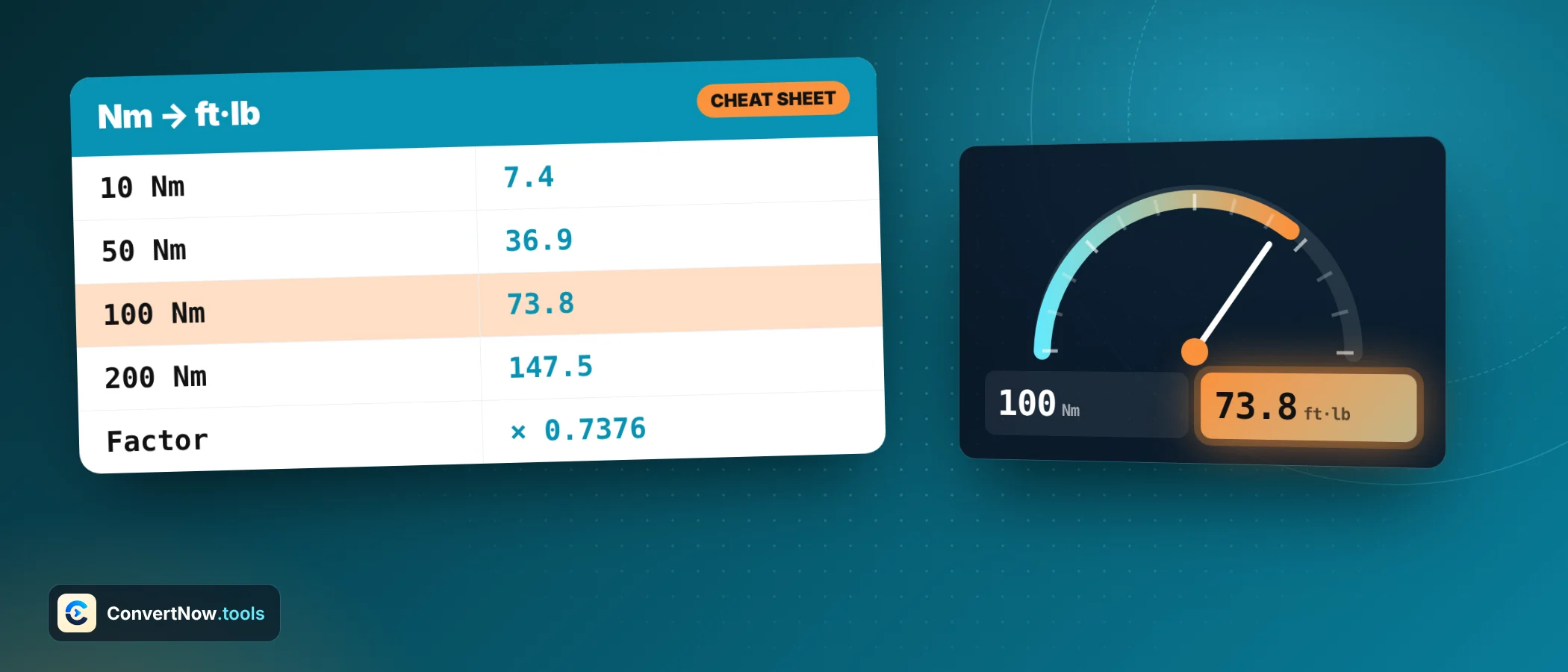
Need nm to ft lb right now? Multiply the newton metre value by 0.7376 and you have foot pounds. A 100 N·m spec becomes 73.76 ft lb. The rest of this page is a lookup sheet you can keep open next to the torque wrench.
For nm to ft lb work, remember that torque is a force times a distance, so it needs both parts in the unit. Use the tables for fast nm to ft lb answers, and open the Torque Converter when your value falls between the rows.
The nm to ft lb factor sheet
| Unit | Symbol | N·m per unit | Units per N·m |
|---|---|---|---|
| Newton metre | N·m | 1 | 1 |
| Foot pound | ft lb | 1.355818 | 0.737562 |
| Inch pound | in lb | 0.112985 | 8.85075 |
| Ounce inch | oz in | 0.00706155 | 141.612 |
| Kilogram force metre | kgf·m | 9.80665 | 0.101972 |
| Kilogram force centimetre | kgf·cm | 0.0980665 | 10.1972 |
| Kilonewton metre | kN·m | 1,000 | 0.001 |
A kilogram force is the weight of one kilogram under standard gravity, 9.80665 m/s squared. That is where 9.80665 comes from. The torque is defined as force times lever arm, as the Wikipedia article on torque explains, and the factor simply carries gravity along with it.
Torque table: 22 common values
Use the group buttons to show only small, medium or large values. The small group covers bicycle and electronics work, the medium group covers most engine and suspension bolts, and the large group covers wheels, axles and structural fasteners. All nm to ft lb values are rounded to the digits shown, and the exact factor is in the sheet above.
| N·m | ft lb | in lb | kgf·m |
|---|---|---|---|
| 1 | 0.74 | 8.9 | 0.10 |
| 2 | 1.48 | 17.7 | 0.20 |
| 4 | 2.95 | 35.4 | 0.41 |
| 5 | 3.69 | 44.3 | 0.51 |
| 6 | 4.43 | 53.1 | 0.61 |
| 8 | 5.90 | 70.8 | 0.82 |
| 10 | 7.38 | 88.5 | 1.02 |
| 12 | 8.85 | 106.2 | 1.22 |
| 15 | 11.06 | 132.8 | 1.53 |
| 20 | 14.75 | 177.0 | 2.04 |
| 25 | 18.44 | 221.3 | 2.55 |
| 30 | 22.13 | 265.5 | 3.06 |
| 40 | 29.50 | 354.0 | 4.08 |
| 50 | 36.88 | 442.5 | 5.10 |
| 60 | 44.25 | 531.0 | 6.12 |
| 80 | 59.00 | 708.1 | 8.16 |
| 100 | 73.76 | 885.1 | 10.20 |
| 120 | 88.51 | 1,062.1 | 12.24 |
| 150 | 110.63 | 1,327.6 | 15.30 |
| 200 | 147.51 | 1,770.1 | 20.39 |
| 250 | 184.39 | 2,212.7 | 25.49 |
| 300 | 221.27 | 2,655.2 | 30.59 |
Skip the manual nm to ft lb maths: enter a value in any torque unit and see all eight units side by side, with the target row highlighted.
Open the Torque ConverterThe reverse: ft lb to Nm
US tool boxes and service manuals speak in foot pounds, so the reverse trip matters just as much. To undo an nm to ft lb result, multiply by 1.3558 and round to one decimal, which is plenty for a torque wrench scale. The inch pound column is there to help you switch to a smaller wrench.
| ft lb | N·m | in lb |
|---|---|---|
| 5 | 6.8 | 60 |
| 10 | 13.6 | 120 |
| 15 | 20.3 | 180 |
| 20 | 27.1 | 240 |
| 25 | 33.9 | 300 |
| 30 | 40.7 | 360 |
| 40 | 54.2 | 480 |
| 50 | 67.8 | 600 |
| 60 | 81.3 | 720 |
| 75 | 101.7 | 900 |
| 80 | 108.5 | 960 |
| 90 | 122.0 | 1,080 |
| 100 | 135.6 | 1,200 |
| 150 | 203.4 | 1,800 |
| 200 | 271.2 | 2,400 |
| 250 | 339.0 | 3,000 |
Inch pound table for small fasteners
Electronics, bicycle components and small housings use inch pounds or newton metres in single digits. Twelve inch pounds make one foot pound, which is why the numbers look big.
| in lb | N·m | ft lb |
|---|---|---|
| 10 | 1.13 | 0.83 |
| 20 | 2.26 | 1.67 |
| 30 | 3.39 | 2.50 |
| 50 | 5.65 | 4.17 |
| 60 | 6.78 | 5.00 |
| 100 | 11.30 | 8.33 |
| 120 | 13.56 | 10.00 |
How to use this sheet in three moves
- Find the unit before any nm to ft lb stepLook for N·m, ft lb, in lb or kgf·m. If the spec only says lb, check the wrench scale and the size of the number. Values under 100 on small parts are usually inch pounds.
- Pick the closest nm to ft lb row or use the factorIf your value is not in the table, scale from a nearby row. For example 35 N·m sits between 30 (22.13) and 40 (29.50), and the exact answer is 25.81 ft lb.
- Check the wrench rangeA wrench has a usable window. Makers usually state it, and it often starts at about 20 percent of full scale. A 25 ft lb target belongs on a wrench rated for a lower range, not a heavy one.
Four worked cases
Case 1, imported part. A European brake caliper bracket shows 110 N·m. The nm to ft lb step is 110 times 0.737562, which gives 81.1 ft lb. Set 81 on a US wrench and you are within 0.1 percent of the spec.
Case 2, old manual. A 1990s service book lists 8 kgf·m for a flange bolt. That is 8 times 9.80665, or 78.45 N·m, or 57.9 ft lb. The old unit is the same torque in different clothes.
Case 3, small screw. A circuit board mount needs 8 in lb. Divide by 8.85 to get 0.9 N·m. That is a gentle turn, and a rough guess here could strip the thread.
Case 4, a wrench in the wrong unit. Your wrench reads only in ft lb and the spec is 55 N·m. The nm to ft lb result is 55 times 0.737562, which is 40.6 ft lb. Round to the nearest mark your scale can show, which is 40.5 on most wrenches.
Each case uses the same two numbers from the factor sheet. Once those feel familiar, an nm to ft lb check takes about five seconds.
Shortcuts you can do in your head
| Shortcut | Example | Result | Error |
|---|---|---|---|
| Nm times 0.74 for ft lb | 100 N·m | 74 ft lb | 0.3% high |
| Ft lb times 1.36 for Nm | 50 ft lb | 68 N·m | 0.3% high |
| Nm times 3 divided by 4 | 100 N·m | 75 ft lb | 1.7% high |
| Nm times 9 for in lb | 10 N·m | 90 in lb | 1.7% high |
| Ft lb divided by 0.74 for Nm | 74 ft lb | 100 N·m | 0.3% low |
The first two nm to ft lb shortcuts are accurate enough for most garage work. The 3 over 4 rule is for estimates only. Never use a shortcut on a value from a safety critical specification such as a wheel, a brake or a steering part. For those, use the exact factor.
Formulas to copy
Torque formulas
ft_lb = n_m * 0.737562
n_m = ft_lb * 1.3558179483
in_lb = ft_lb * 12
n_m = in_lb * 0.1129848290
kgf_m = n_m / 9.80665
n_m = kgf_m * 9.80665Common mistakes at a glance
| Mistake | What happens | Fix |
|---|---|---|
| Reading in lb as ft lb | Fastener is tightened to 12 times the spec | Check the unit and the wrench scale |
| Converting an already rounded number | Result drifts by up to 0.5% | Convert from the original spec |
| Using kgf·cm as N·m | Value off by 10 times | Divide kgf·cm by 10.197 |
| Treating a ft lb spec as N·m | Fastener is under tightened by 26% | Multiply ft lb by 1.3558 |
| Setting a wrench below its range | Reading is not reliable | Use a smaller wrench |
A manual that says 74 ft lb (100 N·m) is quoting rounded values. A true 100 N·m is 73.76 ft lb. The gap of 0.33 percent is harmless, but if you convert it a second time, the error compounds. Always go back to the original unit the maker used.
Reference points for nm to ft lb work
- In nm to ft lb terms, car wheel nuts are often specified between 80 and 100 ft lb, which is 108.5 to 135.6 N·m. Check the manual for your car.
- Bicycle stem and handlebar bolts commonly sit in single digit N·m, and the value is often printed on the part.
- 1 ft lb is 12 in lb, so 60 in lb equals 5 ft lb.
- A lever arm of 1 metre with 1 newton of force gives 1 N·m.
Pair this sheet with
Torque ties to other quantities. A lever arm needs the Length Converter, and shaft work turns into watts on the Power Converter.
The nm to ft lb result is 150 times 0.737562, or 110.63 ft lb. The 1,327 figure is the value in inch pounds.
Frequently asked questions
How do I convert Nm to ft lb?
Multiply by 0.737562. For example 10 N·m is 7.38 ft lb.
How many Nm is 100 ft lb?
One hundred foot pounds is 135.58 N·m. Multiply by 1.355818.
How many inch pounds are in a foot pound?
Exactly 12. A foot has 12 inches, so 1 ft lb equals 12 in lb.
What is kgf·m next to nm to ft lb?
It is a legacy unit equal to 9.80665 N·m. It appears in older manuals and some Asian specifications.
Is Nm in nm to ft lb the same as N·m?
Yes. Both mean newton metres. The dot makes clear it is a product of force and distance, not metres of newtons.
Can I use a ft lb wrench for an Nm spec?
Yes, if you convert first. A 40 N·m spec is 29.5 ft lb, and it must fall inside the middle of the wrench range.
Sources: Wikipedia: Torque