

Frequency Converter: 7 Myths Busted With Clear Facts
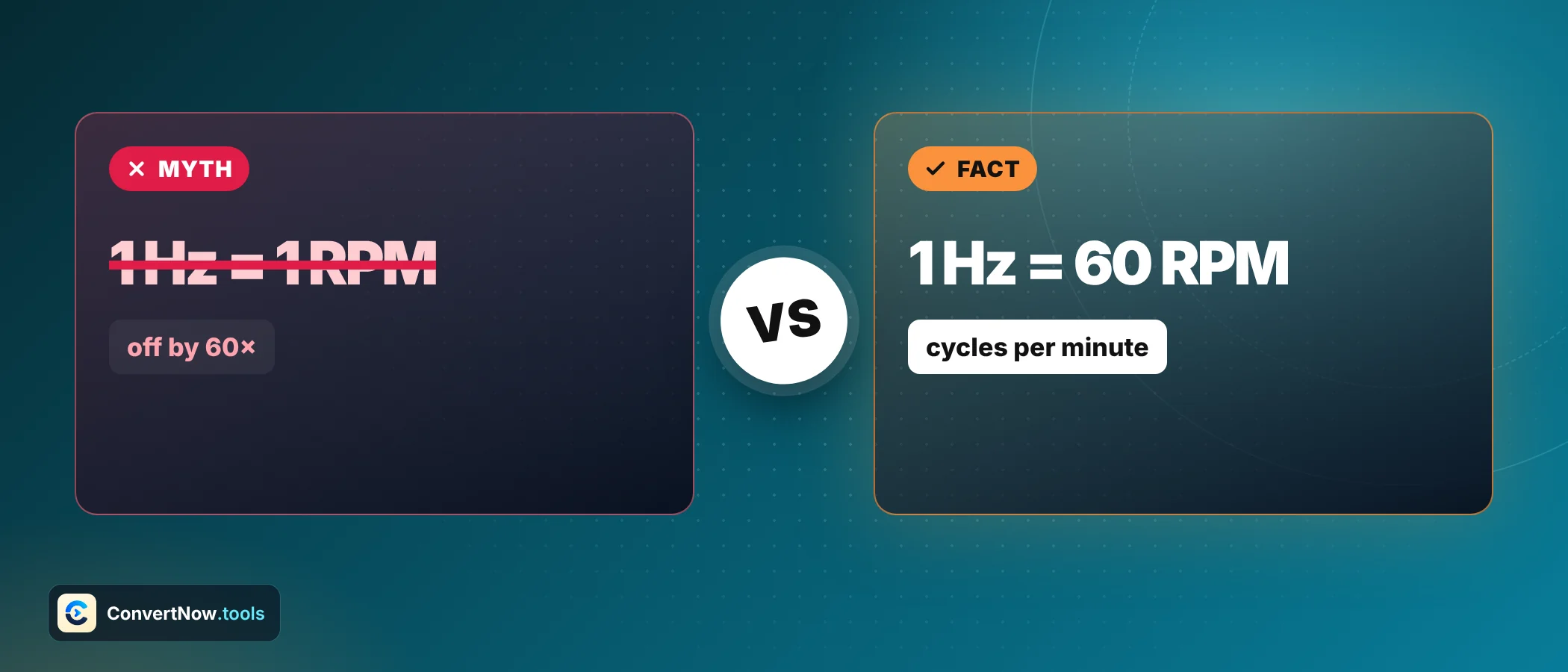
Most mistakes with a frequency converter come from a belief, not from bad arithmetic. People assume hertz and RPM are the same number, or that rad/s is just another spelling of Hz. Neither is true, and the errors are big: off by a factor of 60 in one case and 6.28 in the other.
Below are seven myths, each with the fact, a worked number and the reason people believe it. If you want to check any of them live, the Frequency Converter covers Hz through THz plus RPM, RPS and rad/s.
What this guide covers
- Myth 1: Hz and RPM are the same number
- Myth 2: Hz and rad/s are interchangeable
- Myth 3: More GHz always means a faster computer
- Myth 4: RPS and Hz are the same thing, so the labels do not matter
- Myth 5: 50 Hz and 60 Hz only matter for clocks
- Myth 6: The prefix letters are optional
- Myth 7: Concert pitch A is a law of nature
- How a frequency converter does the maths
- All the myths in one table
- Test yourself
- Where to go after a frequency converter
Myth 1: Hz and RPM are the same number
Fact: one hertz equals 60 RPM. Hertz counts cycles per second. RPM counts revolutions per minute. A minute holds 60 seconds, so every RPM figure must be divided by 60 to become hertz.
A motor spinning at 3,000 RPM turns 50 times each second, so it runs at 50 Hz. A hard disk at 7,200 RPM runs at 120 Hz. The myth survives because both numbers feel like speed, and both are often printed on the same nameplate. Any frequency converter will confirm both figures.
| RPM | Hz (RPM divided by 60) | rad/s (Hz times 6.2832) |
|---|---|---|
| 60 | 1 | 6.28 |
| 1,200 | 20 | 125.66 |
| 1,800 | 30 | 188.50 |
| 3,000 | 50 | 314.16 |
| 3,600 | 60 | 376.99 |
| 7,200 | 120 | 753.98 |
| 15,000 | 250 | 1,570.80 |
Myth 2: Hz and rad/s are interchangeable
Fact: 1 Hz equals 6.2832 rad/s. A full cycle is 2 pi radians, which is about 6.2832. So angular frequency in radians per second is always 6.2832 times larger than the same motion in hertz.
Physics formulas often use the Greek letter omega for rad/s and f for Hz. Mixing them inside one equation is a classic source of a 6.28 times error. A wheel that turns at 100 rad/s completes only 15.92 turns per second, or 954.93 RPM.
A control system that expects rad/s and receives hertz will behave as if the motor were 6.28 times slower. Read the unit label on the input field before you type.
Myth 3: More GHz always means a faster computer
Fact: GHz measures clock cycles per second, not finished work. A 3 GHz processor ticks 3,000,000,000 times each second, so each tick lasts about 0.33 nanoseconds. How much work happens inside each tick depends on the design.
Two chips at the same clock can differ a lot in speed, and a lower clock can win when each cycle does more. Use the figure to compare chips of the same family. Do not use it to rank different designs.
| Frequency | In Hz | Period of one cycle |
|---|---|---|
| 1 kHz | 1,000 | 1 millisecond |
| 1 MHz | 1,000,000 | 1 microsecond |
| 1 GHz | 1,000,000,000 | 1 nanosecond |
| 3 GHz | 3,000,000,000 | 0.33 nanoseconds |
| 1 THz | 1,000,000,000,000 | 1 picosecond |
Myth 4: RPS and Hz are the same thing, so the labels do not matter
Fact: the numbers match, the meanings do not. One revolution per second is one hertz, so a frequency converter shows the same value for both. But hertz applies to any repeating event, such as a sound wave or a blinking light. RPS only describes something that rotates.
That is why engineering documents keep the two apart. A guitar string vibrates at 82.4 Hz, yet nothing on it revolves. Writing that as 82.4 RPS would be wrong even though the arithmetic agrees. A good frequency converter keeps the unit names separate for this reason.
Myth 5: 50 Hz and 60 Hz only matter for clocks
Fact: mains frequency sets the speed of ordinary induction motors. The synchronous speed of an AC motor is 120 times the supply frequency divided by the number of poles. Change the grid from 60 Hz to 50 Hz and the motor slows by one sixth.
| Poles | At 50 Hz | At 60 Hz |
|---|---|---|
| 2 | 3,000 RPM | 3,600 RPM |
| 4 | 1,500 RPM | 1,800 RPM |
| 6 | 1,000 RPM | 1,200 RPM |
A fan, pump or turntable built for 60 Hz and plugged into a 50 Hz supply turns 16.7 percent slower, and it may overheat. That is why imported equipment lists both frequencies on its label, and why a frequency check belongs on every import checklist. A frequency converter helps you check both numbers before plugging in.
Divide by 60. 1,800 divided by 60 is 30 Hz. The figure 188.5 is the value in rad/s, which is a different unit.
20 times 2 pi is 125.66 rad/s. Entering 20 would understate the speed by a factor of 6.28.
Myth 6: The prefix letters are optional
Fact: case changes the size by a factor of a billion. Capital M means mega, or 1,000,000. Lowercase m means milli, or 0.001. So 1 MHz is a radio frequency, while 1 mHz is one cycle every 1,000 seconds.
The same care applies to k, G and T. Lowercase k is kilo. Capital K is not a valid SI prefix for hertz. Whenever a unit label looks odd, read it letter by letter before converting.
Easy to mix up
- MHz and mHz
- kHz and KHz
- GHz and Gbps
- RPM and RPS
What each one means
- 1,000,000 Hz versus 0.001 Hz
- Only kHz is the correct SI form
- Cycles per second versus bits per second
- Per minute versus per second, a factor of 60
Pick the unit you have, pick the unit you need, and read all eight units in one table. Negative values are rejected, since frequency cannot be negative here.
Open the Frequency ConverterMyth 7: Concert pitch A is a law of nature
Fact: A4 at 440 Hz is a standard people agreed on. The note a century ago was often tuned lower, and some orchestras today tune a little higher, around 442 Hz. A change of 2 Hz sounds small but is audible to trained ears.
Each octave doubles the frequency. A3 is 220 Hz, A4 is 440 Hz and A5 is 880 Hz. Knowing that rule lets you check any pitch figure in your head before you reach for the tool. Use a frequency converter to test each octave step.
How a frequency converter does the maths
A frequency converter does not store a grid of every pair. It picks one anchor unit, hertz, and routes everything through it. That keeps the logic short and the results consistent in both directions.
- Convert the input to hertzMultiply by the factor of the source unit. For 3,000 RPM the factor is 1/60, which gives 50 Hz.
- Divide by the target factorFor rad/s the factor is 1/(2 pi), or 0.159155. So 50 divided by 0.159155 gives 314.16 rad/s.
- Check the sanity of the resultGoing from RPM to rad/s must make the number bigger by 0.10472 for each RPM. If it shrank, a factor was inverted.
The same three lines explain every myth above. Each wrong belief skips the anchor step or inverts a factor. When you use the tool, watch for those two failure modes in your own head, and the result will make sense on sight.
All the myths in one table
| Myth | Fact | Example |
|---|---|---|
| Hz equals RPM | Divide RPM by 60 | 3,000 RPM is 50 Hz |
| Hz equals rad/s | Multiply Hz by 2 pi | 50 Hz is 314.16 rad/s |
| More GHz is always faster | Clock is not work per cycle | 3 GHz means 0.33 ns per tick |
| RPS and Hz are the same idea | Same number, different meaning | Guitar string is Hz, not RPS |
| Mains frequency only runs clocks | It sets motor speed | 2 pole motor: 3,000 or 3,600 RPM |
| Prefix case is optional | Case changes the size | MHz versus mHz |
| Concert pitch is fixed | It is a convention | A4 is 440 Hz, sometimes 442 |
Test yourself
Where to go after a frequency converter
Rotation problems often need an angle or a linear speed next. Use the Angle Converter for radians and degrees, and the Speed Converter when a rotating wheel has to become a road speed.
Frequently asked questions
How does a frequency converter turn Hz into RPM?
Multiply hertz by 60. For example, 25 Hz is 1,500 RPM. To go back, divide RPM by 60.
How many rad/s does a frequency converter show for 1 RPM?
One RPM is 0.10472 rad/s, because 2 pi divided by 60 is about 0.10472. So 1,000 RPM is 104.72 rad/s.
How does a frequency converter handle kHz to Hz?
Multiply kilohertz by 1,000. A signal at 2.5 kHz is 2,500 Hz.
What is the difference between MHz and GHz in a frequency converter?
A gigahertz is 1,000 megahertz. A 2,400 MHz wireless band is the same as 2.4 GHz.
Is hertz the same as cycles per second?
Yes. The unit was called cycles per second until the General Conference on Weights and Measures adopted the name hertz in 1960.
Can frequency be negative?
For counting cycles per second it is a positive quantity, so this converter rejects negative input. Signed values appear in signal theory but not in everyday unit conversion.
Sources: Wikipedia: Hertz