

Loan Overpayment Examples: 6 Real Cases, Exact Savings
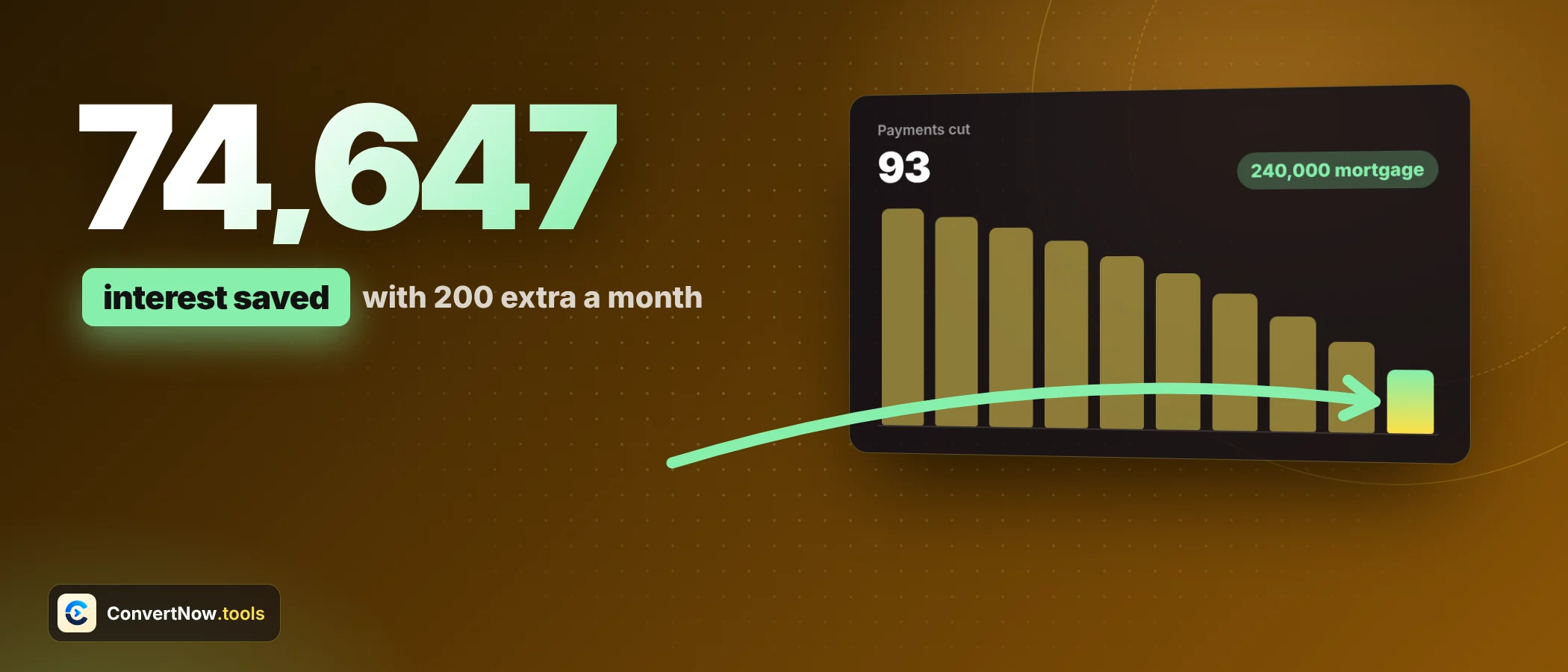
An extra 200 a month on a 240,000 mortgage cuts 93 payments and saves 74,647 in interest. Numbers like that are why loan overpayment examples beat general advice: they show the size of the prize before you change a single standing order.
These loan overpayment examples each use a fixed rate loan with equal monthly payments and interest charged monthly on the remaining balance. Extra payments are assumed to reduce principal in the month they are made, and the regular payment stays unchanged. That keeps the comparison fair.
How the arithmetic works
Each month the lender charges interest on the balance. The rest of your payment reduces principal. An overpayment adds to that principal reduction, so the next interest charge is smaller, and the saving feeds on itself.
One month of the simulation
interest = balance * annualRate / 12
principal = payment - interest + extra
balance = balance - principal
// repeat until balance reaches 0Loan overpayment examples, case 1: A 30 year mortgage with 200 extra every month
Loan: 240,000 at 5.5 percent for 30 years. The regular payment is 1,362.69. Left alone, the loan runs 360 months and costs 250,570 in interest.
| Extra per month | Payoff time | Months saved | Total interest | Interest saved |
|---|---|---|---|---|
| 0 | 360 months (30y 0m) | 0 | 250,570 | 0 |
| 100 | 305 months (25y 5m) | 55 | 206,043 | 44,527 |
| 200 | 267 months (22y 3m) | 93 | 175,923 | 74,647 |
| 400 | 214 months (17y 10m) | 146 | 137,098 | 113,471 |
Doubling the extra from 100 to 200 saves 30,120 more, not 44,527 more. Returns shrink as the balance falls faster. Still, 200 a month is about 15 percent on top of the payment, and it shortens the loan by more than seven years.
Run your own loan overpayment examples. Enter your balance, rate and term, then add monthly extras or a lump sum to see your own savings. The simulation runs in your browser.
Open the Loan Overpayment CalculatorCase 2: A 5 year car loan with 50 or 100 extra
Loan: 25,000 at 9.5 percent for 5 years. The regular payment is 525.05, and the total interest is 6,502.79. Short loans save less in absolute terms, but the rate is high, so the effect per unit is strong.
| Extra per month | Payoff time | Months saved | Total interest | Interest saved |
|---|---|---|---|---|
| 0 | 60 months | 0 | 6,502.79 | 0 |
| 50 | 54 months (4y 6m) | 6 | 5,764.64 | 738.15 |
| 100 | 49 months (4y 1m) | 11 | 5,179.83 | 1,322.96 |
Over the 54 months of example 2 with 50 extra, you add about 2,700 of your own money and remove 738.15 of interest. Every unit you pay beyond the schedule earns a guaranteed return equal to the loan rate.
Case 3: The preset ladder on a 300,000 mortgage
Loan: 300,000 at 6.5 percent for 30 years. The regular payment is 1,896.20 and total interest is 382,633. Here are six extra amounts side by side.
| Extra per month | Payoff time | Months saved | Total interest | Interest saved |
|---|---|---|---|---|
| 25 | 347 months (28y 11m) | 13 | 364,933 | 17,701 |
| 50 | 334 months (27y 10m) | 26 | 349,052 | 33,582 |
| 100 | 312 months (26y 0m) | 48 | 321,639 | 60,995 |
| 200 | 277 months (23y 1m) | 83 | 279,185 | 103,449 |
| 300 | 250 months (20y 10m) | 110 | 247,518 | 135,115 |
| 500 | 210 months (17y 6m) | 150 | 202,874 | 179,759 |
Of all the loan overpayment examples here, the first row of this table is the most surprising. Just 25 a month, less than a streaming subscription, saves 17,701 and removes a full year. Going from 300 to 500 adds 40 months of savings for 200 more a month. Each step is worth taking, but the first small steps are the cheapest per unit saved.
Case 4: One bonus of 5,000, paid at different times
Loan: 250,000 at 5 percent for 30 years. The regular payment is 1,342.05 and interest over 360 months is 233,139. A one time extra of 5,000 is applied in different months, and nothing else changes.
| Paid in month | Payoff time | Months saved | Total interest | Interest saved |
|---|---|---|---|---|
| 12 | 345 months (28y 9m) | 15 | 217,518 | 15,622 |
| 60 | 348 months (29y 0m) | 12 | 221,152 | 11,987 |
| 120 | 351 months (29y 3m) | 9 | 224,827 | 8,313 |
| 240 | 354 months (29y 6m) | 6 | 229,991 | 3,148 |
The same 5,000 saves 15,622 in year one and only 3,148 in year twenty. Time is the ingredient. A lump sum paid early has hundreds of months left to avoid interest.
Case 5: A 3 year personal loan
Loan: 10,000 at 12 percent for 36 months. The regular payment is 332.14 and total interest is 1,957.15. The loan is small and short, so savings are modest, but the percentage effect is still large.
| Extra per month | Payoff time | Months saved | Total interest | Interest saved |
|---|---|---|---|---|
| 0 | 36 months | 0 | 1,957.15 | 0 |
| 25 | 34 months | 2 | 1,790.88 | 166.28 |
| 100 | 27 months (2y 3m) | 9 | 1,430.92 | 526.23 |
With 100 extra, you save a quarter of the interest and clear the loan nine months early. Check the agreement first. Short unsecured loans are the type most likely to carry an early repayment fee.
Interest is charged on the balance every month. Reducing the balance now avoids the most months of interest, as example 4 shows.
Case 6: Monthly extras combined with a lump sum
Loan: 200,000 at 4 percent for 25 years. The regular payment is 1,055.67 and total interest is 116,702. Compare three strategies.
| Strategy | Payoff time | Months saved | Total interest | Interest saved |
|---|---|---|---|---|
| No extras | 300 months (25y 0m) | 0 | 116,702 | 0 |
| 150 extra monthly | 242 months (20y 2m) | 58 | 91,679 | 25,023 |
| 10,000 lump sum in month 12 | 277 months (23y 1m) | 23 | 101,603 | 15,099 |
| Both together | 225 months (18y 9m) | 75 | 80,766 | 35,936 |
The combination saves 35,936, which is slightly less than the two savings added together (40,122). The reason is overlap: once the monthly extra has shrunk the balance, the lump sum has less interest left to remove.
What the six cases have in common
What raises your savings
- A higher interest rate
- A longer remaining term
- Paying extra early in the loan
- Making the extra payment every month without gaps
What reduces your savings
- Extra payments held as advance instalments instead of principal
- Prepayment fees charged by the lender
- Waiting until the balance is already low
- Short loans where little interest is charged anyway
Overpaying is one choice among several, and loan overpayment examples only tell you the cost side. If your loan rate is low, money invested elsewhere may earn more, with more risk. If it is high, paying down debt is a guaranteed return equal to the rate. Run your own figures before deciding.
Set up your own scenarios
- Gather the loan factsYou need the outstanding balance, the yearly rate and the remaining term in years.
- Enter a monthly extraTry a modest amount you will not miss, such as 1 percent of the regular payment, then a larger one.
- Add a lump sum if you have oneGive the amount and the month number. Month 1 is your first payment.
- Read the comparisonLook at payoff date, total interest and the balance by year. Pick the plan you can sustain.
- Call your servicerConfirm extra payments reduce principal and ask about early repayment charges before you pay.
For a different view of the same loan, see the Loan EMI Calculator, which shows how each payment splits between principal and interest, and the Compound Interest Calculator for the investing side of the comparison.
Frequently asked questions
In loan overpayment examples, how much does 200 extra a month save on a mortgage?
It depends on rate and term. On 240,000 at 5.5 percent over 30 years it saves 74,647 of interest and 93 months. On 300,000 at 6.5 percent it saves 103,449 and 83 months.
In loan overpayment examples, is monthly or lump sum better?
Money paid sooner saves more, so a lump sum paid today beats the same amount spread over a year. Monthly extras suit steady income, while a lump sum suits a bonus or tax refund.
Does overpaying always reduce the loan term?
Only when the extra goes to principal and your payment stays the same. Some servicers apply extra money to future instalments unless you mark it as principal only.
Will my lender charge a fee for overpaying?
Some do. Prepayment penalties usually apply to paying off the full balance or a large lump sum within the first few years, and many loans have none. Check your agreement.
Is overpaying a loan better than investing?
If your loan rate is higher than the return you can expect after tax, paying down the loan is the safer gain. At a low rate, investing may earn more but carries risk.
Why are the savings bigger at the start in loan overpayment examples?
The balance is highest then, so interest is highest. Removing principal early avoids the most months of charges.
Sources: Consumer Financial Protection Bureau: what is a prepayment penalty