

Loan EMI Calculator Myths: 7 Facts That Save Real Money
Most borrowers believe the monthly instalment tells them what a loan costs. It does not. A loan EMI calculator proves it in seconds, because the same 300,000 can cost 127,326 in interest or 455,152, depending on a choice most people make by looking at one number.
Below are seven myths I see again and again, each corrected with figures you can reproduce in the Loan EMI Calculator. One base loan runs through most of them: 300,000 at 7.5 percent a year over 20 years, which gives an EMI of 2,416.78.
Frequently asked questions about the loan EMI calculator
How does a loan EMI calculator work out the payment?
Divide the yearly rate by 12 and by 100 to get r, convert the tenure to months n, then use P × r × (1 + r)^n ÷ ((1 + r)^n − 1). If the rate is zero, the EMI is simply the principal divided by n.
Is flat rate cheaper than reducing balance?
No. A flat rate charges interest on the full original amount for the whole term, so a 10 percent flat quote behaves like a much higher reducing rate. The 500,000 example above works out to about 17.3 percent.
Why does the loan EMI calculator show most of my early EMI as interest?
Interest is charged on the outstanding balance, which is highest at the start. On 300,000 at 7.5 percent, 1,875.00 of the first 2,416.78 is interest.
Does a longer tenure save money?
It lowers the monthly payment but raises the total cost. Stretching 300,000 at 7.5 percent from 15 to 30 years cuts the EMI by 683.40 and adds 254,565 of interest.
What does a loan EMI calculator not include?
Processing fees, insurance add ons, taxes, variable rate changes and prepayment charges. It models a fixed rate loan with equal instalments.
Can prepayment reduce total interest?
Yes, and early prepayment does it best. An extra 10,000 after month 12 saves 29,446 on the example loan, while the same sum after month 180 saves 4,310.
Myth 1: A flat rate of 10 percent equals a reducing rate of 10 percent
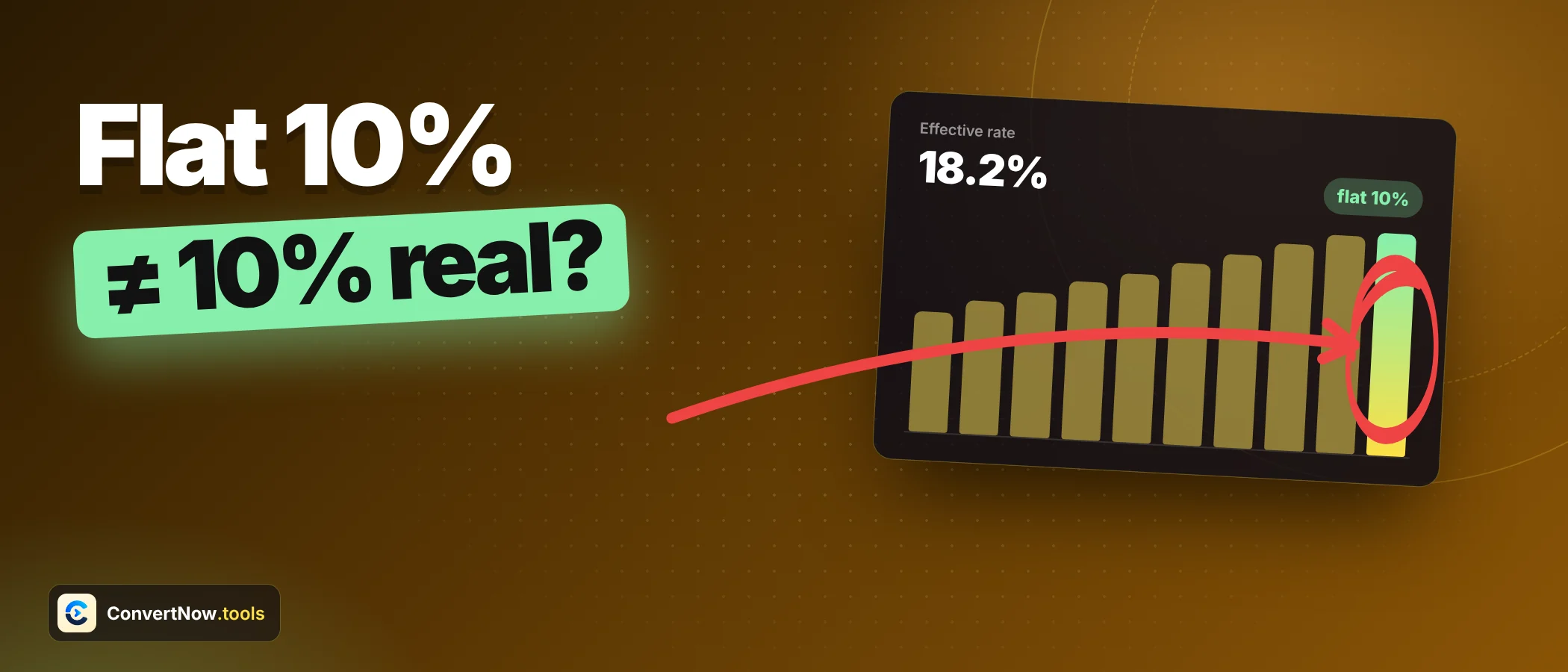
Fact: a flat rate costs far more. Flat interest is charged on the original amount for the whole tenure. Reducing balance interest is charged only on what you still owe. Most home, car and personal loans quote reducing balance, and a loan EMI calculator uses that method.
Take 500,000 over 5 years at a quoted 10 percent. On a flat basis the interest is 500,000 × 10% × 5 = 250,000, so the EMI is 750,000 ÷ 60 = 12,500. On a reducing basis the EMI is 10,623.52 and the interest is 137,411. To make the reducing loan cost as much as the flat one, the rate would have to be about 17.3 percent.
| Method | Monthly EMI | Total interest | Equivalent reducing rate |
|---|---|---|---|
| Flat 10% | 12,500.00 | 250,000.00 | About 17.3% |
| Reducing 10% | 10,623.52 | 137,411.34 | 10.0% |
| Difference | 1,876.48 more | 112,588.66 more | 7.3 points higher |
Myth 2: Every EMI is split evenly between principal and interest
Fact: the split moves every month. Interest is the balance times the monthly rate, so it is biggest on day one. In month one of our loan, 300,000 × 0.625% = 1,875.00 is interest and only 541.78 is principal. That is 22.3 percent of the instalment reducing the debt.
By month 130 the two lines cross, with 1,206.51 of interest and 1,210.27 of principal. In the last month, only 15.01 is interest and 2,401.77 is principal. The EMI never moved. The inside of it did, and a loan EMI calculator with a schedule shows that clearly.
| Year | Interest paid | Principal repaid | Balance at year end |
|---|---|---|---|
| 1 | 22,272 | 6,730 | 293,270 |
| 5 | 19,926 | 9,075 | 260,706 |
| 10 | 15,812 | 13,189 | 203,601 |
| 15 | 9,833 | 19,168 | 120,610 |
| 20 | 1,145 | 27,857 | 0 |
Myth 3: Halfway through the term, half the loan is gone
Fact: after 10 of 20 years you still owe 203,601. That is 67.9 percent of the original amount. The reason is the front loaded interest in the table above. Only 96,399 of principal has been repaid after 120 payments, even though you have paid 290,013 in total.
If you plan to sell a property after 10 years, the payoff figure is about two thirds of the loan, not half. Check the balance on the schedule before you count on equity.
Myth 4: Doubling the tenure halves the EMI, so longer is cheaper
Fact: a longer tenure lowers the EMI a little and raises the total cost a lot. Going from 10 to 20 years does not halve the payment. It falls only 32 percent, from 3,561.05 to 2,416.78, while total interest more than doubles from 127,326 to 280,027.
| Tenure | Monthly EMI | Total interest | Interest as share of loan |
|---|---|---|---|
| 10 years | 3,561.05 | 127,326.37 | 42.4% |
| 15 years | 2,781.04 | 200,586.67 | 66.9% |
| 20 years | 2,416.78 | 280,027.10 | 93.3% |
| 25 years | 2,216.97 | 365,092.06 | 121.7% |
| 30 years | 2,097.64 | 455,151.67 | 151.7% |
The step from 25 to 30 years saves only 119.33 a month and adds 90,060 of interest. The curve flattens, so extra years buy less and less relief. Pick the shortest tenure your budget can carry without strain.
Interest is charged on the full balance early on. In our example year one holds 22,272 of interest against 6,730 of principal.
Myth 5: Half a percentage point hardly matters
Fact: half a point is worth about 22,000 on this loan. At 7.0 percent the EMI is 2,325.90, at 7.5 percent it is 2,416.78 and at 8.0 percent it is 2,509.32. Each half point moves the monthly payment by roughly 91 to 93, which becomes 21,811 to 22,210 across 240 months.
At 7.0 percent
- EMI 2,325.90
- Total paid about 558,216
- Total interest about 258,216
At 8.0 percent
- EMI 2,509.32
- Total paid about 602,237
- Total interest about 302,237
Always compare offers by running both rates through a loan EMI calculator with the same tenure. A smaller rate with a large fee can still lose, which brings us to the last myths.
Myth 6: A prepayment saves the same amount whenever you make it
Fact: timing decides almost everything. A one time extra payment of 10,000, with the EMI left unchanged, cuts the loan shorter. Paid after month 12 it saves 29,446 of interest and removes 16 payments. Paid after month 180 it saves 4,310 and removes 5.
| Paid after month | Interest saved | Payments removed | New loan length |
|---|---|---|---|
| 12 | 29,446 | 16 | 224 months |
| 60 | 19,628 | 12 | 228 months |
| 120 | 10,626 | 8 | 232 months |
| 180 | 4,310 | 5 | 235 months |
The money works hardest while the balance is high. If your lender charges a prepayment fee, set it against these savings before you decide. To model monthly extras and lump sums together, use the Loan Overpayment Calculator.
Myth 7: The EMI is the full monthly cost of the loan
Fact: the formula covers principal and interest only. Processing fees, insurance bundled by the lender, taxes and any rate reset sit outside it. A 1 percent processing fee on 300,000 is 3,000, which is the same as roughly one and a quarter EMIs.
A good loan EMI calculator says so openly. It assumes a fixed rate and equal instalments, and it treats the output as a planning estimate. Ask your lender for the full cost sheet, then compare it with the number your loan EMI calculator gave you.
Summary of the seven myths
| Myth | What is true | Number to remember |
|---|---|---|
| Flat equals reducing | Flat costs much more | 10% flat acts like 17.3% |
| Even split each month | Interest leads early | 1,875 of 2,416.78 in month one |
| Half done at half time | Two thirds still owed | 203,601 after 10 years |
| Longer tenure is cheaper | Lower EMI, higher cost | 30 years costs 151.7% of loan in interest |
| Half a point is small | About 22,000 over 20 years | 91 to 93 a month |
| Prepay any time | Early prepay wins | 29,446 versus 4,310 saved |
| EMI is all costs | Fees sit outside | 3,000 fee on 300,000 |
How to check the result by hand
- Convert the rateDivide the yearly rate by 12 and by 100. For 7.5 percent, r = 0.00625.
- Convert the tenureMultiply years by 12. Twenty years is n = 240.
- Apply the formulaCompute (1 + r)^n, then P × r × that value ÷ (that value − 1). The result is 2,416.78.
- Walk the first monthInterest = balance × r = 1,875.00. Principal = EMI − interest = 541.78. New balance = 299,458.22.
The calculation in a few lines of JavaScript
const P = 300000, rate = 7.5, years = 20;
const r = rate / 12 / 100, n = years * 12;
const f = Math.pow(1 + r, n);
const emi = P * r * f / (f - 1);
console.log(emi.toFixed(2)); // 2416.78Try the loan EMI calculator now. Enter your own amount, rate and tenure to see the EMI, total interest and a year by year schedule. It runs in your browser and nothing is uploaded.
Open the Loan EMI CalculatorSources: Consumer Financial Protection Bureau: what is amortization