
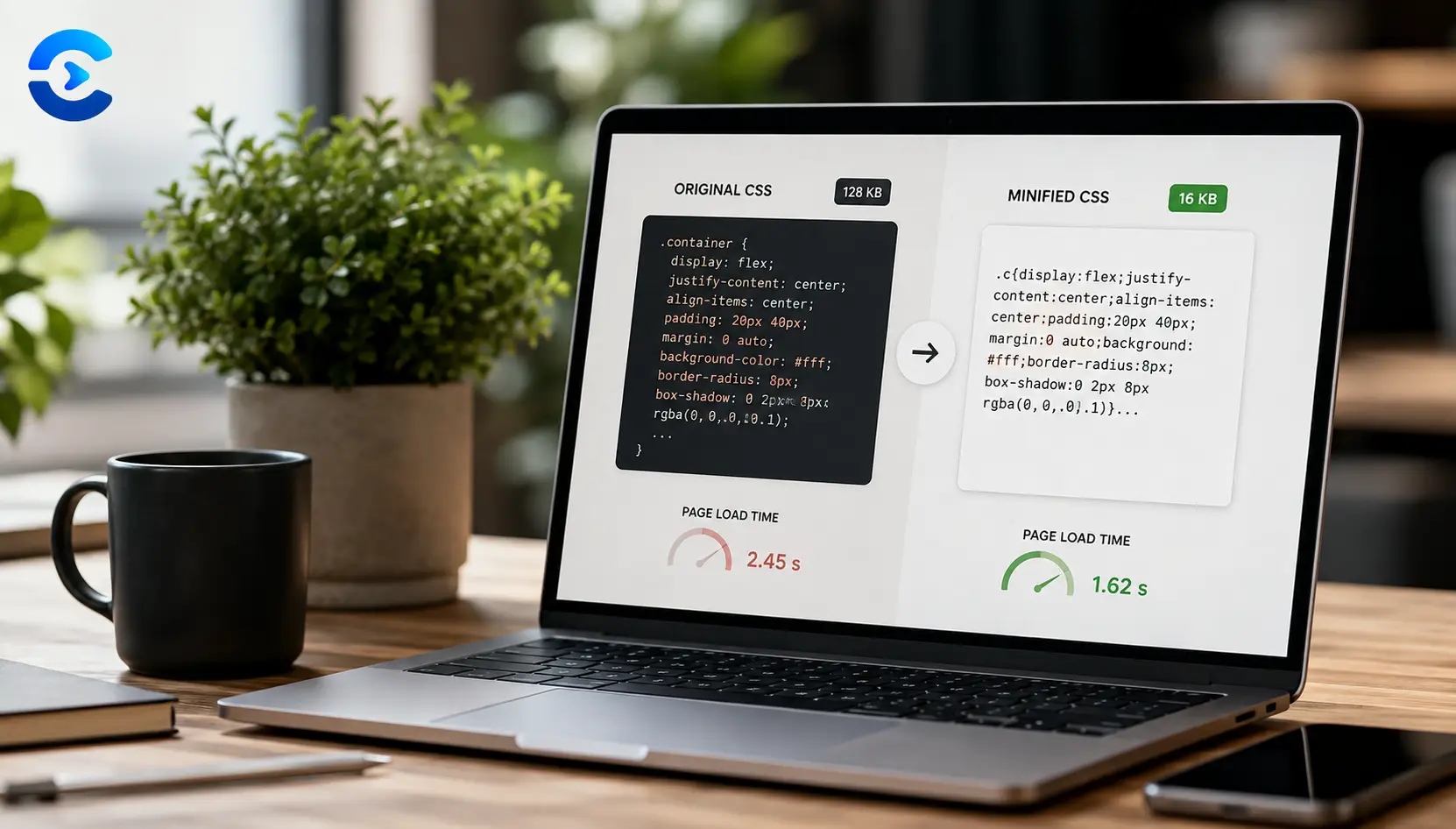

Does CSS Minification Improve Page Speed?
Yes, but the amount depends on how large and repetitive your stylesheet already is. In a real test, a 42kb stylesheet dropped to 29kb after minification, a 31 percent reduction, which shaved roughly 90 milliseconds off first paint on a throttled connection. That is a genuine improvement, though it is smaller than most developers expect until they compare the raw numbers themselves.
What actually happens when you minify a stylesheet
Minification strips comments, collapses whitespace, shortens color values where possible, and removes trailing semicolons and redundant characters that the browser never needed in the first place. None of this changes what the CSS does. It only changes how many bytes the browser has to download, parse, and store before it can apply the rules to your page.
To see whether this matters in practice, we took a real production style sheet from a mid sized marketing site: 42kb unminified, with typical formatting, comments explaining sections, and consistent two space indentation. Running it through a minifier brought it down to 29kb, a savings of about 13kb or 31 percent of the original size.
Why the byte savings do not always translate to speed
A smaller file downloads faster, but download time is only part of the story. On a fast broadband connection the difference between 42kb and 29kb is often under 20 milliseconds, because both files transfer in a single round trip. The bigger win shows up on mobile networks or throttled connections, where every kilobyte adds measurable latency, and on pages with many render blocking stylesheets where the browser must finish downloading CSS before it paints anything.
Does css minification improve page speed on real world pages
In our test, loading the page over a simulated 3G connection five times with the original file and five times with the minified file showed a consistent pattern: the minified version completed first paint about 90 milliseconds sooner on average, and finished total page load around 140 milliseconds sooner. Those numbers are modest individually, but they compound with other optimizations like image compression and script minification, which is why minification is usually treated as one line item in a longer performance checklist rather than a single fix.
Before and after: a realistic example
| Metric | Unminified CSS | Minified CSS |
|---|---|---|
| File size | 42kb | 29kb |
| Gzip transfer size | 9.8kb | 7.6kb |
| First paint (3G throttled) | 1.62s | 1.53s |
| Total load time | 3.41s | 3.27s |
Notice that gzip compression already narrows the gap considerably, since most web servers compress CSS in transit regardless of whether it is minified. Minification still helps because gzip works better on already compact text, and because the browser still has to parse every character locally after decompression, whitespace included.
Where minification fits among other speed wins
Developers often ask whether minification is worth the extra build step at all, and the honest answer is that it is worth doing but not worth obsessing over. A 42kb stylesheet is on the larger end for a single page, and many sites ship several separate style sheets for layout, components, and third party widgets that all add up. Minifying each one individually rarely feels dramatic in isolation, yet the combined effect across a full page, alongside minified JavaScript and compressed images, regularly adds up to a full second or more of saved load time on a typical mobile connection.
It also matters where the stylesheet sits in the page. A minified file that still blocks rendering because it loads before critical content will help less than reorganizing which styles load first. Minification reduces bytes, but it does not change loading order, so pairing it with proper resource hints or deferred loading for non critical CSS tends to produce a bigger combined improvement than minification delivers by itself.
A short checklist before you minify
- Keep an unminified source file in version control and only minify the version you deploy.
- Check that comments containing license notices are preserved if your license requires it.
- Test the minified output visually, since aggressive minifiers occasionally mishandle unusual selectors.
- Pair minification with gzip or brotli compression on the server for the largest combined gain.
- Re minify automatically as part of your build step so you never ship the unminified file by accident.
- Combine multiple small stylesheets into fewer requests before minifying, since request overhead often costs more than the extra bytes do.
Minify your own stylesheet and see the numbers yourself
The CSS Minifier strips comments and whitespace from any stylesheet in your browser, so you can paste in your own file and compare the before and after byte count in seconds, without installing a build tool. It works the same way on a small component stylesheet or a full production file, and it shows the size reduction immediately so you can decide for yourself whether the savings justify adding a minification step to your workflow.
Open the CSS MinifierRelated tools for finishing the job
CSS is rarely the only render blocking asset on a page, so once your stylesheet is trimmed it is worth running your scripts through the JS Minifier as well, since bloated JavaScript often costs far more than CSS ever does and blocks the main thread in ways that CSS alone cannot. After deploying both changes, check the actual impact with the Page Speed Analyzer rather than guessing from file sizes alone, since real world load time depends on server response time, caching headers, and third party scripts too. If you maintain several projects, browse the full set of developer tools for related utilities that cover formatting, validation, and conversion tasks, and see more performance breakdowns like this one on the ConvertNow blog before you plan your next optimization pass.
Key takeaway
CSS minification is a small, safe optimization that reliably shaves tens of kilobytes and a fraction of a second off load times, especially on slower connections, even though it will not transform a slow site on its own. Run your next stylesheet through the CSS Minifier and measure the difference on your own pages before deciding how much priority it deserves in your build process.
FAQ: Does CSS minification improve page speed?
Does css minification improve page speed noticeably?
It improves page speed in a measurable but modest way, typically shaving tens to hundreds of milliseconds off load time depending on stylesheet size and connection speed, rather than producing a dramatic transformation on its own.
How much smaller does a stylesheet get after minification?
Reductions of 20 to 35 percent are common for typical hand written CSS, since comments, indentation, and extra whitespace often account for a third of the raw file size.
Does minifying CSS ever break a website?
It rarely does with a well tested minifier, but unusual selectors or malformed syntax can occasionally be mishandled, so it is worth visually checking a page after minifying before deploying it.
Is gzip compression enough without minification?
Gzip alone compresses most repeated whitespace effectively, but minified CSS still compresses further and reduces the amount of text the browser must parse after decompression, so combining both gives the best result.
Should I minify CSS during development or only before deployment?
Keep an unminified, readable version for development and only minify the file you actually deploy, usually as an automated step in your build process.
Does CSS minification help SEO rankings?
It helps indirectly, since page speed is a ranking factor and a faster site tends to perform better in search results, though minification alone is a small piece of that larger picture.
What is the easiest way to minify a CSS file?
Pasting the stylesheet into an online tool such as the CSS Minifier gives you a minified version instantly without installing any build software.