
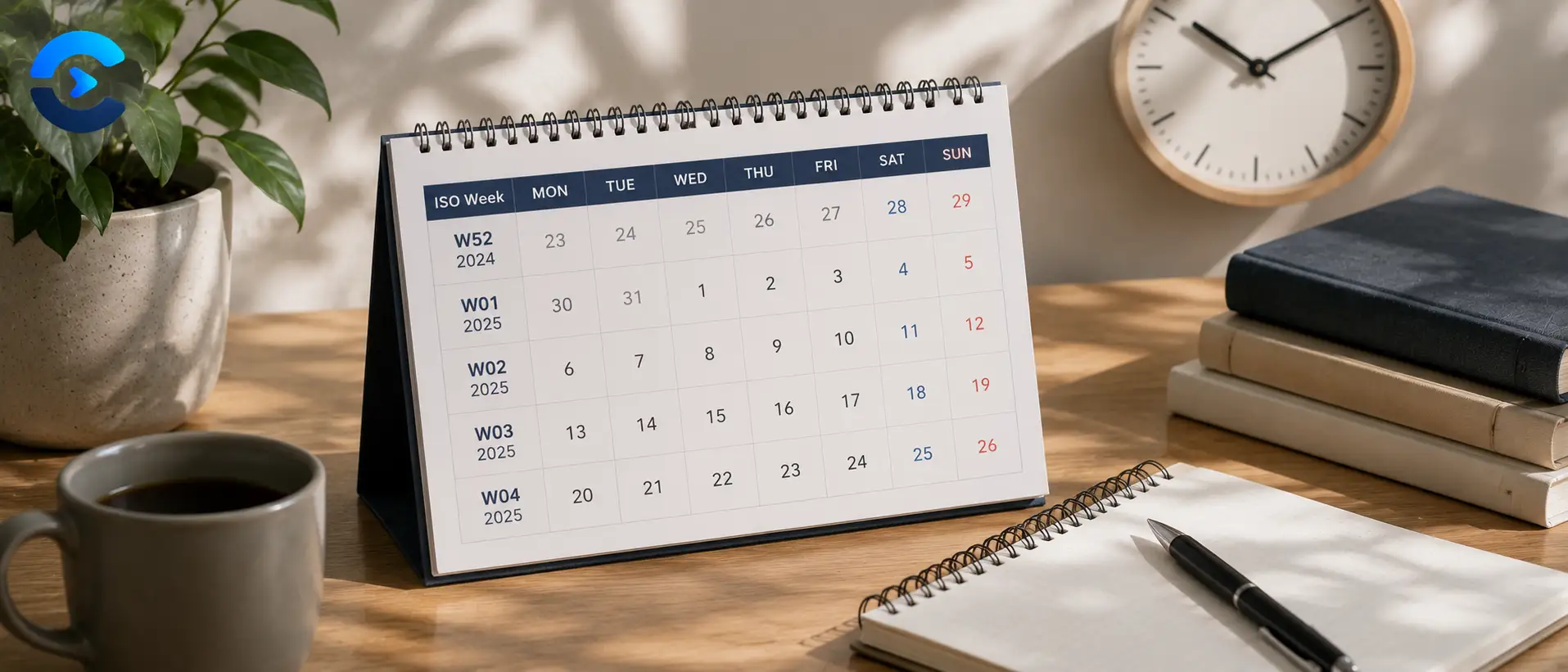

ISO Week Number Explained: Why Week 1 Shifts
In the ISO 8601 standard, week 1 of a year is not the week that contains January 1. It is the week that contains the year’s first Thursday, which also means it is the week containing January 4. Weeks run Monday through Sunday, so if January 1 falls on a Friday, Saturday, or Sunday, that day actually belongs to the last week of the previous year, not week 1 of the new one. This is why an iso week number explained correctly can feel surprising at first, but it is exactly why payroll systems, project planners, and enterprise software rely on it instead of counting weeks from the calendar page.
The ISO 8601 rule in plain terms
The International Organization for Standardization defines its week numbering system inside the ISO 8601 date standard. Two rules make the whole thing work.
First, every week starts on Monday and ends on Sunday. There is no such thing as a week that starts on Sunday in this system, which already differs from how many calendars and spreadsheet tools display a month.
Second, week 1 of any year is defined as the week that contains the first Thursday of that year. Because weeks are Monday through Sunday blocks, this is mathematically identical to saying week 1 is the week that contains January 4. If you remember only one shortcut, remember that one: find January 4, find the Monday through Sunday week it sits in, and that week is week 1.
Why the first Thursday, and not January 1
The first Thursday rule exists so that every ISO week belongs mostly to the year it is numbered for. A Monday to Sunday week always contains four days from one month or year and three from the other, or some similar split depending on where the boundary falls. Anchoring week 1 to the week holding the first Thursday guarantees that week has at least four days in the new year, which is the majority. That is what keeps the numbering consistent and prevents a single stray day from dragging an entire week’s identity in the wrong direction.
A concrete example: 2027
Take January 1, 2027. That date falls on a Friday. Under the Monday through Sunday rule, the week containing that Friday runs from Monday, December 28, 2026 through Sunday, January 3, 2027. The first Thursday of 2027 does not arrive until January 7. So the week of December 28 to January 3 is not week 1 of 2027 at all. It is week 53 of 2026, the final week of the prior ISO year.
Week 1 of 2027 does not begin until Monday, January 4, 2027. Anyone glancing at a calendar and assuming January 1 automatically starts week 1 would be off by an entire week for the first several days of the year. This pattern repeats any time January 1 lands on a Friday, Saturday, or Sunday, which happens several times each decade.
Why software and businesses use ISO week numbers instead of naive counting
A naive week count, where week 1 simply starts on January 1 regardless of the day it falls on, creates uneven weeks at the start and end of every year. Some years would have a one day or two day first week, which breaks anything that expects consistent seven day periods, like payroll cycles, sprint planning, or shift schedules.
ISO week numbers solve that by guaranteeing every week is a full seven days, and by guaranteeing every year has either 52 or 53 such weeks, never a fractional one. That predictability is why the standard shows up across enterprise resource planning systems, manufacturing schedules, European business calendars, and countless project management tools. When two systems both use ISO week numbering, a report labeled “week 12” means the exact same seven days in both, no translation needed.
This also matters for anyone comparing data across years. If you are tracking weekly sales or output and you want week 1 to mean roughly the same slice of the calendar every year, the ISO system keeps that comparison honest in a way a naive January 1 start date cannot.
How to find any date’s ISO week number quickly
You can work it out by hand using the January 4 shortcut, but it gets tedious fast, especially near year boundaries where you have to double check which ISO year a date actually belongs to. If you are scheduling around a working days calculator or trying to line up a delivery date, it is faster to just look the number up directly.
Skip the manual math
Counting Mondays and checking which ISO year a boundary date belongs to is easy to get wrong, especially in years like 2027 where January 1 lands outside week 1. Our free Week Number Calculator gives you the correct ISO week for any date instantly, including the edge cases at the start and end of the year.
Open the Week Number CalculatorRelated date tools worth knowing
ISO week numbers usually come up alongside other date math. If you need to know how many days sit between two dates, a date difference calculator handles that in one step. Planning a deadline that only counts business days can lean on the working days calculator mentioned above. And if a spreadsheet or API hands you a date in a format your team does not use, the date format converter cleans that up fast. You can browse the full set of date and time tools, or check the ConvertNow blog for more explainers like this one.
The short version
Weeks run Monday through Sunday, and week 1 is whichever week holds the year’s first Thursday, or equivalently, January 4. That single rule explains every case where January 1 seems to land in the wrong week, including years like 2027 where it actually belongs to week 53 of the prior year. Next time a date near a year boundary needs a week label, run it through the Week Number Calculator and skip the guesswork.
FAQ: ISO Week Number Explained: Why Week 1 Shifts
What does ISO week number explained actually mean in one sentence?
It means the ISO 8601 standard numbers weeks Monday through Sunday, with week 1 defined as the week containing the year’s first Thursday, which is the same as the week containing January 4.
Why doesn’t week 1 always start on January 1?
Because ISO weeks are fixed Monday through Sunday blocks. If January 1 falls on a Friday, Saturday, or Sunday, it lands in the tail end of the previous year’s final week rather than in a new week 1.
How many ISO weeks are in a year?
Most years have 52 ISO weeks. Some years have 53, which happens roughly once every five or six years depending on leap years and where January 1 falls.
Does the ISO week number depend on the first Thursday or January 4?
Both describe the same result. The week containing the first Thursday of the year is always the same week that contains January 4, so either rule gets you to week 1.
Why do businesses use ISO week numbers instead of counting from January 1?
Counting from January 1 produces uneven weeks at the start and end of the year, which breaks payroll cycles and reporting periods. ISO week numbers guarantee full seven day weeks every time, so schedules and comparisons stay consistent.
Can a date in late December belong to week 1 of the following year?
Yes. If December 31 falls on a Monday, Tuesday, or Wednesday, that day and the days around it can already belong to week 1 of the next ISO year, since the first Thursday of the new year comes early.
Is the ISO week number the same as the week number shown in Excel or Google Sheets?
Not always. Many spreadsheet functions default to a Sunday start week and count from January 1, which does not match ISO 8601. You usually need a specific ISO week function or setting to get matching results.
What is the fastest way to find the ISO week number for a specific date?
Use a dedicated tool rather than counting by hand, especially near year boundaries. The Week Number Calculator linked above returns the correct ISO week instantly for any date you enter.