
Blog
Guides on Analytics, Development and Everyday Tools
-
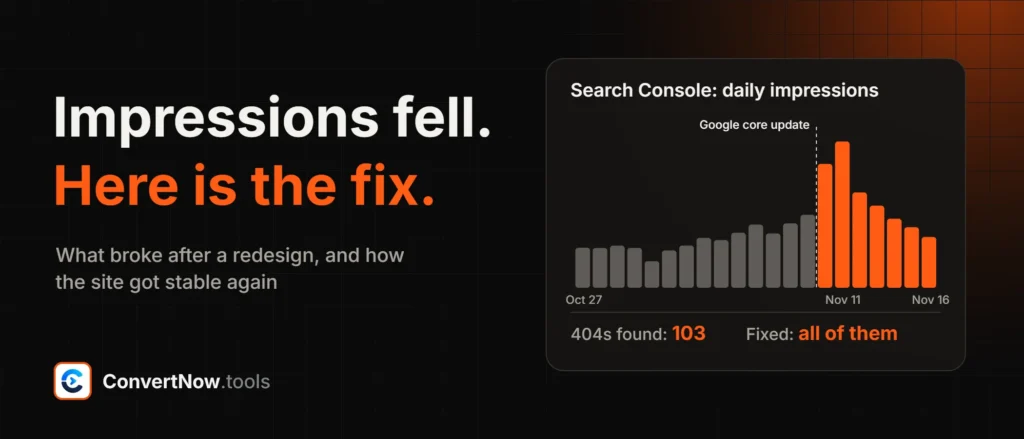
Traffic Drop After Website Redesign: 5 Proven Fixes
My impressions fell 65 percent in five days after a redesign. Here are the 5 real causes, from 103 broken URLs to a hidden title override, and how I fixed each one.
Latest articles
-
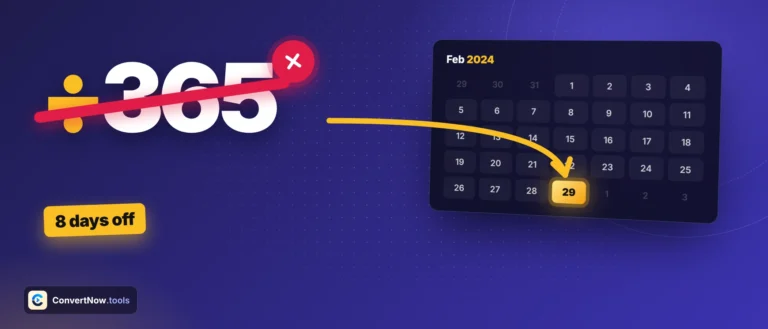
Calculate Age: 8 Simple Rules to Get It Exactly Right
Calculate age in years, months and days with 8 exact rules, four worked dates and a leap day guide, so your result matches the…
-

7 Best Web Analytics Tools in 2026 (Privacy Friendly Picks)
Seven web analytics tools compared on privacy, price and ease of setup.
-

7 Best WordPress Analytics Plugins in 2026 (Free and Paid)
Seven WordPress analytics plugins compared on privacy, cost and what they actually show you.
-

ConvertDash: Cookieless Web Analytics That Counts Real Visitors
How ConvertDash counts real visitors without cookies and shows what it filtered out.
-

ConvertNow Analytics: A Free WordPress Analytics Plugin With No Cookies
What ConvertNow Analytics tracks, how it stays cookieless, and who should install it.
-

What Is HMAC Used For? Why APIs Need Signed Requests
What is HMAC used for? Verifying a request came from a trusted sender and was not altered, something a plain hash alone cannot do.
-

Sitemap Strategy for Large Websites (10K+ Pages)
A practical sitemap strategy for large websites over 50000 URLs. Split by content type, prioritize crawl budget, and help Google find pages faster.
-

Meta Tags for Ecommerce at Scale Without Duplicate Titles
Learn how to build meta tags for ecommerce at scale using attribute based title templates that avoid duplicate titles across thousands of products.
-

Broken Link Checklist After Site Migration: 90 Day Plan
A broken link checklist after site migration covering day 1, week 1, day 30, and day 90 so nothing slips through after launch.
Browse Blogs by category
The reasoning that does not fit on a tool page
Every tool on ConvertNow answers one question in a second. This is where the longer answers live: why the number came out that way, what the format was designed for, and when the tool is the wrong thing to reach for.
A tool page has a job and that job is to get out of your way. It should load, take your input and give you an answer before you have finished reading the heading. What it cannot do is explain why a 20 percent discount followed by a 20 percent rise leaves you short, or why your hard drive shows 931 gigabytes when the box promised a terabyte, or why the same JSON file parses in one language and fails in another. Those answers need paragraphs.
So the writing here sits deliberately behind the tools rather than in front of them. Each post is anchored to a real task, usually one that somebody emailed about after losing an evening to it, and it links to the tool that does the job so you can test the idea on your own data while you read.
Twelve categories run in parallel with the tool library: developer topics, unit conversion, finance, text and content, image and design, dates and time, security, health and fitness, SEO and marketing, maths and numbers, files and documents, and networking. A handful of posts sit across several at once, which is usually a sign the topic is more interesting than its category.
There is no publishing schedule and no filler. Posts appear when there is something worth explaining, which in practice means most weeks.
What you will find here
- Explainers that go past the definition into why it works that way
- How to guides tied to a specific tool you can open alongside
- Comparisons run on one identical scenario, so the difference is visible
- Myth busters, for the advice that gets repeated and was never true
Questions about this blog
Who writes it, how topics are chosen and how the posts connect to the tools.
One person. Prateek Zare, an independent software developer based in Berlin, who also builds and maintains every tool on the site. There is no content team and nothing is outsourced, which is the main reason the posts stay tied to problems that actually came up rather than to a keyword list. More on the about page.
Mostly from email. Somebody describes an evening they lost to a problem, and if the explanation they needed does not exist anywhere decent, it becomes a post. The rest comes from questions that keep arriving about a specific tool, which usually means the tool page is not explaining itself well enough.
Not for most of them. Categories such as finance, health, dates and maths are written for anyone. Developer, security and network posts assume more, but each one states its assumptions at the top rather than letting you discover them halfway through.
They are drafted and edited by a human who has done the thing being described. Where a tool result or a code sample appears, it has been run rather than imagined, and where a standard is cited it has been read. That is the bar, and if a post ever falls short of it, tell us and it gets fixed.
Directly. Almost every post is anchored to one or more of the free tools, and links to them at the point where you would want to try the idea yourself. The tool gives you the answer, the post tells you whether the answer means what you think it means.
Short quotes with a link back are welcome and no permission is needed. For anything longer, or for translation or syndication, email [email protected] first. The tool output itself is a different matter and is entirely yours, with no attribution required.
Most weeks, without a fixed schedule. Existing posts also get corrected and updated when something changes, and a post that is materially out of date is either fixed or removed rather than left to quietly mislead people.