Macro Calculator Daily Protein, Carb & Fat Targets
Calculate your optimal daily protein, carbohydrate, and fat intake from your calorie goal. Choose a preset goal (cut, maintain, bulk, keto) or enter a custom macro split. Instant gram and calorie breakdown.
Not medical advice. This calculator gives a general estimate based on the values you enter. It cannot account for your medical history, medication or body composition. Talk to a doctor or a registered dietitian before acting on any result.
How this macro calculator splits a calorie target into protein, carbs, and fat
A calorie target alone doesn’t tell you what to eat, it tells you how much energy total. Macros, short for macronutrients, break that number into the three sources of dietary energy: protein, carbohydrate, and fat. This tool takes a daily calorie number you already know, applies a percentage split, and converts each slice back into grams using the fixed energy value of each macronutrient. No formula here estimates your calorie needs, that’s a separate step, this tool is purely the allocation math.
Everything computes locally in your browser the instant you click calculate. Nothing you enter is transmitted or saved anywhere.
The conversion: percent of calories to grams
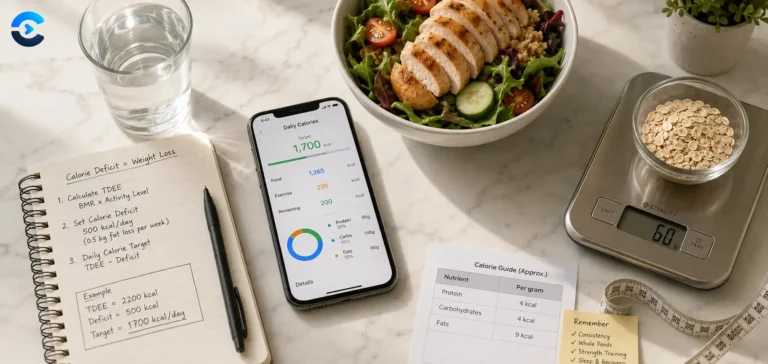
Each gram of protein and carbohydrate provides 4 kilocalories, each gram of fat provides 9. These are the Atwater factors, developed by Wilbur Atwater at the end of the 19th century from calorimetry experiments burning food samples and measuring heat output, adjusted for digestibility. They remain the standard energy values used on every nutrition label today.
The eight preset ratios
Rather than making you guess a split from scratch, the tool ships eight named presets, each reflecting a common dietary approach. Picking Custom unlocks manual entry for all three percentages.
| Preset | Protein | Carbs | Fat |
|---|---|---|---|
| Aggressive Cut | 45% | 25% | 30% |
| Moderate Cut | 40% | 30% | 30% |
| Maintenance | 30% | 40% | 30% |
| Lean Bulk | 30% | 50% | 20% |
| Aggressive Bulk | 25% | 55% | 20% |
| Ketogenic | 25% | 5% | 70% |
| Paleo | 30% | 35% | 35% |
The pattern across cutting presets is higher protein, since research on resistance trained individuals in a calorie deficit consistently shows higher protein intake, generally cited in the range of 1.6 to 2.2 grams per kilogram of body weight, helps preserve lean muscle mass while losing fat. Bulking presets shift the opposite direction, prioritizing carbohydrate to fuel training volume and support the calorie surplus efficiently.
Per-meal breakdown
Three-meal split
Each macro’s daily gram total divides evenly by three, giving a rough target per meal. It’s a planning convenience, not a metabolic requirement, meal frequency and timing have far less impact on outcomes than total daily intake.
Visual bar and legend
The proportional bar renders each macro’s share of total calories as a colored segment, giving you an at-a-glance read on whether a preset is protein-forward, carb-forward, or fat-forward before you commit to it.
- FDA Nutrition Facts Label guidance, which uses the same 4/4/9 Atwater energy factors this tool applies.
- Morton et al., British Journal of Sports Medicine, 2018, meta-analysis on protein intake and resistance training outcomes.
- Institute of Medicine, Dietary Reference Intakes for Macronutrients, the government reference ranges for protein, carbohydrate, and fat intake.
This tool provides an educational estimate for meal planning, not personalized medical or dietetic advice. If you have a metabolic condition, kidney disease, diabetes, or another condition affected by macronutrient intake, work with a registered dietitian or physician to set targets rather than relying on a generic preset.
Diet planning this supports
Setting up daily targets for a food tracking app, structuring a meal prep plan around a specific diet approach like keto or a lean bulk, adjusting nutrition mid training cycle when a coach changes the calorie target but wants the same ratio philosophy, and quickly sanity checking whether a diet plan you found online has a physiologically reasonable split before following it.
Frequently Asked Questions
Macronutrients are the three main nutrient classes that provide energy: protein (4 kcal/g), carbohydrates (4 kcal/g), and fat (9 kcal/g). Unlike micronutrients (vitamins and minerals), which are needed in small amounts, macros are consumed in large quantities and make up virtually all food calories. Hitting a calorie target is necessary for weight management, but getting the right macro ratio determines body composition, how much of the weight change is muscle versus fat, and affects energy, performance, and satiety.
Current research supports approximately 1.6 g of protein per kg of body weight per day for maximizing muscle protein synthesis (around 0.73 g/lb). During a caloric deficit, this increases to 2.2 g/kg (1 g/lb) to prevent muscle loss. For older adults over 65, 1.6 to 2.0 g/kg is recommended to offset age related muscle loss (sarcopenia). This calculator uses percentage based splits as a starting point, if your calorie target is low, always check that the protein target in grams meets the per kg minimums.
No single macro split is universally optimal, the best split is the one you can adhere to. That said, higher protein (35 to 45% of calories) consistently helps with weight loss by increasing satiety, preserving muscle, and slightly boosting metabolism through the thermic effect of food. Lower carb approaches (under 100g/day) can speed early weight loss through glycogen and water depletion, but long term studies show similar fat loss outcomes to other macro distributions at equivalent calorie deficits. Focus on hitting your protein target first, then distribute remaining calories between carbs and fat based on preference.
A ketogenic diet aims to induce ketosis, a metabolic state where the liver produces ketones from fat as an alternative fuel. This requires keeping carbohydrates very low, typically under 20 to 50g per day (5% of calories). The macro split is roughly 70% fat, 25% protein, 5% carbs. The high fat intake fuels energy needs in the absence of glucose. Ketosis typically takes 2 to 5 days to establish and can cause the ‘keto flu’ (headaches, fatigue, brain fog) during the adaptation period as the body switches fuel sources.
Track in grams for precision. Percentages are useful for setting a starting ratio and understanding the energy contribution of each macro, but a percentage of 1,500 kcal and a percentage of 2,500 kcal gives very different gram amounts. If your goal is body composition, hitting a protein target in grams (e.g. 160g/day for a 100kg person) matters more than hitting a percentage. Use this calculator to convert your calorie target and percentage split into gram targets, then use a food tracking app like MyFitnessPal or Cronometer to hit those targets.
Net carbs = total carbs minus dietary fiber and (in some approaches) sugar alcohols. Fiber is not digested or absorbed in the small intestine and does not raise blood glucose. Sugar alcohols are partially absorbed and have varying glycemic impact depending on the type. Net carb counting is particularly important for ketogenic diets, where the goal is to minimize glucose availability. For most other diet approaches, total carbs are the relevant metric since they represent all digestible carbohydrate.
Cycling macros is an advanced approach used by some athletes. Carb cycling alternates high carb days around training with lower carb rest days. Calorie cycling uses a small surplus on training days and a deficit on rest days to average out to a maintenance or slight deficit over the week. For most people starting out, consistent daily macros are easier to track and sustainable. Once you are comfortable hitting daily targets consistently, experimenting with cycling can provide performance benefits and diet variety.
Recalculate every 4 to 6 weeks or whenever your weight changes by 5+ kg. Your TDEE decreases as you lose mass, so maintaining the same calorie target will gradually move from a deficit to near maintenance. Use the TDEE Calculator to find your new maintenance calories, then apply the same percentage split to get new gram targets. You may also need to adjust if performance drops, hunger increases significantly, or weight loss stalls for more than 2 to 3 weeks.
From the blog
The research behind the numbers
Where these formulas came from and what the studies actually showed.