
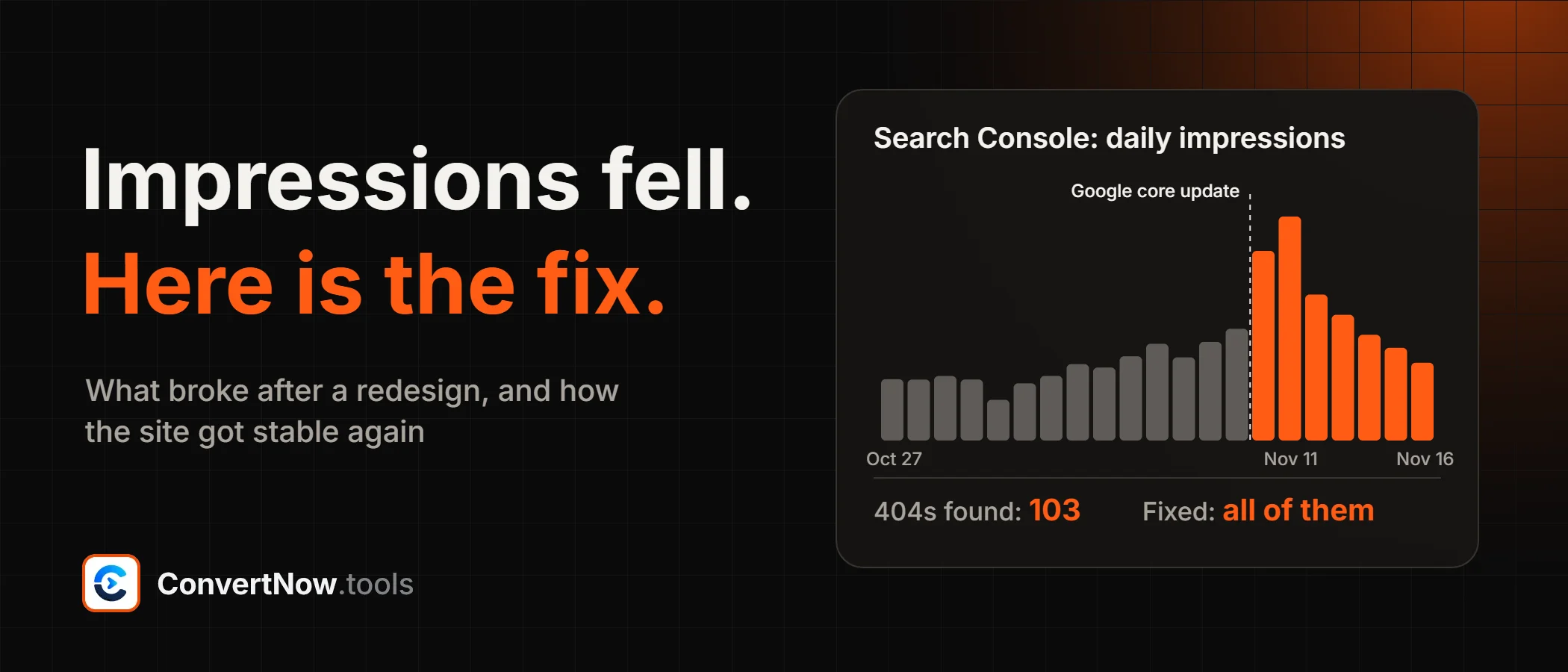

A week after I reworked dozens of pages on ConvertNow, Search Console looked like something had gone badly wrong. Daily impressions fell from 2,510 to 872 in five days and the average position slid from 21 to 52. It looked like a classic traffic drop after website redesign, and my first instinct was to undo everything.
I did not. Instead I went through the data page by page, and the real story turned out to be a mix of my own mistakes and an update from Google that landed at the same time. This post covers what I found, what I fixed, what I left alone on purpose, and a checklist you can use if the same thing happens to you.
What the drop actually looked like
Here is the part that surprised me, and the first thing to check in any traffic drop after website redesign. Before the changes, the site showed around 450 to 700 impressions a day. After the changes it climbed fast, peaked at 2,510 on November 11, then fell back to 872 by November 16. So the drop was real, but the new low was still higher than where the site sat a month earlier.
Clicks barely moved at all, which is the most useful clue in any traffic drop after website redesign. The site got roughly one click a day before, during and after. That told me the lost impressions were mostly searches that never sent anyone to the site anyway.
- Impressions: about 700 a day in October, a peak of 2,510, then 872
- Average position: about 21 before the slide, 52 after
- Clicks: 0 to 5 a day the whole time, 57 over three months
Rule out Google first
Before blaming your own work, check the Google Search Status Dashboard. Google started rolling out its November 2026 core update on November 10, and the biggest swings in rankings across the web showed up around November 14. My slide started on November 12 and 13. The timing matched almost exactly.
Google is clear that a core update is not a penalty. Its guidance on core updates says pages can move without anything being wrong with them. That matters, because the worst thing you can do during a rollout is rewrite every page again. Each edit makes Google evaluate the page from scratch.
A core update explains timing, but it rarely explains a whole traffic drop after website redesign on its own. It does not explain everything. So the next step was to look for things I had actually broken.
The 5 problems behind my traffic drop after website redesign
To find the cause of my traffic drop after website redesign, I listed every change. Three kinds of work had gone live in the same week: a pass on titles and meta descriptions across about 58 tool pages, a move from Elementor to the plain WordPress editor described in my PageSpeed write up, and a cleanup that deleted older blog posts. Here is what each one left behind.
1. 103 deleted posts were returning 404
This was the biggest one. The cleanup had moved 103 blog posts to the trash, and every one of their URLs now returned a 404. That alone would not matter much, except 31 of them still ranked. A post on binary to decimal methods had 1,700 impressions over three months. Posts on psi to bar, nm to ft lb and greatest common divisors sat in the top 10 for their searches.
2. FAQ schema that no longer matched the page
On three converter pages the FAQ section had disappeared from the visible page during the editor move, but the FAQ structured data was still there. Google expects FAQ markup to describe questions people can actually read on the page, so markup without visible answers is a quality problem waiting to happen.
3. A hidden title override
My unit converters page ranked at position 6 for unit conversion with 1,100 impressions and zero clicks. I rewrote the title in Rank Math, saved it, and the live page still showed the old one. The cause was an old snippet in a must use plugin that hardcoded titles for every category page. Rank Math had saved the new title correctly. Something else was quietly replacing it.
4. Impressions that were never going to click
The math category page had 15,400 impressions in three months and not a single click. When I opened the queries, they were sums like 8.42 plus 7.18 plus 9.28. Google answers those with its own calculator, so nobody needs to visit a site. When those impressions dropped, it looked dramatic on the chart and cost nothing.
5. Pages ranking well with no answer to the search
Several pages ranked between positions 3 and 36 for searches the page did not really answer. The binary to decimal converter ranked third for binary to decimal formula without ever showing the formula. The GST calculator ranked for how to calculate GST without explaining how. Ranking without answering is fragile, and it shows up as low clicks.
How I fixed each one
- Restored the posts that still ranked. I brought back the 31 posts with real impressions or top 10 positions, with their original URLs and dates.
- Redirected the rest. The other 72 got 301 redirects to the closest matching tool. A post about mpg conversions now points to the fuel efficiency converter, not the homepage. I tested every one and all 72 return a 301.
- Made the FAQ visible again. On the three converter pages I put the questions and answers back on the page, word for word with the schema.
- Removed the title override. I deleted the one hardcoded line, kept a backup of the file, and the title saved in Rank Math went live straight away.
- Answered the searches pages already ranked for. I added short sections with the binary to decimal formula and worked examples, how to calculate GST and the amount before GST, what an HMAC signature is and how to verify one, plus psi to bar and kJ to kcal reference values.
The goal was not just to undo the traffic drop after website redesign but to come out ahead. For the keywords, I only used searches the pages already appeared for in Search Console, then checked their volume in Google Keyword Planner. Long, specific searches where a page already sits in the top 40 are far easier to win than broad terms where it sits on page five.
What I deliberately did not touch
The take home pay calculator dropped from position 9 to 42. Its content was intact, so the drop was most likely Google reassessing a page about money during the update. I left it alone. The same went for the Strava activity combiner, which earns more clicks than any other page on the site on both Google and Bing.
This felt wrong at the time, because the natural reaction to a traffic drop after website redesign is to keep editing. But changing a page that is already good, in the middle of a core update, mostly resets the clock on it. I would rather wait for the rollout to finish and then compare clean numbers.
A checklist for any traffic drop after website redesign
- Compare clicks, not just impressions. If clicks held steady, you may have lost searches that never mattered.
- Check the Google Search Status Dashboard for an update that overlaps your dates.
- Open Search Console and look at the pages that lost the most, not the site total.
- List every URL you deleted or changed and test each one. Restore pages that still ranked and 301 the rest to the closest match, as in this link checklist.
- View the page source of your key pages. Confirm the title, the H1 and the main content are really there for crawlers, a lesson from the time Google saw an empty tools page.
- Make sure every FAQ in your schema is also visible on the page.
- Fix what is broken, then stop. Give Google two to three weeks before the next round of changes.
If you want to check whether the visitors you do get are real people, the free ConvertNow Analytics plugin separates bots and AI crawlers from humans, which makes a drop like this much easier to read.
Where things stand now
A traffic drop after website redesign feels personal, but most of mine came down to a handful of fixable mistakes and bad timing. Everything that was broken is fixed, and the pages that were fine are untouched. Google also has a solid guide on debugging drops in search traffic if you want a second checklist. I will update this post with the numbers once the core update has fully rolled out and the restored posts are recrawled.
Frequently asked questions
How long does a traffic drop after a website redesign last?
If the cause is on your site, such as broken URLs or missing content, it lasts until you fix it and Google recrawls the pages, usually one to four weeks. If it lines up with a Google core update, rankings often settle within a few weeks after the rollout ends.
Should I undo my redesign if traffic drops?
Not straight away. First check whether the drop matches a Google update, then look for broken URLs, changed titles, lost content and schema errors. Rolling back everything also throws away the changes that were working.
Do 404 errors hurt the rest of my site?
A few 404s for pages that never mattered are normal. Deleting pages that still ranked loses the traffic those pages earned, so restore the good ones or redirect them to the closest matching page.

